Last Updated: November 13, 2026
Quick Summary
Sustainable coffee carts are worth it for events when you plan sourcing, cups, and waste sorting before the event day. Ask your roaster for organic or fair-trade proof, choose reusable cups where washing exists, and track waste diverted in pounds for a post-event report.
- Reusable cups win on waste, while compostable cups win on convenience, so pick based on venue and guest count.
- Compostable cups only help if they reach a compost facility; in a landfill they behave like regular cups.
- A return system needs a deposit or sign-out, clearly marked bins, and a wash plan.
- Track coffee servings, cups reused versus composted versus landfilled, waste diverted in pounds, and milk, food, power, and water use.
- Ask vendors of sustainable coffee carts for proof on sourcing, serviceware, sorting bins, venue requirements, and a post-event waste report.
Table of Contents
- Why Sustainable Event Practices Start With the Coffee Cart
- Sustainable Coffee Sourcing: What to Ask Your Roaster
- Eco-Friendly Coffee Cups for Events: Reusable vs. Compostable
- Coffee Cart Waste Reduction: Sorting, Signage, and Venue Rules
- How to Measure Your Coffee Cart’s Sustainability Impact
- Vetting a Sustainable Coffee Cart Vendor for Your Event
- Frequently Asked Questions
Why Sustainable Event Practices Start With the Coffee Cart
Sustainable coffee carts come down to a few big choices: where the beans come from, what guests sip from, and where the waste ends up.
That is why we at Colada Kulture Co. treat the coffee cart as the starting point, not an afterthought. For the full playbook on running a sustainable coffee catering event, see how to host a sustainable coffee catering event. Guests visit it all day. Every cup is a chance to cut waste or create it.
Coffee is also one of the most visible parts of any gathering. People line up, chat, and watch what happens at the counter. A cart that sorts waste and serves in reusable cups teaches guests by example.
So the question is not whether a cart matters. It is whether the sustainable version is worth the extra planning. Below, we walk through sourcing, cups, waste, and how to measure it all.
Sustainable Coffee Sourcing: What to Ask Your Roaster
Start with one question for your roaster: “How do you source, and can you show me?” A good answer covers farming methods, fair pay for growers, and clear paperwork.
Ask whether the roaster holds organic or fair-trade certification, since these labels give you a paper trail you can point to.
Then ask about compostable packaging for the beans and filters. Small things add up. A cart that ships plastic-wrapped beans undercuts its own message.
If your event is a green conference, sourcing questions get sharper. Planners want proof, not slogans. Our guide to sustainable coffee catering for green conferences covers the details to request before you quiz a roaster.
Eco-Friendly Coffee Cups for Events: Reusable vs. Compostable
The short answer: reusable cups win on waste, while compostable cups win on convenience. Pick based on your venue, guest count, and whether you can run a return system.
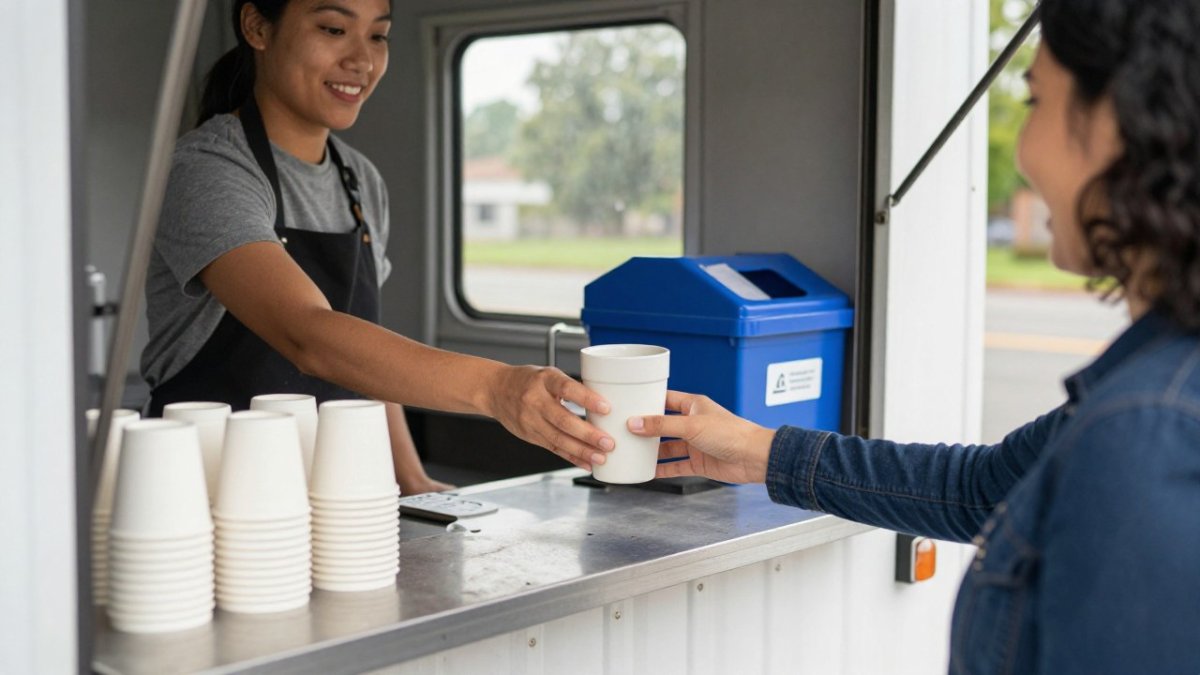
Compostable cups only help if they reach a compost facility. In a landfill, they behave much like regular cups.
Here is how the two compare:
| Factor | Reusable Cups | Compostable Cups |
|---|---|---|
| Waste outcome | Near zero if returned | Composts only with a facility |
| Upfront effort | Return bins and washing | Simple setup |
| Guest experience | Feels premium | Familiar and easy |
| Best for | Sit-down events, offices | Fast turnover, outdoor sites |
Reusable Cup Logistics and Return Systems
A return system needs three things: a deposit or sign-out, clearly marked bins, and a wash plan. Skip any one and cups walk away.
Try a simple check-out board at the cart. Guests return cups for a token or just drop them in a bright bin. At the end of the night, count what came back.
Watch out: if the venue has no dishwashing, reusable cups can stall. Confirm the wash setup before you promise zero waste.
Washing capacity. Confirm the venue’s dishwashing capacity before you commit to reusable service, and account for transport, drying, and storage.
When local composting is unavailable. Verify with the venue and the hauler what actually happens to compostable cups before you print any “compostable” signage.
Coffee Cart Waste Reduction: Sorting, Signage, and Venue Rules
Coffee cart waste reduction starts with three streams: recycling, compost, and landfill. Label each bin in plain words and pictures, and place them right beside the cart.
Guests sort correctly when bins are close and clear. A bin across the room collects mistakes, not material.
Then check venue requirements early. Many sites have rules on bin placement, hauling, and what can leave the building. Some ban compost entirely.
Ask the venue three things:
- Where bins can sit
- Who hauls waste out
- What the local waste system accepts
Local rules vary, so confirm what your hauler actually takes before you print signs. For the full sorting and logistics picture, see our guide on managing event coffee logistics.
How to Measure Your Coffee Cart’s Sustainability Impact
You cannot improve what you do not count. Track a few simple numbers and you have a real story for your client or ESG objectives.
Use this short list:
- Coffee servings poured
- Cups reused versus composted versus landfilled
- Waste diverted from landfill, in pounds
- Milk and food waste at close
- Power and water used by the cart
Keep a tally sheet at the counter. At close, weigh the compost and recycling bags. Those numbers become your waste diverted figure.
This is the angle most guides skip. A one-page post-event report with these figures turns a nice gesture into proof. If you also run an office program, our guide on implementing a sustainable office coffee program shows how to track it over time.
Practical KPIs for Event Coffee Carts
A simple KPI set makes your sustainability claims verifiable. Track these four numbers for every event:
- Waste diversion rate. Weigh compost and recycling separately from landfill at close. Diversion rate = (compost + recycling) ÷ total waste. Report the pounds and the percentage. Do not estimate, use a luggage scale or a venue floor scale.
- Emissions proxy. You do not need a full carbon audit. Track delivery distance in miles, generator hours, and water used in gallons. These three inputs give the client a defensible proxy for the cart’s operational footprint without inventing a precise emissions figure.
Verifying Local Waste-System Acceptance
Before you print a single sign, confirm what the local hauler and composter actually accept. Compostable cups, lids, and stirrers are not universally accepted, and a single contaminated load can send an entire bag to the landfill.
Use this venue checklist:
- Which local composter serves this venue, and do they accept compostable serviceware?
- Does the hauler require compostable items to be certified (for example, BPI-certified)?
- Are there separate bins for compost, recycling, and landfill, and who empties them?
- What happens to compostable cups if the venue has no compost service?
- Are there weight or contamination limits that affect small events?
A common pattern is that venues label bins “compost” but the hauler only accepts food scraps. Verify with the hauler directly, not just the venue contact. If acceptance is unclear, default to reusable cups or landfill-safe serviceware and say so in your report.
Building the Post-Event Report
Combine the KPI numbers and the venue verification into a one-page report: servings per guest, reusable-cup adoption rate, pounds diverted, diversion rate, and the three emissions-proxy inputs. Add a short note on any contingency switch (for example, “switched to compostable cups at 2 p.m. due to wash station failure”). That report is what turns a sustainability claim into evidence a client can use in their own ESG reporting.
Vetting a Sustainable Coffee Cart Vendor for Your Event
Ask vendors of sustainable coffee carts for proof, not promises. A strong mobile coffee catering partner will answer sourcing, cup, and waste questions without flinching.
Use this checklist when you compare vendors:
- Can they name their roaster and show sourcing details?
- Do they offer reusable or compostable serviceware?
- Will they bring and label sorting bins?
- Can they confirm venue requirements in writing?
- Do they provide a post-event waste report?
- Are they insured and on time, with references you can call?
A common mistake is booking on price alone. Cheap quotes often skip the bins, the wash plan, and the reporting. That is where the green claims fall apart.
At Colada Kulture Co., we bring professional baristas, a mobile cart or trailer, and a menu built around your event, from espresso to matcha with whole, oat, and almond milk. We have served over 35 weddings, corporate events, and private celebrations. For a deeper vendor guide, read how to choose professional event coffee vendors.
Sustainable coffee carts are worth it when you plan the details: a roaster you can question, cups that fit your venue, bins guests can find, and numbers you can report. That is the difference between a green logo and real results. Colada Kulture Co. handles the cart, the baristas, and the drink menu so your event runs smooth and looks good doing it. Get started with Colada Kulture Co. and give your guests a coffee break they remember.
Frequently Asked Questions
What reusable or compostable cups work best for coffee cart events?
Confirm acceptance with the venue before ordering, because compostable cups placed in landfill bins behave like any other waste.
How can an event coffee cart reduce waste?
Start with portion planning: estimate servings from guest count and expected coffee break attendance. Ask the vendor what they measure after the event so you can verify the reduction.
How can event organizers measure the sustainability of coffee catering?
Track practical numbers such as cups served, waste weight and water used, and compare them against your guest count to report a per-guest impact figure against ESG objectives.
How can a coffee cart conserve water and energy at an event?
Ask whether the cart runs on venue power or its own generator, and request the generator’s fuel type and run time if it is self-powered.