Last Updated: October 26, 2026
Quick Summary
To implement a sustainable office coffee program, start with a two-week audit of cups brewed, waste, and supply spend, then choose certified sustainable beans and a low-waste machine such as bean-to-cup. Verify compostable packaging with your waste hauler before buying, and track cups per pound of beans and cost per cup monthly against a baseline.
- Run a two-week audit tracking cups brewed, wasted coffee, and supply spend before buying equipment.
- Look for fair trade, organic, shade-grown, or direct trade certification rather than unregulated ethically sourced claims.
- Bean-to-cup machines skip single-use pods and suit teams with 20 or more daily drinkers.
- Confirm in writing that your hauler accepts compostable pods, and pilot one SKU for two weeks first.
- Assign one owner per area and hold a 30-minute monthly review comparing results to baseline.
Table of Contents
- Step 1: Audit Your Current Coffee Setup
- Step 2: Choose Sustainable Coffee Sourcing
- Step 3: Select Eco-Friendly Office Coffee Machines
- Step 4: Plan for Office Coffee Waste Reduction
- Step 5: Follow Office Coffee Program Best Practices
- Step 6: Build a Timeline and Assign Ownership
- Step 7: Measure Success and Track Your Baseline
- Next Step: Request a Quote for Your Office Coffee Program
- Frequently Asked Questions
Step 1: Audit Your Current Coffee Setup
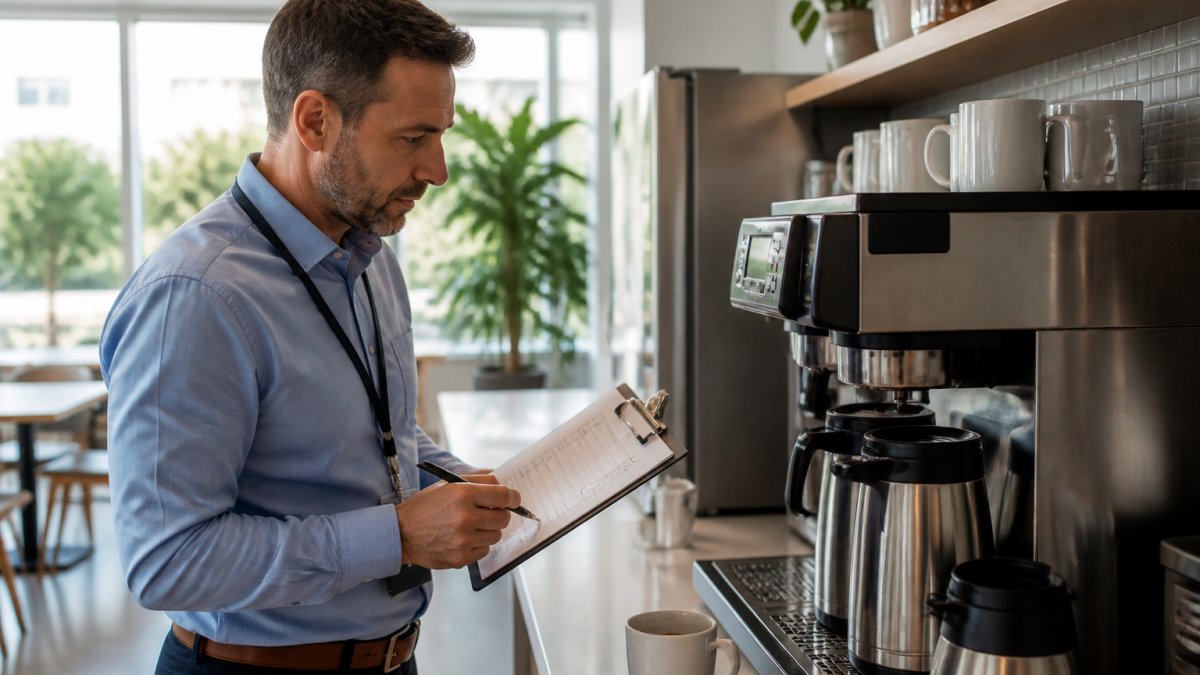
A sustainable office coffee program starts with a hard look at what you already have. Most offices skip this step, then overspend on fixes for problems they never measured.
Start with a simple two-week audit. Track:
- Cups brewed per day (check your machine’s counter or pod usage)
- Cups per employee to spot your heavy and light drinkers
- Wasted coffee poured down the drain each afternoon
- Supply spend across beans, pods, cups, stirrers, and creamers
- Breakdowns and repairs logged by your facilities team
The waste number usually shocks people. A common mistake is buying a new machine before fixing habits. If half a pot goes cold every afternoon, the machine isn’t your problem.
If you’re weighing a professional service against a self-run kitchen, our guide to professional coffee service versus an office kitchen setup breaks down the trade-offs before you commit.
Step 2: Choose Sustainable Coffee Sourcing
Sustainable coffee sourcing means buying beans grown, processed, and traded in ways that protect farmers and ecosystems. It’s the foundation of any green coffee plan, and it’s where most programs cut the wrong corners.
Look for these markers on the bag:
- Fair trade certification for farmer income protection
- Organic certification for chemical-free growing
- Shade-grown labels that support biodiversity
- Direct trade relationships with named farms or importers
Ask your supplier where the beans come from and how they were grown. A local roaster often answers these questions faster than a big distributor. That transparency matters more than a logo.
Watch out: “Ethically sourced” is not a regulated term. Any roaster can print it on a bag. Check for third-party certification instead of trusting front-of-package claims.
Step 3: Select Eco-Friendly Office Coffee Machines
Eco-friendly office coffee machines balance energy use, waste, and drink quality. The right pick depends on headcount and how your team actually drinks coffee.
Compare your main options:
| Machine Type | Best For | Waste Profile | Energy Use |
|---|---|---|---|
| Bean-to-cup | 20+ daily drinkers | Low (no pods) | Medium |
| Pod/espresso | Small teams | High unless compostable | Low |
| Batch brewer | High-volume drip crowds | Medium | High |
| Pour-over station | Small, quality-focused teams | Low | Low |
Bean-to-cup machines skip single-use pods entirely. Pod machines win on convenience but generate the most waste unless you buy compostable pods.
For teams under 15 people, our roundup of the best coffee machines for small offices covers picks that fit tight spaces and green goals.
Step 4: Plan for Office Coffee Waste Reduction
Office coffee waste reduction targets three streams: grounds, cups, and packaging. Each needs its own plan, and each has a verification step most programs skip.
- Coffee grounds: compost them, or partner with a local garden program. Confirm whether your hauler accepts food-soiled paper filters alongside grounds; many curbside programs do not.
- Reusable mugs: stock a shared cabinet and stop buying single-use cups. Pair the cabinet with a simple sign-out sheet or a dishwasher schedule so mugs actually return to circulation.
- Reusable filters: swap paper for a metal or cloth filter where your brewer allows. Check your machine warranty first, some manufacturers void coverage if non-OEM filters are used.
- Compostable pods and packaging: verify they’re accepted by your waste hauler before you buy. See the verification steps below.
- Bulk purchasing: buy beans and creamers in larger containers to cut packaging. Confirm that bulk containers are recyclable in your local stream; some lined bags are not.
Verify compostability before you commit
“Compostable” only works if a facility actually composts it. Many compostable pods end up in landfills because commercial composters won’t take them, or because local rules exclude food-soiled packaging. Before you buy:
- Ask the hauler, not the vendor. Call your waste hauler and ask two questions: Do you accept compostable coffee pods and packaging in the commercial organics stream? Do you require a specific certification (for example, a third-party compostability mark) on the package?
- Check the certification, not the word. Look for a recognized third-party compostability certification on the package rather than the word “compostable” alone. Certification marks indicate the material was tested to break down under specified conditions, but they do not guarantee your local facility will accept it.
- Match the certification to the facility. A package certified for industrial composting may not break down in a backyard bin, and vice versa. Ask which stream your hauler runs and buy packaging certified for that stream.
- Pilot one SKU first. Run a two-week pilot with a single compostable pod SKU and confirm with the hauler that the material actually reaches the compost stream rather than the landfill transfer station.
“Compostable” and “biodegradable” are not the same claim, and neither guarantees acceptance by your local hauler. A product can be certified compostable and still end up in a landfill if your facility’s organics program excludes it. Always confirm acceptance in writing before scaling a purchase.
Close the loop on cups and grounds
- Cup counting: place a small tally sheet or a counter app at the mug station for two weeks to measure single-use cup avoidance. Without a count, you cannot report progress.
- Grounds donation: if you partner with a garden program, set a pickup schedule and a designated bin with a lid. Confirm the program accepts coffee grounds mixed with paper filters if your brewer uses them.
- Signage at the point of disposal: label bins clearly with what is and is not accepted. A common failure is compostable packaging placed in the recycling bin because the labels were unclear.
For waste guidance, the EPA’s composting guidance explains what your hauler will and won’t accept and how to confirm local rules.
Step 5: Follow Office Coffee Program Best Practices
Strong office coffee program best practices keep quality up and waste down over time. They’re less about equipment and more about routine.
Set a weekly rhythm:
- Clean the machine on a posted schedule, not when someone remembers
- Train one or two “coffee champions” to own daily checks
- Post simple drink cards so people brew the right ratios
- Run a monthly taste check to catch stale beans early
- Survey staff quarterly on drinks, milks, and decaf needs
Inclusion belongs here too. Stock whole, oat, and almond milk, plus decaf and matcha, so non-coffee drinkers and dairy-free staff aren’t left out. A program only works if everyone can use it. For rollout ideas, see our guide to planning employee appreciation coffee breaks.
Step 6: Build a Timeline and Assign Ownership
A sustainable office coffee program needs a timeline and a named owner. Without both, green plans stall within a month.
A realistic rollout:
- Weeks 1-2: Finish the audit and set a waste baseline
- Weeks 3-4: Choose your supplier and machine
- Weeks 5-6: Install, train coffee champions, and post signage
- Weeks 7-8: Launch with a tasting event
- Ongoing: Monthly reviews and quarterly surveys
Assign one owner per area: sourcing, equipment, waste, and budget. One person can’t do everything. Split the load and set a 30-minute monthly check-in.
Step 7: Measure Success and Track Your Baseline
You can’t prove a program is sustainable without numbers. Track a baseline before you change anything, then measure against it. The framework below gives you a repeatable way to do both.
Set the baseline first
Run a two-week baseline period before launch. Record the same metrics you will report monthly so the before-and-after comparison is honest:
- Cups brewed per day from the machine counter or pod usage log
- Pounds of beans or pods purchased during the period
- Single-use cups and lids purchased (count the case quantity, not the receipt total)
- Pounds of grounds and packaging discarded (use a kitchen scale for one week, then estimate)
- Repair and service calls logged by facilities
- Supply spend across beans, pods, cups, stirrers, creamers, and cleaning supplies
Track these monthly
- Cups per pound of beans (efficiency): divide cups brewed by pounds of beans used. A rising number means you are brewing closer to demand and wasting less.
- Single-use cups avoided (count reusable mug uses at the station)
- Pounds of grounds composted (confirm with the hauler’s pickup log)
- Cost per cup across all supplies (see the calculation below)
- Employee satisfaction on a simple 1-5 scale, surveyed quarterly
Calculate cost per cup honestly
Cost per cup is the metric that exposes a cheap machine with expensive pods. Add up over a year:
- Equipment: purchase price or lease payments, divided by expected years of service
- Coffee: annual bean or pod spend divided by annual cups brewed
- Consumables: cups, lids, stirrers, filters, creamers, cleaning supplies
- Servicing and repairs: service contract plus out-of-warranty repairs
- Utilities: estimate the machine’s energy draw from its nameplate rating and your usage hours
Divide the annual total by annual cups brewed. A common pattern is that a lower-priced pod machine costs more per cup than a bean-to-cup unit once pods, cups, and servicing are included, but the gap depends on headcount and drink mix, so run the numbers for your own usage rather than assuming.
Report cost per cup alongside cups per pound of beans. Together they show whether you are saving money by wasting less or simply buying cheaper inputs.
Verify supplier claims against public standards
For sourcing verification, check supplier claims against Fair Trade USA’s certification standards and USDA Organic labeling rules. Ask for the certificate number and confirm it is current, not just the logo on the bag. For waste guidance, the EPA’s composting guidance explains what your hauler will and won’t accept.
Review cadence
Hold a 30-minute monthly review with the program owner and coffee champions. Compare the month against baseline, flag any metric moving the wrong way, and adjust one variable at a time so you can tell what worked.
Next Step: Request a Quote for Your Office Coffee Program
Building a sustainable office coffee program takes real work: audits, sourcing checks, machine research, and monthly tracking. Most teams get through the audit, then run out of time before launch.
That’s where we come in. Colada Kulture Co. provides mobile coffee cart and trailer catering, with professional baristas serving freshly prepared hot or iced drinks. The drink selection includes espresso, matcha, and seasonal flavors, with whole, oat, and almond milk options, plus customizable catering packages for any occasion. Colada Kulture Co. has served over 35 weddings, corporate events, and private celebrations.
Not sure whether a cart or full catering fits your event? Compare mobile coffee bar versus traditional catering first. Ready to plan an event with professional baristas? See our professional mobile barista service options.
Get started with Colada Kulture Co. and plan a coffee experience for your event.
Frequently Asked Questions
How do you make an office coffee program more sustainable?
For an event, Colada Kulture Co. offers mobile coffee cart and trailer catering with customizable packages and a drink selection that includes espresso, matcha, and seasonal flavors.
What is the most sustainable way to brew coffee at work?
Colada Kulture Co. provides mobile coffee cart and trailer catering for events, with freshly prepared hot or iced drinks.
How can an office measure the sustainability of its coffee program?
Colada Kulture Co. provides mobile coffee cart and trailer catering for events, with customizable packages and a drink selection that includes espresso, matcha, and seasonal flavors.
Are reusable cups better than disposable cups in an office?
Colada Kulture Co. offers mobile coffee cart and trailer catering for events, with freshly prepared hot or iced drinks.