
Last Updated: November 20, 2026
Quick Summary
A mobile food trailer inspection checklist is a pre-inspection document covering every item a health or fire inspector will examine before your unit is cleared to operate. It should cover your permit and plan review paperwork, food safety items like sinks, water, waste and temperature control, and fire safety items like extinguishers, propane and electrical.
- Submit your layout drawing, equipment list and menu for plan review before buying or installing equipment.
- The pre-operational inspection checks the built unit against the approved plan, so mismatches cause delays.
- Cold food must be held at 41°F or below and hot food at 135°F or above.
- The wastewater tank must be larger than the fresh water tank, with a visible level gauge.
- A 2A10BC extinguisher must be mounted, tagged and within its service date.
Table of Contents
- What a Mobile Food Trailer Inspection Checklist Must Cover
- Your Mobile Food Vendor Permit and Pre-Inspection Paperwork
- Food Safety Inspection Checklist: Sinks, Water, and Temperature Control
- Food Truck Fire Inspection Checklist: Extinguishers, Propane, and Electrical
- Using a Mobile Food Trailer Inspection Checklist PDF on Inspection Day
- Book Your Trailer for Your Next South Florida Event
- Frequently Asked Questions
What a Mobile Food Trailer Inspection Checklist Must Cover
A mobile food trailer inspection checklist is a pre-inspection document that walks you through every item a health or fire inspector will examine before your unit gets cleared to operate.
The checklist that matters isn’t the one the inspector hands you. It’s the one you build before they arrive.
Most operators fail on small, fixable things. A missing thermometer. A gray water tank with no gauge. A fire extinguisher tag that expired last month. Inspectors don’t grade effort.
Below, we’ll show you exactly what each inspection category covers, how to prepare the paperwork, and how to use a printable checklist on the day itself. For ideas on turning a passed inspection into bookings, see these marketing strategies for a mobile espresso business.
Your Mobile Food Vendor Permit and Pre-Inspection Paperwork
The paperwork comes first. No inspector will schedule a visit until your mobile food vendor permit application is complete, and in most jurisdictions the plan review is the gate that everything else waits behind.
Plan to gather:
- Vehicle registration, title, and license plates for the trailer
- Valid driver’s license for whoever tows or operates the unit
- A commissary agreement or base-of-operations letter, if your jurisdiction requires one
The FDA Food Code sets the baseline food safety standards most state and local health departments adopt, but your local authority having jurisdiction may add requirements on top of it.
The approval sequence most operators follow
- Plan review submission. Submit your layout drawing, equipment list, and menu before you buy or install equipment. Reviewers check sink placement, water tank sizing, ventilation, and finish materials against the local code.
- Plan review approval. You receive an approved plan or a deficiency letter. Fix deficiencies on paper, not in the trailer.
- Pre-operational inspection. After the build, the health authority inspects the unit against the approved plan. This is where mismatches between the drawing and the installed equipment cause delays.
- Permit issuance. The operating permit is issued after the pre-operational inspection passes, often with a fee and a renewal cycle.
- Fire and vehicle steps. Fire marshal inspection and vehicle registration run on separate tracks and can be scheduled in parallel with health review.
A common mistake is treating plan review as a formality. It isn’t. Moving a sink after plan review means resubmitting the drawing and waiting again. Buy equipment that matches the approved plan, and photograph the installation as you go so you can answer reviewer questions without a site visit.
How to verify your local rules instead of borrowing a checklist
Every jurisdiction runs its own permitting process, and a checklist from a neighboring county may not match yours. Use this method rather than copying a form:
- Find the authority having jurisdiction. Search your state health department’s food program page, then the county or city environmental health office that issues mobile food permits. The issuing office is the authority, not a statewide summary.
- Ask for the mobile food unit packet. Most offices publish a plan review packet, a fee schedule, and a pre-operational inspection form. Request the current version by date.
- Confirm the commissary rule. Some jurisdictions require a licensed commissary or base of operations; others allow a permitted warehouse. Ask whether the agreement must be submitted with the application or at inspection.
Watch out: rules change between renewal cycles, and a checklist that passed last year may not reflect the current packet. Re-request the packet each renewal rather than reusing an old form.
Food Safety Inspection Checklist: Sinks, Water, and Temperature Control
This is where most inspections are won or lost. The food safety inspection checklist covers three things above all: water, waste, and temperature. The part that actually decides a pass is how you measure and document them.
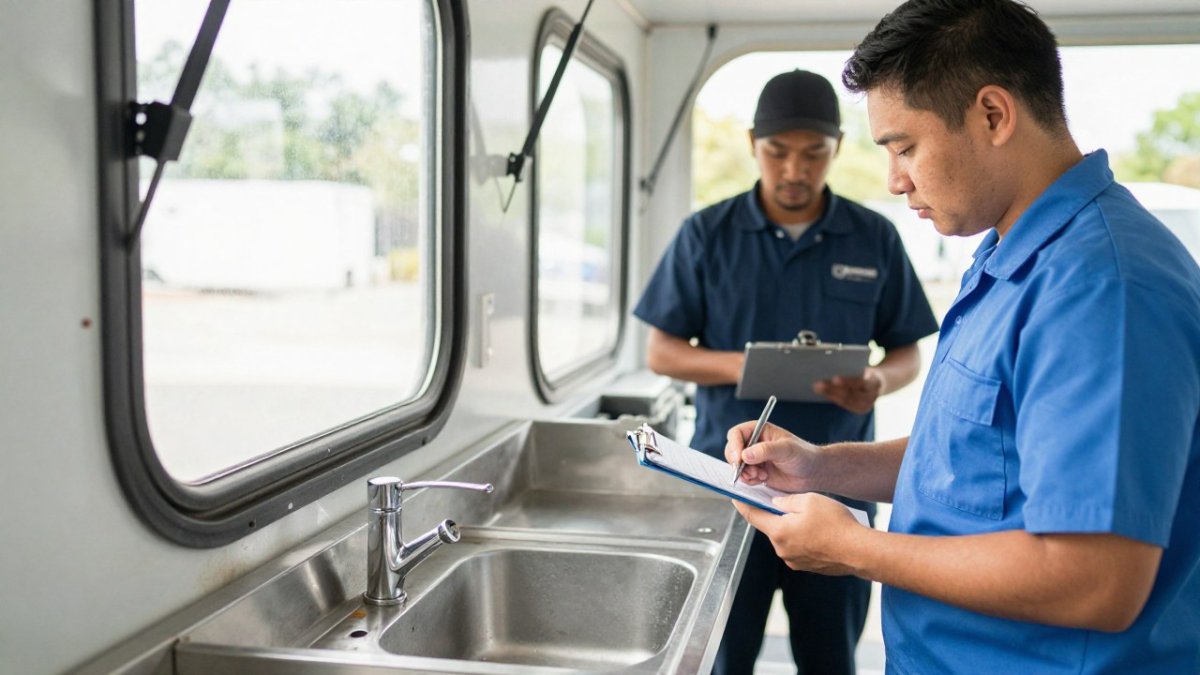
Here’s what inspectors check, in plain terms:
- Handwashing sink: separate from the warewashing sink, stocked with soap and paper towels, and able to run hot and cold water
- Warewashing sink: three compartments for wash, rinse, and sanitize
- Potable water tank: sized to your operation, with a fill port that keeps water clean
How to measure and document temperatures
Temperature control is the item inspectors test most, and the test is procedural, not just numerical. Use a calibrated probe thermometer and record the reading, the time, and the unit checked.
- Calibrate before inspection day. Use the ice-point method: fill a cup with crushed ice and water, stir, insert the probe, and confirm it reads 32°F. Adjust the calibration nut if the unit allows. Repeat after any drop or extreme temperature swing.
- Measure the food, not the air. Open the unit, insert the probe into the thickest part of the food, and wait for the reading to stabilize. Air temperature in a trailer swings every time the door opens.
- Check cold holding at the start and end of service. Record both readings. A unit that starts at 38°F and ends at 44°F is a finding even if the morning log looks clean.
Water, waste, and sink procedures
- Fresh water: fill from a potable source, keep the fill hose capped and dedicated to potable water, and record the fill date.
- Gray water: confirm the tank is larger than the fresh tank and that the level gauge is readable from outside the unit. Empty at an approved disposal point, not a storm drain.
- Handwashing: stock soap and single-use towels at the sink, and confirm hot water reaches the faucet. Handwashing supplies get checked at the same time as the sink itself.
Employee hygiene matters too: handwashing supplies, gloves, and clean aprons all get checked, and a written procedure for when to wash hands is stronger evidence than a verbal answer.
Watch out: a probe thermometer that reads 32°F in ice water but is never calibrated after a drop will drift, and an inspector who sees an uncalibrated probe may treat every temperature log as unreliable.
Food Truck Fire Inspection Checklist: Extinguishers, Propane, and Electrical
Fire safety is a separate inspection, often run by the fire marshal rather than the health department. The food truck fire inspection checklist usually requires:
- A 2A10BC extinguisher, mounted, tagged, and within its service date
- A propane system with leak-tested connections and proper ventilation
- Electrical wiring that’s grounded and rated for the load
A common failure point is the extinguisher tag. If it’s expired, you fail, even if everything else is perfect. Check the tag date the week before inspection, not the morning of.
Equipment condition ties into this section too. Loose propane lines, frayed cords, and missing knobs all read as safety risks to an inspector.
Using a Mobile Food Trailer Inspection Checklist PDF on Inspection Day
A mobile food trailer inspection checklist PDF is only useful if it’s built for the day, not the drawer. Print it, clip it to a board, and walk your unit in the same order the inspector will.
Here’s a simple walkthrough:
| Step | What to Do | Time |
|---|---|---|
| 1 | Check paperwork folder: permit, registration, commissary letter | 5 min |
| 2 | Walk sinks and water tanks, confirm levels and hot water | 10 min |
| 3 | Test refrigeration and hot holding with a probe thermometer | 10 min |
| 4 | Check extinguisher tag, propane connections, wiring | 5 min |
| 5 | Confirm cleanliness of food-contact surfaces and storage | 10 min |
Add evidence fields to your PDF: a spot for the thermometer reading, the extinguisher tag date, and the inspector’s signature. That record protects you at the next inspection.
For more practical trailer-operation guidance, browse The Brew Blog between inspections.
Time needed for each inspection-day checklist step
Book Your Trailer for Your Next South Florida Event
Compliance is the floor, not the ceiling. Once your unit passes inspection, the real work begins: turning a clean, certified trailer into an experience guests remember.
That’s where we come in. If you’re planning an event and want to see what it costs, check our pricing for mobile coffee catering in Miami. You can also read our mobile coffee trailer rental review for a closer look at how a rental works locally.
Get started with Colada Kulture Co. and give your guests a coffee experience worth talking about.
Inspection day rewards the operator who prepared weeks earlier, not the one scrambling that morning. Build your checklist, confirm your local rules, and keep your records current.
Frequently Asked Questions
What do food trailer inspectors look for during an inspection?
Inspectors work through three main areas. Health inspectors check handwashing and warewashing sinks, potable water supply, wastewater tanks, refrigeration and hot holding temperatures, food-contact surface cleanliness, and employee hygiene. Fire inspectors check extinguisher ratings and placement, propane system condition, and electrical safety. Plan reviewers check your vehicle registration, driver’s license, and permit paperwork before anyone steps inside. Walking your trailer against a mobile food trailer inspection checklist before the visit catches most of these items early.
What should be on a mobile food trailer pre-inspection checklist?
A working pre-inspection list covers sinks and water (handwashing sink stocked, warewashing sink functional, potable water tank full, wastewater tank empty), temperature control (thermometer on hand, refrigeration and hot holding verified), fire safety (2A10BC extinguisher charged and mounted, propane lines leak-free), paperwork (mobile food vendor permit, vehicle registration, driver’s license), and cleanliness of food-contact surfaces. Run the list the day before the inspection, not the morning of, so you have time to fix anything that fails.
What do fire inspectors check on a food trailer?
A food truck fire inspection checklist usually covers a charged 2A10BC extinguisher mounted near the cooking area, propane tanks secured and stored correctly, leak-free gas lines and connections, ventilation and hood condition, and electrical wiring that is protected from grease and moisture. Some authorities having jurisdiction also check for a working smoke or fire detection device. Requirements vary by jurisdiction, so confirm the local fire marshal’s list before your appointment rather than assuming a neighboring city’s rules apply.
How often should you inspect a mobile food trailer?
Run a full self-inspection before every scheduled health or fire inspection and at least weekly during active service. Daily checks should cover temperatures, sink supplies, and extinguisher readiness. Because inspection intervals and renewal schedules differ by jurisdiction, confirm your local authority having jurisdiction’s calendar and keep your mobile food trailer inspection checklist PDF updated with each visit’s results and corrective actions.