
Table of Contents
- What Sustainable Coffee Catering Actually Means for Conferences
- Building a Zero-Waste Coffee Service Station
- Compostable Coffee Supplies for Conferences: What Holds Up
- Sourcing Fair-Trade Coffee for Events Without Losing Flavor
- Carbon Footprint Calculation for Coffee Service
- Milk, Energy, and the Equipment That Decides Your Emissions
- Vendor Vetting Checklist for Sustainable Coffee Catering
- Conclusion
- Frequently Asked Questions
Last Updated: September 29, 2026
What Sustainable Coffee Catering Actually Means for Conferences
Sustainable coffee catering for green conferences means sourcing, serving, and disposing of conference coffee to reduce environmental impact at every stage: bean origin, brewing energy, service ware, and waste. It is not a single swap, like trading plastic stirrers for wood, treating it as one is the mistake most event teams make.
Three pillars decide whether your coffee service holds up:
- Sourcing: where the beans come from and how growers are paid
- Service: how the coffee is brewed, poured, and packaged
- End-of-life: what happens to grounds, cups, and milk cartons after the event
Building a Zero-Waste Coffee Service Station
A zero-waste coffee service station pairs three things: clearly labeled diversion bins, signage telling guests what goes where, and a staff flow that keeps the line moving without cross-contaminating streams. Most failures are logistical, not philosophical.
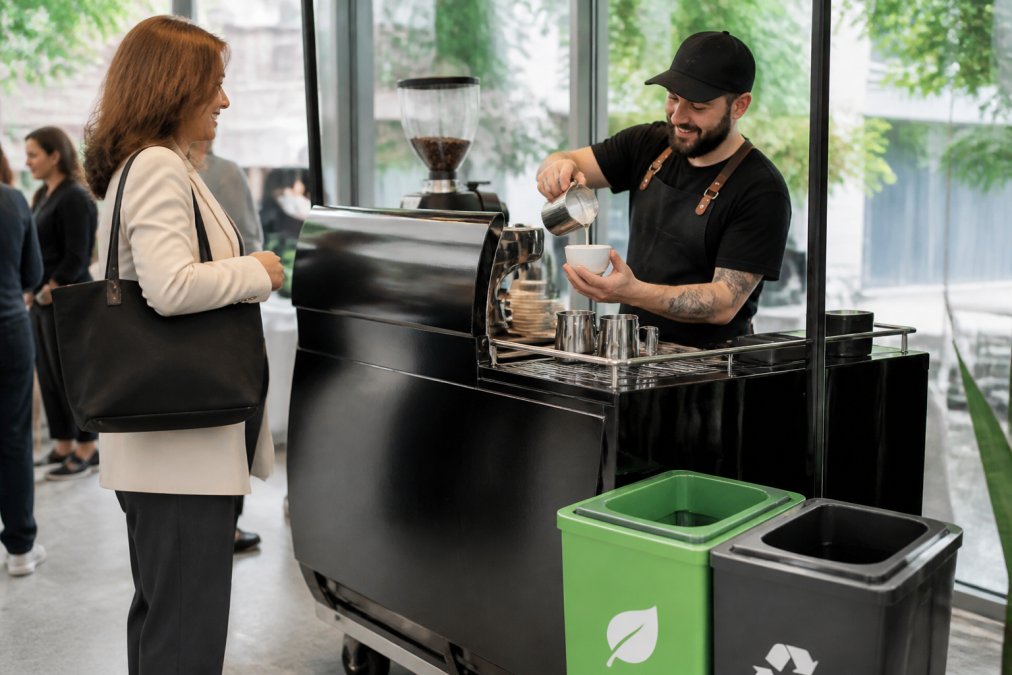
Here’s the setup that works in high-volume conference halls:
- Position bins within arm’s reach of the cart. Guests won’t walk 20 feet to compost a cup.
- Label by item, not by category. “Coffee grounds and cups here” beats “Compostables.”
- Assign one staffer to bin duty during peak rushes. Lines back up when bins overflow.
- Use color-coded liners so your waste hauler can verify diversion rates later.
Ask your venue’s waste hauler what they actually accept before you print signage. Many commercial compost facilities reject “compostable” cups because they can’t process them fast enough, and your diversion numbers collapse.
Compostable Coffee Supplies for Conferences: What Holds Up
Compostable coffee supplies for conferences work only when three conditions align: the material is certified compostable, your venue’s waste stream accepts it, and the cup doesn’t fall apart mid-latte. Cheap options fail the third.
What to check before you buy:
- Certification: look for third-party compostability certification, not just the word “biodegradable” on the box
- Lid fit: mismatched lids leak and slow down service
- Heat tolerance: single-wall compostable cups get uncomfortable fast with hot espresso
- Cold drink performance: iced drinks expose weak seams
Skipping the venue’s waste-stream check before ordering compostable supplies is the fastest way to send a full pallet to landfill. Confirm acceptance in writing, or your sustainability review will show zero diversion.
Sourcing Fair-Trade Coffee for Events Without Losing Flavor
Sourcing fair-trade coffee for events means reading certifications properly and tasting before committing to a volume order. Fairtrade certification verifies minimum pricing and labor standards for growers; it does not guarantee roast quality. Those are separate decisions.
A practical approach:
- Request origin and certification details from your roaster, not just the label claim
- Ask for a cupping sample before the event, not after
- Confirm the roast date on delivery, since specialty coffee stales quickly
- Match the roast to your service style: espresso blends for carts, single origins for pour-over stations
Carbon Footprint Calculation for Coffee Service
Carbon footprint calculation for coffee service means estimating greenhouse gas emissions across four stages: bean production and transport, roasting, brewing energy, and waste disposal. A rough, documented estimate beats none when a client asks, and separates a credible sustainability report from a greenwashed one.
A Practical Estimation Framework for Event Planners
Most conference coffee service emissions fall into four buckets. Here’s how to estimate each without hiring a consultant:
1. Bean production and transport
2. Roasting
3. Brewing energy
4. Milk and waste
A Worked Example for a 300-Person Conference
Assume 300 attendees, average 1.5 coffee drinks each, so 450 drinks. If 60% take dairy milk at 50 ml per drink, that’s about 13.5 liters of dairy; the remaining 40% take oat at the same volume, about 9 liters. Using commonly cited emission factors, roughly 3 kg CO₂e per liter for dairy and 0.9 kg CO₂e per liter for oat, the milk alone accounts for about 40.5 kg CO₂e from dairy and 8.1 kg CO₂e from oat.
What to Document for Your Client’s CSR Team
A credible estimate includes:
- System boundaries (cradle-to-gate vs. cradle-to-grave)
- Emission factor sources (EPA, peer-reviewed studies, or supplier data)
- Assumptions about milk ratios, cup types, and waste diversion rates
- Acknowledged uncertainties
EPA greenhouse gas equivalencies calculator can help you translate your estimated emissions into relatable terms, passenger vehicles equivalent, homes’ energy use, and so on, which often lands better with non-technical stakeholders than raw CO₂e figures.
If your client requires a formal carbon report, ask whether they need scope 1, 2, or 3 accounting. Coffee service emissions typically fall under scope 3 (supply chain) for the client, which means your documentation feeds directly into their broader reporting.
The Unique Angle: A Conference-Specific Calculator
Most sustainability guides speak in generalities about carbon footprints. What they miss is a conference-specific framework planners can use. The four-bucket model above, beans, roasting, brewing, milk and waste, gives you a repeatable structure. Plug in your attendee count, milk ratio, and brewing method, and you have a defensible estimate in under an hour.
Milk, Energy, and the Equipment That Decides Your Emissions
Equipment choice is the biggest lever most planners overlook. An energy-efficient brewing setup paired with oat milk cuts per-cup emissions more than almost any other swap. But details matter: not all batch brewers are efficient, not all espresso machines are power hogs, and your milk default shapes both emissions and guest satisfaction.
The Milk Decision: Defaults Beat Options
Offering oat, almond, and whole milk lets guests choose lower-impact drinks without a separate menu. But the real reduction comes from making oat the default, the milk guests receive unless they ask otherwise. A common pattern at green conferences is to stock dairy but not feature it, cutting dairy consumption without removing choice.
Trade-offs to know:
- Oat milk has the lowest footprint of the common alternatives and the best texture for espresso drinks. It can separate in very hot coffee, so ask your barista to steam it properly.
- Almond milk carries a higher water footprint than oat in many production systems, though still far lower than dairy.
- Whole milk remains the highest-footprint option per liter, but some guests expect it. Keeping a small backstock avoids complaints without driving volume.
Brewing Equipment: Match the Machine to the Event
Batch brewers for high-volume windows use less power per cup than pulling every shot to order. A 1.5-gallon brewer can serve 20-30 cups in minutes and hold temperature in an insulated urn. Brew only what you’ll serve in the next 30-45 minutes, holding coffee for hours degrades quality and wastes energy.
Energy Sources and Venue Constraints
Most conference venues provide grid power, which varies by region. If your venue has on-site solar or buys renewable energy credits, that lowers the brewing stage’s footprint. Ask the venue for their energy mix, more planners should.
The Unique Angle: End-of-Life Waste Management for Coffee Grounds
Few guides discuss what happens to spent grounds after a large-scale event. It’s a major pain point for green conferences because grounds are heavy, wet, and often contaminated with cups or stirrers when bins aren’t managed properly.
Options for grounds management:
- Commercial composting through the venue’s waste hauler, if they accept food waste. Confirm in writing.
- On-site composting if the venue has a program, some convention centers partner with local farms.
- Giveaway stations where attendees can take grounds for home gardens. This works well for smaller events but requires signage and bags.
- Anaerobic digestion facilities accept grounds and capture methane for energy, but they’re not available in every market.
The three highest-impact swaps for most conferences: oat milk as the default, batch brewing during peak rushes, and composted grounds instead of landfill. Equipment and menu decisions beat signage every time, but only if you verify the waste stream accepts what you’re serving.
Vendor Vetting Checklist for Sustainable Coffee Catering
A vendor vetting checklist keeps you from accepting sustainability claims you can’t verify. Ask every potential coffee caterer the same questions and compare answers side by side.
- Can you provide certification documentation for your beans and supplies?
- How do you handle waste diversion at the venue, and what’s your typical diversion rate?
- What’s your brewing equipment, and how is it powered?
- Which milk alternatives do you carry as standard?
- Where do your spent coffee grounds go after the event?
- Can you share references from comparable events?
| Question | Why It Matters | Red Flag Answer |
|---|---|---|
| Certification docs | Verifies sourcing claims | “We’re working on it” |
| Waste diversion plan | Confirms end-of-life handling | No specific answer |
| Brewing equipment | Drives energy use | “Whatever the venue has” |
| Milk alternatives | Largest footprint lever | Only dairy available |
| Grounds disposal | Closes the loop | “They go in the trash” |
Corporate event planners running conferences with 100-500 attendees who need documented sustainability metrics for client reporting and internal environmental targets.
Conclusion
Building a genuinely sustainable coffee program takes more than ordering compostable cups and calling it done. Planners who get it right treat sourcing, service, and end-of-life as one connected system, and verify every claim before it goes in a client report.
Frequently Asked Questions
What makes coffee catering sustainable for large-scale conferences?
Three things separate sustainable coffee catering from standard service: where the beans come from, how the drinks are served, and what happens to the waste. Look for Fairtrade or organic certified beans, compostable cups and stirrers, and a vendor that separates grounds for composting rather than landfill. A mobile cart also cuts the energy and logistics footprint compared with a full built-out coffee station. Ask your caterer for a written waste management plan before you book.
How do you manage compostable waste at a coffee station?
Compostable cups only break down when they reach a commercial composting facility, so the collection setup matters as much as the cup itself. Place clearly labeled bins directly beside the cart, not across the room, and assign one staff member to monitor them during peak hours. Coordinate with your venue or a local hauler to pick up grounds and packaging the same day. If no commercial composting exists nearby, reusable cups and mugs are the stronger choice.
What should I look for in a sustainable coffee catering partner?
Ask four questions: Which roaster supplies your beans, and is it Fairtrade or organic certified? What happens to spent grounds after the event? Can you show a waste diversion rate from a recent conference? And what milk options do you carry as standard? A vendor that answers these with specifics, not general claims about being green, is the one worth booking. Vague answers are usually a sign of greenwashing.
Are plant-based milk alternatives standard for green event catering?
Oat and almond milk now appear on most specialty coffee menus, and they matter for your carbon footprint because dairy milk typically carries a higher emissions load per liter than plant-based options. Confirm your caterer stocks whole, oat, and almond milk at no extra charge, and ask whether the oat milk is a barista-grade version that steams well. Offering oat as the default rather than the upgrade nudges guests toward the lower-impact choice without a lecture.

