Table of Contents
- How to Plan Event Coffee: Start with Guest Count and Consumption
- Choosing Your Coffee Service Style and Beverage Station Setup
- Mobile Coffee Cart Rental Miami: Logistics and Setup Requirements
- Event Coffee Service Best Practices: Timing and Rush Hour Management
- Sustainability and Eco-Friendly Disposal Solutions
- Troubleshooting Common Coffee Service Failures
- Integrating Coffee with Food Pairings and Accessibility
- Budgeting and Planning Your Event Coffee Service
How to Plan Event Coffee: A Complete Guide
Last Updated: August 4, 2026
Planning event coffee requires more strategy than most people realize. The difference between a forgettable beverage station and an experience guests remember comes down to a few critical decisions made before the first cup is poured. Whether you’re organizing a corporate gathering in downtown Miami, a luxury wedding in South Florida, or a brand activation, knowing how to plan event coffee transforms what could be a logistical headache into a genuine highlight of your event.
At Colada Kulture Co., we’ve orchestrated coffee service for over 35 celebrations across South Florida, and we’ve learned that success hinges on understanding your guest count, choosing the right service style, and managing the physical logistics that most planners overlook.
The most common mistake event planners make is underestimating how much coffee guests will actually consume. Most people plan for one cup per person. In reality, at events lasting four hours or longer, you’ll need 1.5 to 2 cups per person, especially if the event includes a morning or afternoon coffee break.
How to Plan Event Coffee: Start with Guest Count and Consumption
The foundation of every successful event coffee service starts with your expected guest count and event duration. A corporate morning meeting of 50 people has dramatically different coffee needs than a four-hour wedding reception with 200 guests.
Calculate your base volume using this formula: plan for 0.75 to 1 cup per person for events under two hours, 1 to 1.5 cups per person for events lasting two to four hours, and 1.5 to 2 cups per person for all-day events. A 100-person corporate event lasting three hours means you should prepare approximately 100 to 150 cups of coffee, or roughly 12.5 to 18.75 gallons of brewed coffee.
Weather and season matter significantly. South Florida heat means guests will gravitate toward cold beverages even at morning events. A June wedding reception outdoors will see 60-70% of guests choosing iced options.
Calculate your base coffee volume using guest count × event duration factor, then add 20% buffer for peak consumption windows. For a 150-person event lasting four hours, plan for 225-300 cups total.
Using a Coffee Catering Calculator to Estimate Volume
A coffee catering calculator removes the guesswork from consumption planning. These tools account for guest count, event duration, time of day, and venue type to generate accurate volume recommendations.
Most professional event coffee services use calculators that factor in total headcount, event duration, percentage of guests expected to consume coffee (typically 65-80%), average cup size, and the ratio of hot to cold beverages based on season and time of day. For example, a 200-person South Florida corporate event from 9 AM to 1 PM in July would calculate as follows: 200 guests × 1.25 cups per person = 250 cups. At 70% hot and 30% cold, that’s 175 hot cups and 75 cold cups. One gallon of brewed coffee yields approximately 16 cups, so you’d need roughly 11 gallons of hot coffee and 5 gallons of cold brew.
Choosing Your Coffee Service Style and Beverage Station Setup
How you serve coffee shapes the entire guest experience. The three primary service styles, espresso bar, drip coffee station, and cold brew service, each offer distinct advantages depending on your event type, guest count, and venue constraints.
An espresso bar puts a trained barista front and center, crafting individual drinks to order. This creates a memorable, interactive experience and works exceptionally well for smaller events (under 150 guests), upscale weddings, and brand activations. A single barista can realistically serve 15-20 drinks per hour during peak times.
Drip coffee stations offer simplicity and speed. Pre-brewed coffee sits in thermal dispensers alongside cups, condiments, and sweeteners. Guests help themselves, minimizing wait times. This approach scales well for large corporate events and conferences.
Cold brew service has emerged as the hybrid solution. Cold brew concentrate can be prepared days in advance and mixed to order with hot or cold water and milk. A single person can serve 30-40 drinks per hour. Cold brew performs exceptionally well in South Florida’s climate, where iced beverages dominate even at morning events.
A well-designed beverage station includes distinct zones: the ordering or serving area, the condiment station (milk alternatives, sweeteners, stirrers), the cup station (cups, sleeves, napkins), and a staging area where finished drinks wait to be picked up. This layout prevents bottlenecks and keeps the service flow moving smoothly.
For mobile coffee cart rental in Miami and throughout South Florida, the cart itself functions as your beverage station. Professional mobile carts are designed with efficiency in mind: the espresso machine and grinder occupy the center, cup dispensers flank either side, and the condiment station sits at the cart’s front or back depending on setup.
A poorly designed beverage station becomes a bottleneck that frustrates guests and creates service delays. If your station forces guests to queue in a single line, you’ll lose efficiency fast. Parallel stations (two separate serving areas) cut wait times in half for events over 100 people.
Espresso Bar vs. Drip Coffee vs. Cold Brew Service
Espresso Bar Service shines when quality and experience matter more than speed. A trained barista creates specialty drinks, lattes, cappuccinos, macchiatos, flat whites, to order, delivering customization and craft. This approach works beautifully for upscale weddings, product launches, and corporate events where you want to signal that you’ve invested in the experience.
One barista handles 15-20 drinks per hour during peak times. Two baristas can manage 30-40. At a 200-person event with peak consumption hitting all at once, you’ll face wait times unless you staff generously.
Drip Coffee Service prioritizes speed and simplicity. Thermal dispensers keep large volumes of pre-brewed coffee hot for hours. Guests pour their own cup, add condiments, and move on. This style works for conferences, large corporate gatherings, and situations where coffee is a convenience rather than an experience.
Cold Brew Service offers the best balance of quality, speed, and scalability. Cold brew concentrate brewed 24-48 hours before the event can be stored in compact containers and mixed to order with hot or cold water. A single barista can serve 30-40 drinks per hour. Cold brew also tastes excellent even after hours of sitting, and it performs exceptionally well in South Florida’s heat.
Drink Variety and Menu Customization
Guest expectations around coffee variety have shifted dramatically. Today, guests expect options: non-dairy milk alternatives, specialty drinks, seasonal flavors, and often matcha or other non-coffee beverages.
A strong event coffee menu balances simplicity with choice. For most events, offer: black coffee (hot and cold), lattes or cappuccinos, cold brew, and one seasonal or signature drink. Add oat milk, almond milk, and whole milk as standard. Include honey, agave, and a few flavor shots (vanilla, caramel) if your service includes an espresso bar.
Keep the core menu tight, more than 5-7 drink options creates decision paralysis. Add customization options (milk choices, flavor shots, sweetener options) rather than entirely different drinks.
Non-dairy alternatives have become non-negotiable. Oat milk is now the default expectation, but offering almond and coconut milk as well ensures you’re covered.
Create a simple, laminated menu card that lists your drink options and any specialty drinks unique to your event. This reduces ordering confusion, speeds up service, and gives guests a clear sense of what’s available before they reach the counter.
Mobile Coffee Cart Rental Miami: Logistics and Setup Requirements
A mobile coffee cart transforms any venue into a café. Whether you’re hosting an event at a high-rise downtown Miami office, a beachfront South Florida venue, or an outdoor garden, a professional mobile coffee cart provides the equipment, aesthetics, and operational flexibility that stationary setups can’t match.
Mobile carts come in two primary configurations: standard carts (roughly 4 feet long, 2.5 feet wide, and 6 feet tall) and larger trailers (8-12 feet long with full kitchen capabilities). Standard carts work for events up to 150-200 guests. Larger trailers suit events exceeding 200 guests or situations where you need multiple beverage stations.
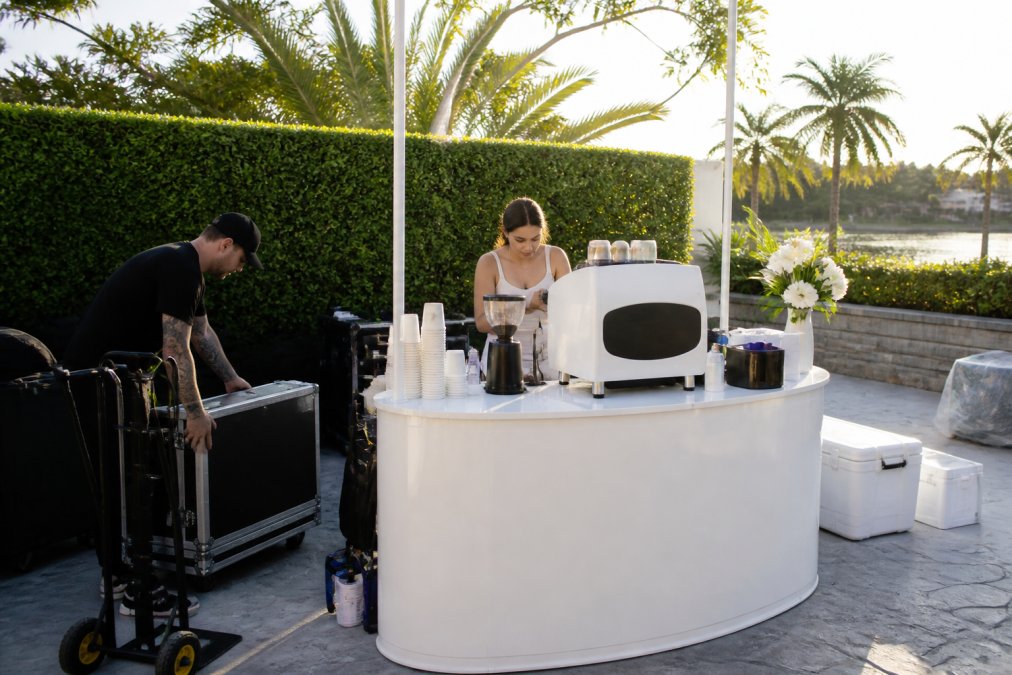
The cart is a self-contained unit: espresso machine, grinder, water system, power supply, cup dispensers, and storage for supplies all fit within the footprint. This means you can set up quality coffee service almost anywhere, parking lots, gardens, rooftop terraces, even beach venues (though sand requires extra precautions).
Power, Water, and Space Considerations
Every mobile coffee cart requires two essential utilities: power and water.
Power requirements vary by cart type. A standard espresso cart typically draws 20 amps at 120 volts, which is standard household electrical service. If your venue doesn’t have an outlet near your desired cart location, you’ll need a generator. Many South Florida event venues, hotels, country clubs, and outdoor event spaces have power available near common areas.
Water supply is equally critical. The espresso machine needs fresh water to brew coffee, and you’ll also need water for cleaning and steaming milk. Most carts carry 30-50 gallons of fresh water in onboard tanks, which is sufficient for events up to 150-200 guests. For larger events, you’ll need a water connection or multiple refills during service.
Space requirements depend on your cart size and service style. A standard cart needs a 4×8-foot area minimum, with an additional 3-4 feet of clearance in front for guests to queue. A cart positioned in a high-traffic area serves more guests naturally. Work with your venue coordinator to identify the optimal location: near the main gathering space, visible from entry points, and positioned so guests don’t have to detour significantly to reach it.
Barista Staffing and Service Speed
The quality of your coffee service depends directly on the skill and speed of the person (or people) behind the cart. A trained barista can manage an espresso machine, steam milk, and interact with guests simultaneously.
For events up to 100 guests, one barista handles the load comfortably, assuming the event lasts no more than four hours and peak consumption is spread across 30-45 minutes. For events of 100-200 guests, you’ll want two baristas to maintain service speed and quality. Above 200 guests, three baristas prevents excessive wait times.
A skilled barista produces 15-20 espresso-based drinks per hour. With cold brew or drip service, one person can handle 30-40 drinks per hour. The barista also influences guest perception and represents your event’s hospitality.
Event Coffee Service Best Practices: Timing and Rush Hour Management
Peak consumption windows are predictable. At morning events, the rush hits in the first 15-30 minutes as guests arrive. At afternoon events, consumption spreads more evenly, with a secondary peak around 3-4 PM. At evening events after dinner, demand spikes 30-45 minutes after dinner service concludes.
Understanding your event’s specific timing allows you to prepare. If you’re hosting a morning corporate event starting at 8 AM, have your cart fully stocked and ready to serve by 7:45 AM. Position it prominently near the entrance so arriving guests see it immediately.
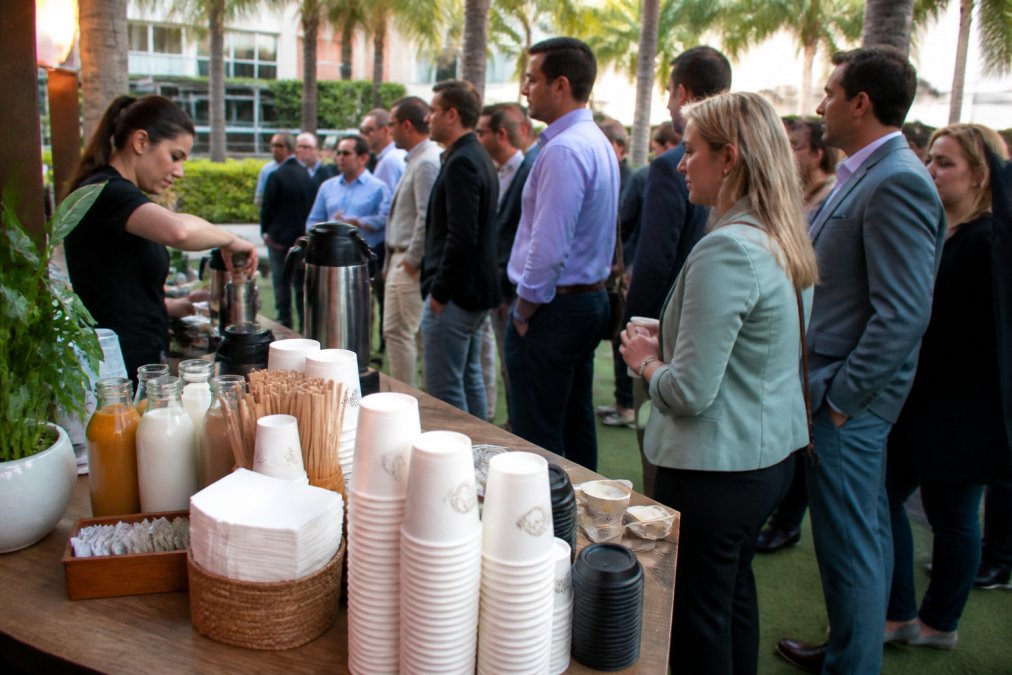
Rush hour management requires tactical adjustments. Pre-position supplies within arm’s reach of the barista. Simplify the menu during peak times by highlighting three or four drinks to speed up ordering. Have a staging area where finished drinks wait briefly before guests pick them up. For larger events, consider staggered service with two stations 30-40 feet apart to cut wait times in half.
Peak Consumption Windows and Service Flow
Peak consumption windows vary by event type, but the pattern is consistent: guests consume coffee when they’re transitioning between activities or settling into a new space.
Service flow is the sequence of actions a guest takes from deciding to get coffee to walking away with their drink. Optimize this flow and you reduce wait times dramatically. The ideal flow is: (1) guest sees the menu, (2) guest orders, (3) barista makes the drink, (4) guest adds condiments, (5) guest leaves. Each step should take no more than 30-45 seconds during peak times.
Common flow bottlenecks include unclear menus, guests asking questions while others are waiting, crowded condiment stations, and overly complex drinks. Keep peak-time drinks simple and save specialty creations for slower periods.
Condiment Stations and Non-Dairy Alternatives
The condiment station is where many event coffee services lose efficiency. A poorly organized condiment area creates congestion as guests hunt for sugar, milk, and stirrers.
The ideal condiment station has distinct zones: milk alternatives (oat, almond, coconut, whole milk) in one area, sweeteners (sugar, honey, agave, stevia) in another, flavor shots (vanilla, caramel, hazelnut) in a third, and stirrers, napkins, and lids in a final zone. Arrange these in a line so guests move through them sequentially.
Non-dairy milk alternatives are expected. Oat milk has become the default, but many guests also request almond or coconut milk. Offering all four covers the vast majority of preferences. Clearly label each milk option with large, easy-to-read text.
Organize condiment stations in a linear flow (milk → sweeteners → flavor shots → stirrers) rather than clustering everything in one area. This prevents congestion and keeps service moving.
Sustainability and Eco-Friendly Disposal Solutions
Event coffee service generates significant waste: cups, lids, sleeves, napkins, and condiment packets. Sustainable practices reduce environmental impact and increasingly align with guest expectations, especially at corporate and upscale events.
The most impactful change is switching from disposable to compostable cups. Compostable cups look identical to traditional disposable cups but break down in commercial composting facilities within 90-120 days. Many South Florida venues now require or encourage compostable serviceware.
Instead of individual sugar and sweetener packets, use bulk dispensers or small bowls. Instead of individual creamer packets, use milk pitchers. This approach reduces packaging waste by 70-80% and simplifies the condiment station setup.
For events generating high volumes of coffee waste, partner with a waste management company that specializes in event sustainability. They can separate compostable, recyclable, and landfill waste, diverting 60-80% of event waste from landfills.
Troubleshooting Common Coffee Service Failures
Even with careful planning, things go wrong. Knowing how to recognize and fix common issues prevents minor problems from derailing your event.
Cold espresso shots happen when the espresso machine hasn’t warmed up sufficiently before service begins. Solution: start your machine 30-45 minutes before service begins and run a few practice shots to bring it to operating temperature.
Slow pour from the espresso machine indicates a clogged group head. Solution: have the barista backflush the machine or run water through the group head without the portafilter.
Milk that won’t froth properly usually means the steam wand is clogged or the milk is the wrong temperature. Solution: purge the steam wand to clear any dried milk, then try again. Use cold milk from a refrigerator.
Water not flowing from the espresso machine suggests an empty water tank or a kinked water line. Check the onboard water tank level first. If it’s full, inspect the water line for kinks or disconnections.
Long lines and guest complaints indicate understaffing or an inefficient service flow. If you have a backup barista on standby, bring them in immediately. Simplify the menu and move slower guests to the side.
Equipment breakdown during service requires a backup plan. If your espresso machine fails and you don’t have a backup, pivot to cold brew service or drip coffee to keep service moving.
Integrating Coffee with Food Pairings and Accessibility
Coffee service reaches its full potential when integrated with food offerings and designed to be accessible to all guests.
Food pairings elevate the coffee experience. Pastries and biscotti pair naturally with espresso or cappuccino. Fruit and granola pair well with cold brew. Work with your catering team to coordinate timing so coffee service and food service don’t create congestion.
Accessibility is critical. Ensure your coffee cart is positioned where guests with mobility challenges can reach it. Offer a "call ahead" option where guests can request coffee and have it brought to them. Clearly label all ingredients for guests with dietary restrictions or allergies. Offering decaf espresso and caffeine-free alternatives (herbal tea, matcha, hot chocolate) ensures everyone feels included.
For guests with hearing impairments, have a visual menu board in addition to verbal ordering. For guests who are blind or have low vision, provide a printed menu in large text or offer to read options aloud.
Budgeting and Planning Your Event Coffee Service
Coffee service costs vary widely depending on your choices: service style, equipment, staffing, and whether you’re renting or using your own equipment.
When budgeting, account for these line items: equipment rental (if using a mobile cart), barista staffing, coffee and supplies (beans, milk, cups, condiments), and contingency for unexpected needs.
Request quotes from multiple coffee catering services in Miami and South Florida. Compare not just price but what’s included: Do they provide backup equipment? What happens if the espresso machine breaks? Are they flexible with menu customization? Do they handle setup and breakdown?
| Service Style | Guest Experience | Service Speed | Staffing Needs | Best Event Type |
|---|---|---|---|---|
| Espresso Bar | Premium, interactive | Moderate (15-20 drinks/hr) | 1-2 baristas | Upscale weddings, product launches |
| Drip Coffee Station | Basic, self-serve | Fast (unlimited) | 1 attendant | Large conferences, corporate meetings |
| Cold Brew Service | Quality, modern | Fast (30-40 drinks/hr) | 1-2 baristas | Any event, especially warm-weather venues |
| Hybrid (Cold Brew + Espresso) | Premium, flexible | Fast to moderate | 2 baristas | High-end events, 150+ guests |
Planning event coffee successfully means understanding your guest count, choosing the right service style for your event type, managing logistics carefully, and recognizing that coffee service is an opportunity to create a memorable moment. Whether you’re hosting a corporate gathering in downtown Miami, a luxury wedding in South Florida, or a brand activation, the principles remain the same: anticipate demand, invest in quality service, and design an experience that makes guests feel valued.
Colada Kulture Co. specializes in exactly this kind of thoughtful event coffee service. With professional baristas, mobile cart options, customizable menus including oat milk and specialty drinks, and a deep understanding of South Florida venues, we handle the logistics so you can focus on your event. We’ve delivered premium coffee experiences for over 35 weddings, corporate events, and private celebrations throughout Miami and South Florida, and we know how to handle the unique challenges of high-rise offices, beachfront venues, and everything in between. Request a quote from Colada Kulture Co. and let’s create a coffee experience your guests will actually remember.
Frequently Asked Questions
How much coffee per person should I plan for an event?
Most events average 1.5 to 2 cups per person for a 2-4 hour gathering. For morning events (7-11 AM), expect higher consumption. Afternoon events typically see 30-40% less volume. A coffee catering calculator factors in event duration, time of day, and guest demographics. For South Florida events in warm weather, cold brew and iced coffee consumption often exceeds hot coffee by 20-30%. Always order 10-15% extra to account for unexpected demand spikes.
What's included in a typical mobile coffee cart rental in Miami?
A mobile coffee cart rental typically includes the cart or trailer, espresso machine, grinder, hot water dispensers, and refrigeration for cold storage. Most rentals provide barista staffing, basic beverage options (espresso, drip coffee, cold brew), and milk alternatives like oat and almond milk. Setup and breakdown are usually included. Confirm power requirements with your venue, especially for high-rise downtown Miami offices with strict loading dock access. Premium services may offer customizable menus, specialty drinks, and pastry pairings.
How do I calculate coffee volume for 100 guests using a catering calculator?
Start with your guest count (100) and multiply by average consumption: 1.5-2 cups per person = 150-200 cups total. Adjust for event timing: morning events add 20%, afternoon events subtract 30%. Account for non-coffee drinkers (typically 15-20% of guests). A coffee catering calculator automates this and factors in your specific service style. For a 3-hour corporate event in South Florida with 100 guests, plan for 180-220 total beverages including coffee, tea, and cold alternatives.
What are the best event coffee service practices for high-traffic events?
Implement a clear service flow: set up multiple beverage stations to reduce bottlenecks, position the condiment station separately from the serving line, and staff adequately for peak consumption windows. Morning events peak 30 minutes after start time; afternoon events peak mid-event. Use disposable cups with clear sizing to speed service. Train baristas to anticipate orders and pre-stage cups. For large South Florida weddings and corporate activations, consider dual espresso machines and separate cold brew dispensers to maintain service speed when 200+ guests are in line.
This article was written using GrandRanker