Table of Contents
- Understanding Mobile Coffee Cart Power Requirements
- Calculating Total Wattage for Your Mobile Coffee Cart
- Mobile Espresso Machine Power Consumption Essentials
- Choosing the Right Coffee Cart Generator Size
- Battery Setup for Coffee Cart Operations
- Coffee Truck Electrical System Setup and Safety
- Venue Power Limitations and On-Site Electrical Access
- Power Load Calculation Worksheet and Implementation
Last Updated: July 26, 2026
Understanding Mobile Coffee Cart Power Requirements
Running a successful mobile coffee operation requires understanding your exact electrical power needs. Underpowered systems lead to equipment failures, missed sales, and frustrated customers during peak hours. At Colada Kulture Co., we’ve worked with dozens of mobile coffee operators across South Florida events, and the most common issue isn’t espresso quality, it’s miscalculating total wattage demand before setup day.
Most mobile coffee entrepreneurs guess at power needs and discover mid-event that their espresso machine won’t pull shots while the grinder runs. Below, we’ll walk you through calculating exact power requirements, selecting the right generator or battery system, understanding electrical safety standards, and troubleshooting common power failures.
Why Power Planning Matters for Your Mobile Setup
Equipment damage from power surges and brown-outs is expensive and avoidable. When voltage fluctuates or amperage spikes occur during startup, sensitive electronics in espresso machines and grinders fail silently, sometimes days after an event.
Event venues impose strict electrical restrictions. A high-rise downtown Miami office building may only allow 20 amps on a single circuit. Knowing your power requirements upfront lets you assess whether a venue can support your operation before you commit.
Peak hour demand differs from average demand. Your espresso machine draws significantly more power during startup than during steady operation. Professional operators plan for worst-case scenarios, all equipment running simultaneously.
Running undersized electrical systems causes more mobile coffee cart failures than any other factor. A generator that’s “close enough” will shut down unexpectedly, and battery systems will drain in half the expected time. Always oversize your power system by at least 20% to handle real-world demand spikes.
Calculating Total Wattage for Your Mobile Coffee Cart
The starting point for any mobile coffee cart power requirements guide is understanding the wattage of each piece of equipment. Wattage tells you how much electrical power your equipment consumes. Voltage is the electrical pressure in your system (typically 120V or 240V in the U.S.). Amperage is calculated by dividing wattage by voltage.
Critical distinction: running watts are what your equipment uses during normal operation, while starting watts are the initial surge when equipment powers on. Your generator or battery system must handle both.
Running Watts vs. Starting Watts
A typical commercial espresso machine draws 3,000 to 4,500 running watts during steady operation. When you first power it on, the heating element creates a startup surge reaching 5,000 to 6,000 watts for 2-3 seconds. If your generator is only rated for 4,000 watts, it will shut down immediately.
This is the most common mistake in mobile coffee power planning. Operators look at running wattage and assume that’s their total requirement. In reality, you need a generator or inverter system rated for the highest startup surge across all equipment.
Many commercial-grade espresso machines include a soft-start feature that reduces the initial power surge. Verify this feature is enabled on your machine.
Grinders present a similar challenge. A commercial burr grinder typically runs at 400-600 watts but can draw 800-1,000 watts during startup. If your espresso machine and grinder both start simultaneously, the combined startup load could exceed 7,000 watts.
Load Balancing and Peak Hour Power Loads
Load balancing means staggering when equipment powers on so you’re not drawing maximum wattage from everything at once. Turn on your espresso machine first, wait 30 seconds for it to stabilize, then power up the grinder and other equipment.
Peak hour power loads occur during your busiest service windows. Calculate your peak load by adding the running watts of every piece of equipment you’d realistically operate at the same time. Assume you will run everything together during a rush.
Create a spreadsheet listing each piece of equipment, its running watts, and its startup watts. Add a column for “peak load scenario”, the realistic simultaneous operation during your busiest hour. This becomes your minimum generator or battery capacity requirement.
| Equipment | Running Watts | Startup Watts | Notes |
|---|---|---|---|
| Espresso Machine | 3,500 | 5,500 | Soft-start enabled |
| Grinder | 500 | 900 | Burr grinder |
| Water Pump | 300 | 600 | Booster pump |
| Refrigeration | 400 | 800 | Mini-fridge for milk |
| POS System | 150 | 200 | Terminal + printer |
| Peak Load (all simultaneous) | 4,850 | 8,000 | Minimum generator: 10,000W |
Mobile Espresso Machine Power Consumption Essentials
Your espresso machine is the primary power consumer in any mobile coffee setup. Understanding its specific power requirements is essential for accurate planning.
Typical Espresso Machine Wattage and Amp Draw
Commercial espresso machines designed for mobile use typically draw between 3,000 and 4,500 running watts. A 3,500-watt machine running on 120V draws approximately 29 amps during operation. Running on 240V, the same machine draws about 15 amps.
240V systems are preferable for mobile operations. Lower amperage means you can use lighter-gauge extension cords and smaller circuit breakers. A 120V system drawing 29 amps requires heavy-gauge copper wire and creates significant voltage drop over distance.
The startup surge for espresso machines typically reaches 120-150% of running wattage. Dual-boiler espresso machines consume more power than single-boiler machines because they heat two separate water reservoirs simultaneously, reaching 4,500 to 5,500 running watts with startup surges exceeding 7,000 watts.
Grinder and Support Equipment Power Needs
A commercial burr grinder typically consumes 400-600 running watts but draws 800-1,000 watts during startup. Water pumps for pressure-fed systems draw 300-600 watts depending on the pump type. Refrigeration for milk and syrups typically requires 400-600 watts for a compact commercial unit. A point-of-sale system, card reader, and receipt printer consume 150-300 watts total.
Your total espresso machine power requirement isn’t just the machine itself. Account for the grinder, water pump, refrigeration, and POS system as separate loads. Combined, these support systems often add 1,500-2,500 watts to your peak load calculation.
Choosing the Right Coffee Cart Generator Size
Selecting a generator means understanding the difference between portable gasoline generators, propane generators, and inverter-based systems.
Generator vs. Battery and Inverter Systems
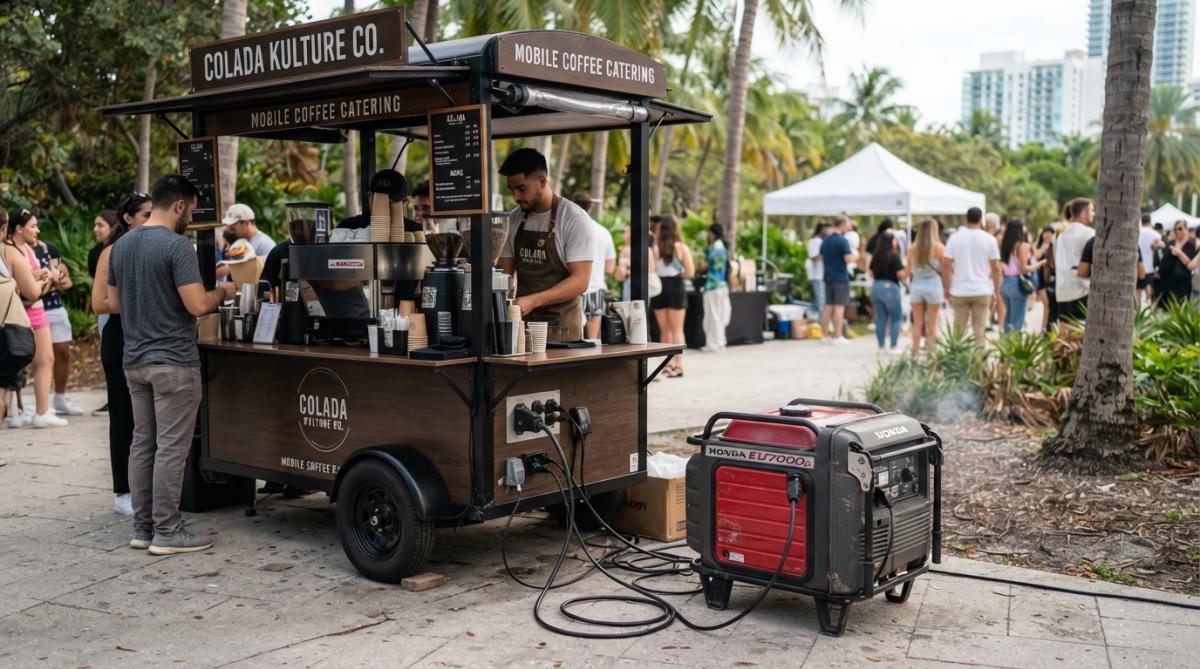
A portable gasoline generator produces AC power directly. A 10,000-watt gasoline generator can handle the startup surge of a full espresso machine setup and run continuously for 8-10 hours on a full tank. Gasoline generators are inexpensive and reliable. The downsides: they’re loud (typically 80-90 decibels) and produce emissions.
Propane generators are quieter than gasoline models and produce fewer emissions. They’re ideal for indoor events or venues with strict environmental requirements.
Inverter generators produce cleaner power with less voltage fluctuation, making them safer for sensitive electronics. They’re more fuel-efficient and significantly quieter. For mobile coffee operations where noise matters (weddings, corporate events), inverter generators are worth the premium.
Battery systems paired with inverters offer zero emissions and silent operation. A lithium battery bank with a 6,000-watt inverter can power a mobile coffee setup for 4-6 hours depending on actual load. Battery systems are ideal for indoor venues, upscale events where noise is prohibited, and locations where fuel storage isn’t practical.
The catch with batteries: recharging takes time. A 10 kWh lithium battery system might take 4-6 hours to fully recharge from a standard 240V outlet. If you’re running multiple events per day, you need either multiple battery banks or a backup generator.
Fuel Type, Runtime, and Noise Considerations
Gasoline generators typically run 8-12 hours on a full tank at 50% load. At full load, runtime drops to 4-6 hours. Propane generators can run indefinitely with a continuous propane supply connection.
Noise is measured in decibels. A conventional gasoline generator at full load produces 85-90 decibels. An inverter generator produces 70-80 decibels. A battery system with an inverter produces zero noise beyond the cooling fan (typically 40-50 decibels).
For wedding and high-end corporate events, noise matters. According to EPA noise guidelines for residential areas, sound levels above 70 decibels during daytime hours can violate local noise ordinances.
Never run a gasoline generator indoors or in partially enclosed spaces. Gasoline generators produce carbon monoxide, which is odorless and lethal. Always operate gasoline generators outdoors, at least 20 feet from the event space.
Battery Setup for Coffee Cart Operations
Lithium battery systems have transformed mobile coffee operations. They’re silent, produce zero emissions, and pair perfectly with espresso machine power requirements.
Lithium Battery Capacity and Inverter Pairing
Battery capacity is measured in kilowatt-hours (kWh). A 10 kWh lithium battery system can theoretically power a 1,000-watt load for 10 hours. In practice, use only 80% of rated capacity to extend battery lifespan, so a 10 kWh system provides about 8 kWh of usable power.
Your espresso machine draws roughly 3,500 watts at full operation. A 10 kWh battery system can power it for approximately 2.3 hours at continuous full load. Add a grinder, water pump, and refrigeration (another 1,500 watts), and your total load is 5,000 watts. The same battery system now provides about 1.6 hours of runtime.
Battery systems work best for shorter events, 2-3 hour catering windows, product launches, or afternoon corporate events. For all-day operations (8+ hours), you need either multiple battery banks or a backup generator.
The inverter converts DC power from the battery into AC power for your equipment. A 6,000-watt inverter is suitable for most mobile coffee setups.
When Battery Systems Make Sense
Battery systems excel at indoor events, upscale venues with noise restrictions, and locations where fuel storage is impractical. They’re ideal for operators running multiple short events throughout the day.
Battery systems don’t make sense for all-day outdoor events or venues where you can’t recharge between services. The total cost of a battery system typically exceeds a quality generator, but the operational benefits justify the cost for high-end events.
Coffee Truck Electrical System Setup and Safety
Electrical safety is non-negotiable. Improper setup causes equipment damage, personal injury, and liability issues.
120V vs. 240V Electrical Needs
120V systems are standard in most U.S. homes. A 120V circuit can safely deliver 15-20 amps continuously, which equals 1,800-2,400 watts. This is insufficient for a commercial espresso machine that draws 3,500+ watts.
240V systems deliver double the voltage, allowing the same wattage at half the amperage. A 3,500-watt espresso machine on 240V draws 14.6 amps instead of 29 amps. This reduces voltage drop over extension cords and allows lighter-gauge wire.
For mobile coffee operations, 240V is strongly preferred when available. If a venue only offers 120V, you’re limited to equipment drawing less than 2,400 watts.
GFCI Outlets, Circuit Breakers, and Code Compliance
GFCI (Ground Fault Circuit Interrupter) outlets detect electrical faults and shut off power within milliseconds. They’re required by electrical code in wet environments, kitchens, bathrooms, and outdoor locations.
When you plug into a venue’s electrical outlet, check whether it’s GFCI-protected. If it’s not, you should not plug in commercial food equipment. GFCI protection is a legal requirement and a safety feature you depend on.
Circuit breakers protect the electrical system from overload. If you draw more amperage than the circuit is rated for, the breaker trips and power cuts off. If a venue’s breaker keeps tripping when you plug in, your equipment is drawing more power than that circuit can handle.
According to NEC Article 422 for appliance installation, commercial equipment must be properly grounded and protected by appropriately-sized circuit breakers. Never daisy-chain extension cords, never use residential-grade cords for commercial equipment, and never plug into an outlet showing signs of damage.
Extension Cords and Power Strip Safety
Extension cords have amperage ratings based on wire gauge and length. A 12-gauge extension cord rated for 20 amps can safely deliver power up to 50 feet. A 10-gauge cord rated for 30 amps can safely run 100 feet.
Match the extension cord rating to your equipment’s amperage draw and the distance you’re running it. If your espresso machine draws 29 amps on 120V, you need a 12-gauge extension cord rated for at least 30 amps. Running a 14-gauge "regular" extension cord creates heat in the cord, which is a fire hazard.
Power strips are dangerous for commercial equipment. A standard power strip is rated for 15 amps total across all plugged-in devices. Never use power strips for commercial coffee equipment.
The single most important electrical safety rule: your equipment’s amperage rating must match or be lower than the extension cord’s amperage rating. A 29-amp espresso machine requires a 30+ amp-rated extension cord. Mismatches cause fires.
Venue Power Limitations and On-Site Electrical Access
Before you commit to an event, you must assess what power the venue can actually provide. This determines whether you can operate at all and which power solution makes sense.
Assessing Available Shore Power at Your Event Location
Shore power is permanent electrical service at the venue. A wedding venue might have a 20-amp 120V outlet on the patio. A corporate office might have 240V service in the break room. A farmers market might have pedestals with multiple outlets throughout the space.
When you scout a venue, ask these specific questions:
- What voltage is available? (120V, 240V, or both?)
- What amperage can the circuit handle? (15A, 20A, 30A, 50A?)
- How far is the outlet from where you’ll set up?
- Is the outlet GFCI-protected?
- Are there any restrictions on electrical usage?
Document the answers and take photos of the outlet. Measure the distance you’ll need to run extension cords. If the outlet is 150 feet away, you need a heavy-gauge extension cord rated for that distance.
Some venues have strict power limitations. A high-rise downtown Miami office might only allow 20 amps on a single circuit because the building’s electrical system is at capacity. If a venue can’t provide adequate power, you rely on your generator or battery system.
Troubleshooting Power Failures at Events
Power failures happen. A breaker trips, a cord gets unplugged, or a venue’s electrical system has an issue. You need a systematic approach to diagnose and fix the problem quickly.
First, check the obvious: Is the extension cord plugged in? Is the outlet switched on? Is the equipment’s power switch in the ON position? These simple checks resolve 50% of power issues.
If those check out, test the outlet itself. Plug a different device into the same outlet. If that device doesn’t work, the problem is the outlet or the venue’s circuit. Notify the venue’s facilities team immediately.
If the outlet works but your equipment doesn’t, check whether the extension cord is appropriate for your equipment’s amperage. If you’re running a 29-amp espresso machine on a 15-amp extension cord, voltage drop might cause the equipment to shut down.
If you’re using a generator, check the fuel level and whether the generator is producing power. A generator that shuts down during operation might be overloaded. Reduce your load by turning off non-essential equipment and see if the espresso machine runs.
If you’re using a battery system, check the battery’s state of charge. A battery showing 30% charge might not have enough power to handle a startup surge. Switch to your backup generator or reduce your load until you can recharge.
Always carry backup power. If you rely on a generator, have extra fuel on-site. If you rely on batteries, have a backup generator. Redundancy prevents lost revenue and reputation damage.
Power Load Calculation Worksheet and Implementation
The only way to truly understand your power requirements is to measure and document them.
Step-by-Step Wattage Calculation Process
Step 1: List Every Piece of Equipment
Document every electrical device on your cart, including the espresso machine, grinder, POS system, phone charger, display lights, water pump, and refrigeration.
Step 2: Find the Wattage Rating
Check the specification sheet or the label on the back of each device. Most equipment has a label listing voltage, amperage, and wattage. If you see only voltage and amperage, calculate wattage: Volts × Amps = Watts.
Step 3: Identify Startup vs. Running Watts
Contact the manufacturer if the specification sheet doesn’t distinguish between starting and running watts. If you can’t find startup wattage, assume it’s 150% of running wattage.
Step 4: Create Your Peak Load Scenario
List the realistic combination of equipment that would run simultaneously during your busiest hour. Assume you will run everything at once during a rush.
Step 5: Add 20% Headroom
Add 20% to your peak load total. This headroom accounts for voltage drop over extension cords, minor equipment you might have forgotten, and unexpected power surges. Example: Peak load = 5,000 watts. With 20% headroom = 6,000 watts minimum generator/battery capacity.
Step 6: Select Your Power Solution
If your peak load with headroom is 6,000 watts, you need a 6,000-watt generator or a battery system with a 6,000-watt inverter. Round up to the next standard size to ensure adequate capacity.
Common Mistakes to Avoid in Power Planning
Mistake 1: Using Only Running Watts
Calculating power based on running watts alone causes generators to shut down during startup. Always plan for startup wattage.
Mistake 2: Assuming You’ll Never Run Everything Simultaneously
During a rush, you will run your espresso machine, grinder, water pump, and refrigeration at the same time. Plan for this scenario.
Mistake 3: Underestimating Startup Surges
Heating elements create massive startup surges. An espresso machine with a 3,500-watt running load might spike to 5,500 watts during startup.
Mistake 4: Neglecting Support Equipment
Grinders, water pumps, refrigeration, and POS systems add 1,500-2,500 watts to your total load.
Mistake 5: Using Undersized Extension Cords
A 14-gauge extension cord rated for 15 amps cannot safely deliver power to a 29-amp espresso machine. Match the cord to your equipment’s amperage.
Mistake 6: Ignoring Voltage Drop
Extension cords lose voltage over distance. Use heavy-gauge cords for long runs.
Mistake 7: Not Planning for Redundancy
Always have a backup. If you rely on generator power, carry extra fuel. If you rely on venue power, have a backup generator.
| Mistake | Impact | Solution |
|---|---|---|
| Using only running watts | Generator shuts down during startup | Plan for startup wattage (120-150% of running watts) |
| Assuming partial load | Equipment fails during peak hours | Calculate peak load assuming all equipment runs simultaneously |
| Neglecting support equipment | Underestimating total power need | Document every electrical device: grinder, pump, refrigeration, POS |
| Undersized extension cords | Fire hazard and voltage drop | Match cord amperage rating to equipment’s amperage draw |
| Ignoring voltage drop | Equipment receives insufficient voltage | Use 10-gauge or heavier for runs over 100 feet |
| No backup power | Event failure if primary power fails | Carry backup generator or extra battery bank |
Running a reliable mobile coffee operation means understanding your power requirements before setup day. This guide covers calculating wattage, selecting generators or batteries, understanding electrical safety, and troubleshooting failures.
Colada Kulture Co. specializes in premium mobile coffee catering for South Florida events. We’ve perfected our power systems through hundreds of weddings, corporate gatherings, and brand activations. Our professional baristas operate with redundant power solutions, heavy-gauge electrical systems, and backup equipment, because we never let power issues compromise the experience. If you’re planning an event and want reliable, professional mobile coffee service with zero power-related disruptions, get started with Colada Kulture Co. today.
Frequently Asked Questions
How many watts does a mobile coffee cart need?
Most mobile coffee carts require 3,000 to 6,000 watts depending on equipment. An espresso machine typically draws 1,500-3,000 watts, a grinder adds 500-1,500 watts, and support equipment (water heater, point-of-sale systems) adds another 1,000-2,000 watts. Calculate your specific wattage by listing each piece of equipment and checking its nameplate for amp draw, then multiply amps by voltage (120V or 240V) to get watts.
What kind of generator do I need for a coffee cart?
For most mobile coffee carts, a 5,000-7,000 watt portable generator is ideal. Choose one with inverter technology to protect sensitive electronics like espresso machine controls and payment systems. Consider fuel type (gasoline, propane, or dual-fuel), noise level (quieter inverter models are better for events), and runtime. A 240V generator may be necessary if your espresso machine requires 240V input, so verify your equipment's electrical specifications before purchasing.
Can a coffee cart run on batteries instead of a generator?
Yes, lithium battery systems with inverters can power mobile coffee carts, though they work best for shorter events (2-4 hours). A battery setup requires a high-capacity lithium battery (typically 10-20 kWh) paired with a 5,000-6,000 watt inverter. Battery systems are quieter, produce zero emissions, and eliminate fuel costs, but they're more expensive upfront and require recharging. For all-day events or frequent use, generators remain more practical and cost-effective.
What electrical code requirements apply to mobile coffee carts?
Mobile coffee carts must comply with the National Electrical Code (NEC) and local building codes. Key requirements include GFCI (ground-fault circuit interrupter) protection on all outlets, proper circuit breaker sizing, correct wire gauge for extension cords, and safe grounding. Venue-specific codes may apply, many high-rise offices or event spaces have additional electrical restrictions. Always contact your venue before setup and consider hiring a licensed electrician to inspect your electrical system.
How do I calculate peak load power for a busy coffee cart event?
Peak load occurs when multiple high-wattage devices run simultaneously, typically when the espresso machine heats water, the grinder operates, and payment systems are active. Add up the starting watts (not running watts) of all equipment that might run at once. For example: espresso machine starting watts (2,500) + grinder (1,200) + water heater (1,500) = 5,200 watts peak load. Your generator or inverter system must handle this peak, not just average usage. Include a 20-30% safety buffer above your calculated peak.
What's the difference between 120V and 240V for a mobile coffee setup?
Most espresso machines and grinders run on 120V single-phase power, which is standard at most venues. Some larger commercial equipment requires 240V, which delivers more power with lower amperage and is more efficient for high-draw devices. Check your equipment's nameplate to confirm voltage requirements. If your equipment needs 240V but the venue only has 120V outlets, you'll need a 240V generator or shore power connection. Mixing voltages incorrectly can damage equipment or create safety hazards.
What should I do if power fails during an event?
Prevent failures by bringing a backup power source, either a second generator or a battery inverter system. During setup, test all connections and verify adequate power supply before guests arrive. If failure occurs, immediately switch to backup power if available. Keep a troubleshooting checklist: check circuit breakers haven't tripped, verify extension cords are fully connected, confirm the generator has fuel, and test GFCI outlets. For venue-supplied shore power, contact the venue's maintenance team. Always have your electrician's contact information on hand.
This article was written using GrandRanker