Table of Contents
- Define Your Mobile Coffee Service Model
- Essential Mobile Coffee Cart Equipment List
- Health Department Requirements for Mobile Coffee
- Permits, Licensing, and Insurance for Mobile Operations
- Coffee Catering Pricing Guide and Business Model
- Logistics, Setup, and Breakdown for Events
- Building Your Target Market and Booking Strategy
- Menu Curation and Barista Training for Consistency
Last Updated: August 7, 2026
Define Your Mobile Coffee Service Model
A mobile coffee service brings freshly brewed specialty coffee directly to events, venues, and corporate locations. Unlike stationary cafés, mobile operations require careful planning around equipment portability, power and water logistics, staffing, and client expectations. At Colada Kulture Co., we’ve found that the strongest operations start by clearly defining their business model before investing in equipment or permits.
Your first decision is choosing between a cart-based or trailer-based setup. Carts are lighter, faster to set up, and fit tight spaces, ideal for weddings and pop-up activations. Trailers offer more counter space and can handle higher-volume events with multiple baristas.
Next, clarify your service model. Are you selling coffee by the cup at markets? Operating as a catering vendor for private events? Offering branded experiences for corporate activations? Each model has different equipment needs, pricing structures, and operational demands. Define your menu scope early, a focused menu reduces complexity and training burden.
Essential Mobile Coffee Cart Equipment List
Your equipment investment determines both startup costs and operational capacity.
Espresso Machine and Grinder Selection
The espresso machine is your most critical piece of equipment. The La Marzocco Linea Mini is widely considered the gold standard for mobile coffee carts. Its dual boiler system maintains exceptional temperature stability, its compact footprint fits tight counter spaces, and its 110V power configuration works with standard event electrical.
The Mahlkonig X54 grinder is equally important, compact, fast, and capable of precise adjustments for espresso and other brewing methods.
Water and Power Solutions for Mobile Setup
Water and power are the operational constraints that separate professional operations from amateur ones. Most event venues have electrical outlets, but they may not provide the amperage or voltage stability your equipment demands.
The Caffewerks Espresso Machine Pump System solves the water problem by drawing water directly from standard 5-gallon jugs, eliminating the need for venue plumbing and delivering consistent pressure to your espresso machine.
A single espresso machine draws 1500-2000 watts during peak operation. Add a grinder, water pump, and point-of-sale system, and you’re consuming 2500-3500 watts total. Standard event outlets provide 15-20 amps at 110V, which is 1650-2200 watts, barely enough. For outdoor events or venues with unreliable power, solar generators like the Jackery Explorer 1000 Plus provide silent, eco-friendly backup with 1000 watt-hours of capacity.
Health Department Requirements for Mobile Coffee
Health department regulations vary by state and county, but all U.S. jurisdictions require mobile food service operations to meet specific sanitation and safety standards. In Florida, mobile coffee services fall under the Department of Business and Professional Regulation (DBPR) food service rules. Non-compliance results in citations, fines, or operational shutdown.
Your cart or trailer must have a certified water supply system, either a plumbed connection or an approved portable water tank. Wastewater must be disposed of properly into an approved greywater system, never dumped into storm drains. Your equipment must be NSF-certified (National Sanitation Foundation), meaning it meets food-safety standards for commercial use.
Your cart must include a three-compartment sink or approved handwashing station with hot and cold running water, soap, and paper towels. If you’re storing milk, syrups, or pastries, you need refrigeration capable of maintaining proper temperatures. Keep logs of temperature checks, health inspectors will ask to see them.
Personal hygiene requirements include food handler certification for all staff. In Florida, food service workers must complete a food handler course and pass an exam. The certification is valid for three years and costs roughly $4-30 per person.
Permits, Licensing, and Insurance for Mobile Operations
Operating a mobile coffee service legally requires multiple permits and licenses.
First, you need a business license from your city or county. This is basic registration that identifies you as a legal business entity, typically costing $50-200 annually.
Second, you need a food service license or mobile food facility permit from your county health department. The application requires proof that your cart meets health and safety standards, equipment certifications, water system approval, and waste disposal plan. The permit costs vary widely, from $100-500 annually.
Third, if you’re operating at multiple venues or events, you may need individual permits or approvals for each location. Some venues require proof of liability insurance before allowing you on-site.
Insurance is non-negotiable and often required by venues. General liability insurance protects you if a customer is injured or property is damaged. Product liability insurance covers illness allegedly caused by your beverages. Commercial auto insurance covers your vehicle if you’re transporting equipment. The Food Liability Insurance Program (FLIP) offers specialized policies for mobile beverage carts starting at $299 per year for basic coverage.
Coffee Catering Pricing Guide and Business Model
Pricing a mobile coffee service requires balancing cost of goods, operational overhead, and market positioning.
Most mobile coffee catering operations charge per-drink pricing or per-hour service fees. Per-drink pricing is straightforward: customers pay $5-8 for specialty drinks, $3-5 for coffee, $2-3 for tea. Per-hour service fees ($150-400 per hour, depending on location and complexity) work for private events where you’re providing a dedicated barista experience.
Your cost of goods for a specialty drink is typically $1-2 (coffee beans, milk, syrups, cup, lid, sleeve). A healthy mobile coffee operation targets 60-70% gross margin after cost of goods, leaving 30-40% to cover labor, overhead, and profit.
Minimum order requirements protect your profitability. Most professional mobile coffee services require minimum orders of $300-600, depending on location and distance. A professional booking agreement includes a cancellation clause, for example, full refund if cancelled more than 30 days in advance, 50% charge if cancelled 7-30 days in advance, full charge if cancelled within 7 days.
| Pricing Model | Best For | Typical Rate | Minimum Order |
|---|---|---|---|
| Per-drink pricing | Markets, festivals, high-volume events | $5-8 specialty drinks | 50-100 drinks |
| Per-hour service | Private events, weddings, corporate gatherings | $200-400/hour | 2-4 hour minimum |
| Hybrid (per-drink + service fee) | Premium events with customization | $6-8 drinks + $100-200 setup | Varies |
| Package pricing | Pre-negotiated catering | Bundled pricing for guest count | 50+ guests |
Logistics, Setup, and Breakdown for Events
The difference between a professional mobile coffee operation and an amateur one is often visible in logistics execution.
Pre-Event Planning and Site Assessment
Every event starts with a site assessment conversation. Before confirming a booking, ask specific questions: What’s the electrical capacity at the event space? Is there a dedicated circuit, or will you be sharing power with other vendors? Can you access water, or will you need to bring 5-gallon jugs? Is there covered parking for your vehicle? What are the load-in and load-out times? Are there any venue restrictions on equipment, noise, or setup location?
Create a pre-event checklist for every booking. Confirm the event date, time, guest count, menu, and any special requests at least two weeks before. Confirm again 48 hours before and the morning of the event.
Setup Workflow and Ergonomics
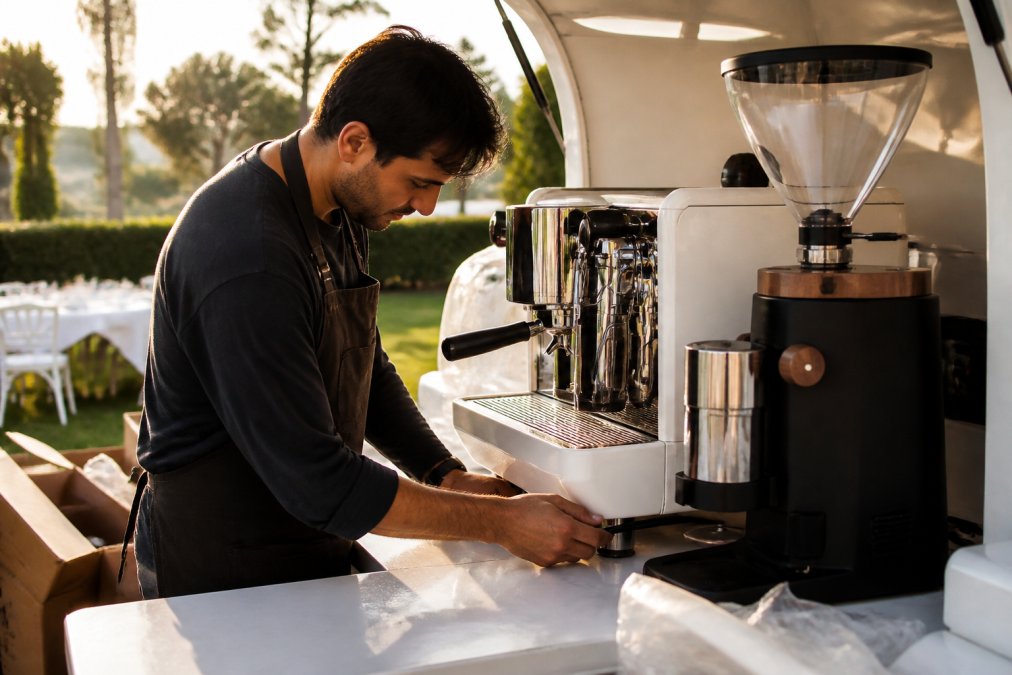
A well-designed setup takes 30-45 minutes for a cart, 45-60 minutes for a trailer. Your setup sequence should be practiced until automatic: position and secure the cart, establish power, establish water, power on equipment, stock supplies, test the system.
Ergonomics directly impact barista speed and accuracy. Your counter layout should minimize movement and strain. The espresso machine should be at a comfortable height for pulling shots (typically 36-42 inches high). The grinder should be immediately adjacent. The milk steamer should be positioned for easy access. The POS system should be at eye level.
Breakdown and Waste Management
Start breakdown 15 minutes before your scheduled end time. Stop taking new orders, finish serving current customers, and begin cooling down equipment.
Waste management is both an operational and environmental responsibility. Coffee grounds, used milk, and other organic waste should be disposed of properly. Never dump greywater into storm drains or regular trash. Track what you used versus what you brought, and adjust your supply ordering for future events.
Building Your Target Market and Booking Strategy
Your target market determines your pricing, positioning, and marketing approach.
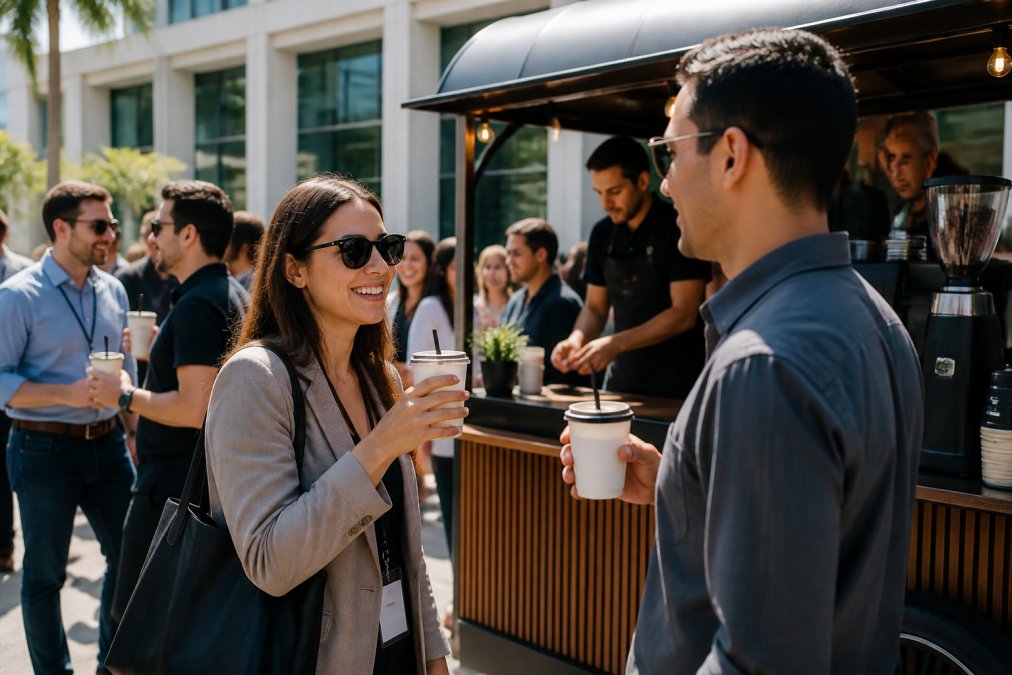
Corporate events are reliable, recurring, and price-sensitive. HR departments book coffee service for employee appreciation events, office parties, and wellness initiatives. They value consistency, professionalism, and on-time delivery.
Weddings are high-touch, emotionally important, and willing to pay premium prices for quality and customization. Couples want their coffee service to reflect their wedding aesthetic. Wedding clients typically book 6-12 months in advance and are influenced by referrals and social media. Colada Kulture Co. specializes in this segment, understanding that your wedding’s beverage experience is part of your celebration’s story.
Brand activations and product launches are event-driven, high-energy, and focused on social media engagement. Marketing teams want a coffee cart that’s visually striking, Instagram-worthy, and capable of handling high volume quickly.
Build your booking system around your target market. For corporate events, create a simple online booking form and follow up with a proposal. For weddings, use a more detailed consultation process with design mockups and menu tastings. For brand activations, emphasize customization and visual branding options.
Flashquotes is a catering management platform designed specifically for mobile food businesses. It handles event booking, invoicing, staff scheduling, and packing lists. For growing mobile coffee operations managing multiple events per week, Flashquotes centralizes administrative tasks and reduces scheduling errors.
Menu Curation and Barista Training for Consistency
Your menu defines your brand and your operational complexity. Start with the fundamentals: espresso, cappuccino, latte, Americano, macchiato. Add cold brew and iced coffee for warm-weather events. Consider a signature drink that reflects your brand, Colada Kulture Co. offers specialty drinks that celebrate South Florida culture and coffee craftsmanship. Add alternatives: oat milk, almond milk, whole milk. Include a non-coffee option like matcha latte, hot chocolate, or herbal tea. Limit yourself to 6-8 core drinks.
Barista training directly impacts consistency and customer satisfaction. Every barista should pull shots at the same temperature and pressure, steam milk to the same texture, and follow the same workflow. Create a training manual documenting your standards. Train new baristas on this manual before they work an event. Have experienced baristas observe new staff on their first few events.
Invest in barista certification programs. The Specialty Coffee Association (SCA) offers barista certification courses that establish baseline standards.
Running a successful mobile coffee service requires equal parts operational excellence, business acumen, and customer service. The equipment, permits, and logistics are the foundation, but your reputation is built on consistency, professionalism, and memorable experiences. Every event is an opportunity to exceed expectations and earn referrals for your next booking. Colada Kulture Co. has built our business on this principle: invest in quality equipment, train your team relentlessly, and treat every event like it’s your most important one. When you deliver exceptional coffee and service, clients remember you. They book you again, refer you to friends, and become advocates for your brand. That’s how a mobile coffee service scales from one cart to a thriving business.
Frequently Asked Questions
What permits and licenses do I need to operate a mobile coffee service?
Requirements vary by county and city in the US. Most jurisdictions require a food service license, mobile vendor permit, and health department approval. Your cart must pass health inspections covering water systems, waste disposal, and food handling. Florida counties like Miami-Dade have specific mobile food service regulations. Contact your local health department and business licensing office for exact requirements in your area.
How do I price my mobile coffee catering services competitively?
Mobile coffee cart equipment list costs, fuel, staff, and supplies inform your pricing. Factor in setup/breakdown time, travel distance, event duration, and headcount. Most mobile coffee services charge per-person rates or flat event fees plus per-drink charges. Consider your target market, corporate events and luxury weddings support premium pricing. Request a quote from multiple services to understand your local market, then price based on your quality, brand positioning, and operational costs.
What are the key health department requirements for mobile coffee operations?
Health department requirements for mobile coffee include a certified water supply system (potable water), proper greywater disposal into approved waste tanks, food handler certification for staff, regular equipment cleaning and maintenance logs, and proof of liability insurance. Your mobile setup must have adequate handwashing stations, food storage at proper temperatures, and documented cleaning procedures. Pass a pre-operation inspection before each event and maintain compliance records.
How long does it take to set up and break down a mobile coffee cart?
Setup typically takes 30-45 minutes for a mobile coffee cart, depending on venue conditions and equipment complexity. This includes water connection, power verification, equipment testing, and workspace organization. Breakdown takes 20-30 minutes. High-rise venues with strict loading dock access or outdoor setups with challenging terrain may require additional time. Plan 15-20 minutes for site assessment before events to identify power and water access, ensuring smooth logistics on the day.
This article was written using GrandRanker