Table of Contents
- Why Permits Matter for Mobile Food Trailers
- Florida Mobile Food Dispensing Vehicle License Requirements
- Miami-Dade Food Truck Permits and Local Business Licensing
- Food Trailer Commissary Requirements in Florida
- Health and Food Safety Permits
- Mobile Food Vendor Zoning and Parking Rules
- Fire Safety, Insurance, and Vehicle Registration
- Inspection Readiness and Common Compliance Mistakes
- Frequently Asked Questions
Last Updated: October 21, 2026
Why Permits Matter for Mobile Food Trailers
Operating a mobile food trailer without proper mobile food trailers permits exposes you to fines, shutdown orders, and legal liability.
Permits operate at multiple levels: state regulations set baseline standards, and local city and county rules add requirements.
The process is predictable: submit documentation, pass inspections, and receive approval. Planning ahead prevents delays and gives you time to fix issues inspectors find.
Florida Mobile Food Dispensing Vehicle License Requirements
The Florida mobile food dispensing vehicle (MFDV) license is your foundational state permit. This license authorizes you to operate a mobile food trailer across Florida. The Department of Business and Professional Regulation (DBPR) issues it after you meet specific operational standards.
Application Process and Documentation
You’ll need to complete the MFDV license application through the DBPR. The application requires:
- Proof of a commissary agreement (where you prepare and service your trailer)
- A detailed description of your menu and food preparation methods
- Documentation of your water supply and wastewater disposal system
- Proof of a valid business entity (LLC, corporation, or sole proprietorship registration)
- A food handler certificate for yourself and any staff members
Submit your application with a site plan showing trailer layout, equipment placement, and handwashing facilities. The DBPR reviews your documentation and schedules an inspection verifying equipment, water system, and waste disposal compliance.
Processing typically takes 2-4 weeks after submission. Once approved, you receive your MFDV license. This license is valid for one year and must be displayed on your trailer during operation.
Renewal and Compliance
Renew your MFDV license annually, submitting 30 days before expiration to avoid gaps. Renewal requires updated documentation if your commissary, menu, or procedures have changed.
Compliance means maintaining your commissary agreement, keeping food handler certificates current, and passing annual inspections of equipment, water systems, and waste disposal. Address violations promptly to keep your license active.
Miami-Dade Food Truck Permits and Local Business Licensing
Florida state permits are necessary but not sufficient. Miami-Dade County and the City of Miami impose additional local requirements. Local permits verify that your operation fits zoning rules and meets community standards.
Local Business Tax Receipt
The local business tax receipt (often called a business license) is your Miami-Dade authorization to operate commercially. Apply through the Miami-Dade County Department of Regulatory and Economic Resources. You’ll need:
- Your EIN (Employer Identification Number) or Social Security Number
- Proof of your business entity registration
- Your trailer’s VIN and registration documents
- A description of your business activities (mobile food service)
Processing typically takes 3-5 business days, and the fee depends on projected revenue. Display your tax receipt prominently on your trailer alongside your state permits.
City and County Approval Process
Beyond the tax receipt, the City of Miami requires a mobile food unit permit. This permit confirms that your specific operation complies with city ordinances.
Many operators apply for state and local permits simultaneously to save time. However, you must have your state MFDV license approved before the city will issue its permit. Start with state permits, then move to local ones.
The city reviews your commissary location, proposed operating areas, and menu, verifying your commissary is within acceptable distance of your operating zone. Confirm your intended locations comply before submitting, since some neighborhoods restrict mobile food units.
Miami-Dade County also requires a health permit from the Department of Health, separate from your state MFDV license. The county conducts a final inspection verifying your food safety practices before issuing the permit.
Food Trailer Commissary Requirements in Florida
Your commissary is the fixed facility where you prepare food, refill water tanks, and dump wastewater. Florida requires all mobile food trailers to have an approved commissary. Your commissary must meet strict food safety standards and be properly licensed.
Approved Servicing Locations
An approved commissary must be:
- A licensed food service establishment (restaurant, catering kitchen, or dedicated commissary facility)
- Equipped with commercial-grade kitchen equipment
- Staffed by food handlers with valid certificates
- Located within a reasonable distance of your operating area (typically within 50 miles, though local rules vary)
You don’t need to own the commissary, many operators rent space from restaurants or shared kitchens. Confirm the facility is licensed and willing to support mobile food operations before signing.
Your commissary agreement must specify the facility’s address and license number, your authorized access days and times, equipment and utilities you can use, cleaning and maintenance responsibility, and cost and payment terms.
Water Supply and Wastewater Disposal
Your trailer must have a potable water supply and a wastewater disposal system. Water supply options include:
- Connection to an approved water source at your commissary
- A sealed, food-grade water tank filled at your commissary
- Connection to a municipal water system at your operating location
Wastewater disposal requires:
- A sealed holding tank in your trailer
- Regular emptying at an approved disposal facility
- Documentation of disposal procedures
Never dump wastewater on the ground or into storm drains. Your water and wastewater system design must be approved before you operate.
Health and Food Safety Permits
Health permits confirm that your operation meets food safety standards. These permits involve multiple agencies and require ongoing compliance.
Health Inspection and Food Handler Certification
The Florida Department of Health inspects your trailer, verifying:
- Proper food storage and temperature control
- Clean equipment and surfaces
- Handwashing facilities with hot and cold water
- Separate compartments for clean and dirty items
- Proper labeling of all foods and ingredients
You and any staff must hold valid food handler certificates showing completed food safety training. Many counties offer online programs, and certificates are valid for 3-5 years depending on your county.
Some jurisdictions require a food manager certification (a higher-level credential) if you’re managing food preparation. Food manager training covers more advanced topics like HACCP (Hazard Analysis Critical Control Points) and allergen management.
Health inspections happen before you receive your permit and annually afterward. Treat inspections as opportunities to verify your practices meet standards, not as confrontations. Inspectors want to help you succeed.
Mobile Food Vendor Zoning and Parking Rules
Zoning regulations determine where you can legally operate your mobile food trailer. These rules vary significantly by neighborhood and venue type.
Approved Operating Locations and Event Venues
Miami-Dade has designated zones where mobile food vendors can operate:
- Public parks and recreational areas (with permission)
- Special event venues (festivals, farmers markets, concerts)
- Private property with owner permission
- Designated mobile food vendor zones in commercial areas
You cannot operate on residential streets without a special permit. Operating in prohibited zones without mobile food trailers permits results in fines and confiscation of your trailer.
Before committing to a location, verify its zoning status with the City of Miami Planning Department or Miami-Dade County Zoning Division. For events, the organizer typically secures approval, confirm this before signing an event contract.
Parking and Loading Requirements
Your trailer must comply with parking regulations:
- Park only in designated spaces or with explicit property owner permission
- Maintain at least 10 feet clearance from fire hydrants
- Never block emergency exits, driveways, or loading zones
- Use proper tire blocks and safety chains to secure the trailer
- Display reflective warning triangles if parked on streets overnight
At event venues, coordinate loading docks, parking, and setup times with management. Arrive early to assess space and power, and confirm your trailer’s dimensions and weight meet venue specifications, some high-rise venues have strict loading windows and weight limits.
Fire Safety, Insurance, and Vehicle Registration
Fire safety permits ensure that your propane system and cooking equipment meet safety standards. Insurance protects you from liability. Vehicle registration confirms your trailer is roadworthy.
Fire Permits and Equipment Standards
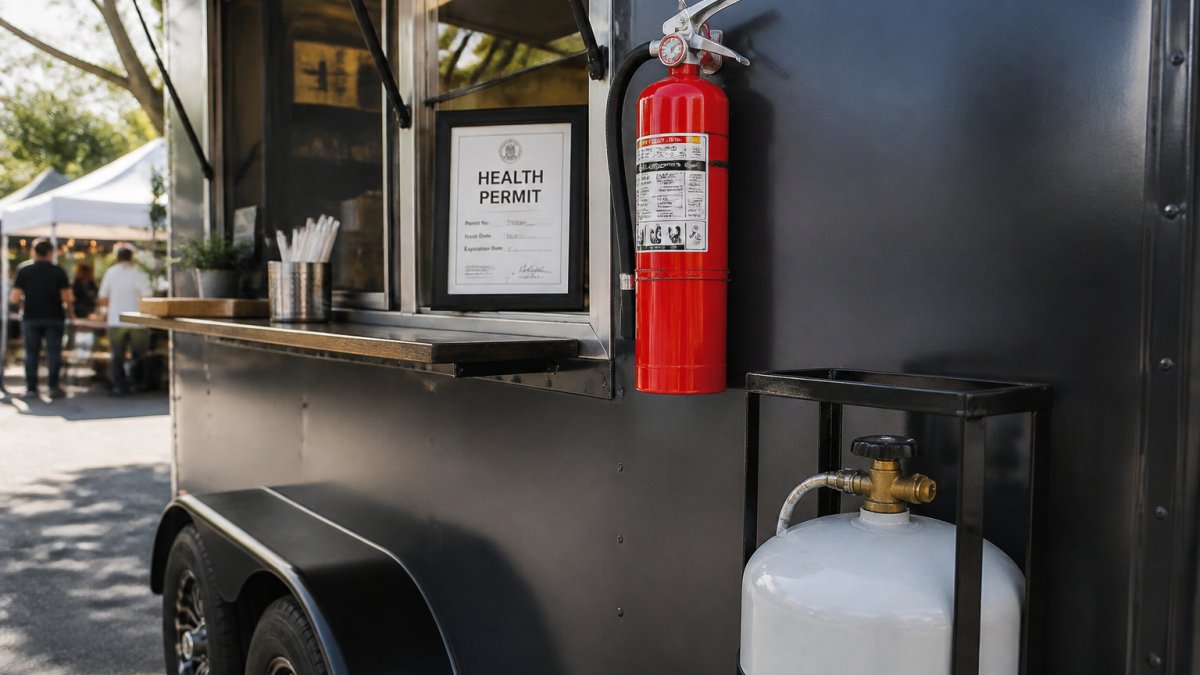
Your trailer’s propane system and cooking equipment require fire inspection and approval. Contact your local fire marshal’s office to schedule an inspection. Inspectors verify:
- Propane tank is properly secured and labeled
- Propane lines are leak-free and correctly installed
- Fire extinguisher is mounted, inspected, and accessible
- Cooking equipment vents safely
- Electrical systems are grounded and safe
Fire extinguishers must be rated for commercial food service (Type K for grease fires), mounted visibly on your trailer exterior, and serviced annually. Keep documentation of all inspections and maintenance.
Some jurisdictions require a separate fire permit in addition to the health permit. This permit confirms that your equipment meets fire codes. Once approved, display your fire permit prominently on your trailer.
A common mistake is assuming your propane system is safe because it worked before. Propane systems degrade over time. Have your system professionally inspected annually, even if you’re not required to. A propane leak can be catastrophic.
Insurance and Liability Coverage
Operating a mobile food trailer requires general liability insurance covering bodily injury and property damage claims.
Your insurance policy should cover:
- Food poisoning or contamination claims
- Customer injury on or near your trailer
- Property damage to your equipment or others’ property
- Vehicle liability (if your trailer is towed)
Liability limits typically range from $1 million to $2 million. Shop around with insurance brokers who specialize in food service.
Keep your insurance certificate current, many venues request updated certificates annually, and lapses can result in event cancellations and legal exposure.
Trailer Registration and Vehicle Documentation
Your trailer must be registered as a vehicle with the Florida Department of Motor Vehicles. Registration requires:
- Proof of ownership or lease agreement
- VIN (Vehicle Identification Number)
- Proof of insurance
- Payment of registration fees
Registration is valid for one year. Renew it before expiration. Display your registration sticker on your trailer as required by law.
If your trailer is towed, ensure the towing vehicle is properly registered and insured. Verify weight limits and hitch specifications, improper towing can result in accidents and liability.
Inspection Readiness and Common Compliance Mistakes
Inspections determine whether you receive your permits and maintain compliance. Preparing properly increases approval odds and identifies issues before they become problems.
Before your inspection, verify:
- All equipment is clean and functional
- Water supply system is connected and tested
- Wastewater tank is empty and secure
- Food storage areas are organized and labeled
- Handwashing station has hot and cold water
- Fire extinguisher is mounted and current
Common mistakes that cause inspection failures:
- Inadequate handwashing facilities (cold water only, no soap, or blocked access)
- Improper food storage (foods stored directly on floors, cross-contamination risks)
- Malfunctioning refrigeration or heating equipment
- Outdated or missing food handler certificates
- No approved commissary agreement on file
- Propane system not properly secured or labeled
Address these issues before inspection. Many inspectors offer pre-inspection consultations, use them to identify and fix problems early.
Operating a mobile food trailer in the region requires navigating multiple permit requirements across state and local levels.
| Permit Type | Issuing Agency | Processing Time | Renewal Frequency |
|---|---|---|---|
| MFDV License | Florida DBPR | 2-4 weeks | Annually |
| Local Business Tax Receipt | Miami-Dade County | 3-5 days | Annually |
| City Mobile Food Unit Permit | City of Miami | 1-2 weeks | Annually |
| County Health Permit | Miami-Dade Health Dept | 1-2 weeks | Annually |
| Fire Permit | Local Fire Marshal | 1-2 weeks | As required |
Frequently Asked Questions
What permits do you need for a mobile food trailer in Florida?
Operating a mobile food trailer in Florida requires a state-issued Mobile Food Dispensing Vehicle (MFDV) license from the Department of Business and Professional Regulation (DBPR), a local business tax receipt, health department food service permit, fire safety permit, vehicle registration, and zoning/parking approval from your local city or county. Each jurisdiction may have additional requirements, so verify with your specific county and city before launching operations.
How long does it take to get a mobile food trailer approved?
Processing times vary by jurisdiction. Starting early and submitting complete documentation reduces delays.
Do food trailers need a commissary or approved servicing location in Florida?
Yes, food trailers must have an approved commissary or servicing location where they store equipment, prepare food when needed, and dispose of wastewater. This facility must be licensed by the health department and meet all food safety standards. Your commissary address must be listed on your MFDV license and health permit, and inspectors verify compliance before and during operation.
What insurance does a mobile food trailer need?
Mobile food trailers typically require general liability insurance (minimum $1 million coverage), product liability insurance, and vehicle/trailer insurance. Many event venues and catering clients require proof of insurance before allowing operations on their property. Insurance costs depend on revenue projections, coverage limits, and claims history; consult an insurance broker familiar with food service operations for accurate quotes.