Table of Contents
- Why Espresso Cart Rental Works at Trade Shows
- Trade Show Coffee Catering: A Booking and Planning Timeline
- Espresso Cart Setup Requirements: Venue Checklist
- Rental Packages and What Drives the Price
- Capacity Planning and Queue Management
- Mobile Coffee Bar Menu Ideas for a Busy Booth
- Coffee Cart for Brand Activation: Cups, Cart, and Lead Capture
- Conclusion
- Frequently Asked Questions
Last Updated: October 20, 2026
Why Espresso Cart Rental Works at Trade Shows
An espresso cart rental for trade show events turns a standard booth visit into a reason to linger: a crafted drink, a moment of rest, and a branded touchpoint attendees remember.
Trade show floors are crowded, loud, and tiring, and after a few hours attendees stop making eye contact with vendors.
That is the real value of coffee catering at a trade show. You are not selling espresso. You are buying attention.
Trade Show Coffee Catering: A Booking and Planning Timeline
Book your espresso cart rental as soon as your booth space is confirmed, ideally eight to twelve weeks before the show. Venue approval, power access, and staffing take longer than most exhibitors expect.
| When | What to Do | Why It Matters |
|---|---|---|
| 8-12 weeks out | Confirm booth size, show dates, and expected foot traffic | Sets cart footprint and staffing level |
| 6-8 weeks out | Submit vendor paperwork to the venue | Many expo halls require insurance and vendor forms |
| 4-6 weeks out | Lock the menu and milk options | Oat and almond milk orders take lead time |
| 2-3 weeks out | Approve cup artwork and cart branding | Print deadlines are unforgiving |
| 1 week out | Confirm load-in window and power drop | Prevents a scramble on setup morning |
| Day before | Walk the floor and mark your setup spot | Saves 30 minutes on show day |
The mistake we see most often is treating coffee like an afterthought: exhibitors lock in the booth, banners, and swag, then hunt for a coffee cart two weeks out, when the best vendors are booked and venue approval becomes a bottleneck.
Skipping the venue’s vendor approval step is the fastest way to lose your coffee service. Many expo halls require a certificate of insurance and a signed vendor agreement before anyone can wheel a cart through the loading dock. Miss that deadline and your barista shows up to a locked door.
Espresso Cart Setup Requirements: Venue Checklist
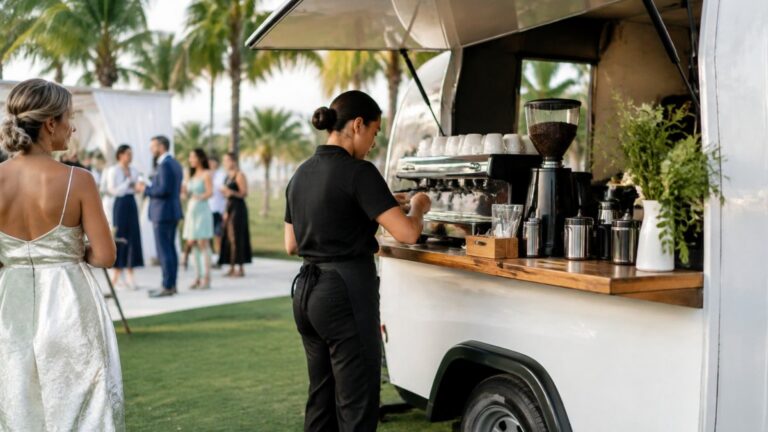
A self-contained mobile espresso cart needs three things from the venue: power, water, and floor space. Confirm all three in writing before the show. Most professional carts fit a standard 10×10 booth, but “compact” is not the same as “no requirements.”
Power, Water, and Floor Space
Ask the venue for the exact amperage at your booth and whether the circuit is shared.
On water, a well-built cart carries its own supply and wastewater tank, so it needs no plumbed connection, which matters at expo halls where running a water line to a booth is impossible or expensive.
Floor space is the third piece. Plan for the cart, a small queue area, and a clear exit path.
Loading Dock and Setup Window
Confirm your load-in time, the dock number, and whether the venue requires a union labor crew to move equipment, some expo halls mandate their staff for anything rolled onto the floor, which adds cost and coordination.
Build in a setup window of at least 60 to 90 minutes before doors open. A professional barista team needs time to dial in the grinder, test the machine, chill milk, and stage cups; rushed setups produce inconsistent shots, and attendees notice.
Ask the venue for a floor plan marked with power drops and the nearest loading dock before you finalize your booth location. A booth near a power source and a short roll from the dock saves real time on setup morning, and it is a detail most exhibitors never think to request.
Rental Packages and What Drives the Price
Pricing for an espresso cart rental depends on four factors: hours of service, guest count, menu complexity, and branding. There is no single rate, and any vendor quoting a flat number before asking about your show is guessing.
| Package Type | Typical Inclusions | Best For |
|---|---|---|
| Espresso only | Espresso, Americano, one milk option, single barista | Short shows, small booths |
| Espresso and milk drinks | Lattes, cappuccinos, oat and almond milk, two baristas | Full-day expos, steady traffic |
| Full specialty bar | Espresso, matcha, seasonal drinks, cold brew, pastries, branded cups | Brand activations, launches |
| Multi-cart setup | Two or more carts, larger team, custom menu | Large-scale events, high traffic |
Staffing and duration move the number most: a two-hour pop-up needs one barista, while a full show day with a line at 10 a.m. needs a team and possibly a second cart.
What Should Be Included in a Standard Quote
A complete trade show quote should state these line items in writing. If a proposal is missing any, ask before you sign.
- Service hours and overtime rate, the base window (for example, 9 a.m. to 5 p.m.) and the hourly rate for extending into a reception or evening session
- Staffing count and roles, how many baristas, whether a lead or shift supervisor is included, and whether a front-of-line host is part of the package
- Menu and milk options, which drinks are included, which are upgrades, and whether oat, almond, and whole milk are standard or add-ons
Add-Ons That Change the Total
Most vendors price the base package and then quote add-ons separately. The common ones at trade shows are:
- Branded cup printing, a per-cup or per-order setup fee, with a minimum quantity and a print deadline
- Cart wrap or branded panels, a design and production charge, often with a proof approval step
- Extra barista or front-of-line host, an hourly rate per person, usually with a minimum shift
How to Compare Two Proposals
Put both quotes side by side and normalize them before you decide. Three questions expose the real difference:
- What is the all-in cost per service hour, including setup and breakdown labor? A lower hourly rate with a separate four-hour setup charge can cost more than a higher rate that bundles it.
- What is the included drink quantity, and what happens when you exceed it? Some quotes cap drinks and bill overages per cup; others are unlimited within the service window.
- What is excluded that you will have to source yourself? Power runs, a generator, branded cups, or waste removal can add real cost if the vendor leaves them to you.
A vendor who answers all three in writing is easier to trust than one who quotes a single number and promises to “work it out.” We do not publish flat rates because every trade show is different. Request a quote with your dates, booth size, and expected attendance, and you will get an itemized package built around your show.
Capacity Planning and Queue Management
A single professional barista can serve roughly 120 drinks per hour when the menu is tight and the workflow is clean. That number drops fast if the menu sprawls or the queue has no structure. Capacity planning is the part of trade show coffee service most exhibitors underestimate, and it is the difference between a booth that welcomes walk-ups and one that turns them away.
Estimate the Traffic Curve, Not the Average
Capacity planning starts with an honest traffic estimate. Ask the show organizer for expected attendance and the busiest hours, most expos have a morning rush, a lunch lull, and a mid-afternoon spike. Staff for the spike, not the average, using a simple hour-by-hour model:
- Get the daily attendance figure from the organizer and divide it across show hours to get an average hourly flow past your booth.
- Apply a capture rate, the share of passersby who stop for a drink. A common planning range is 5 to 15 percent, higher for a booth near the entrance or a main aisle, lower for a back-corner location.
- Apply a peak multiplier, the busiest hour often runs 1.5 to 2 times the average, so size staffing to that hour.
- Convert stops to drinks per hour and compare against barista throughput.
For example, a show with 6,000 attendees over a six-hour floor day averages 1,000 people per hour past a central booth. At a 10 percent capture rate, that is 100 stops per hour at the average, and 150 to 200 during the peak. One barista at 120 drinks per hour cannot hold that peak; two baristas can, with a front-of-line host to keep the queue moving.
Staffing Math by Menu and Volume
Throughput depends on the drink mix as much as the barista. A rough planning guide:
- Drip coffee or cold brew on tap, 200 or more servings per hour per station, because there is no extraction step
- Espresso and Americano, roughly 120 to 150 drinks per hour per barista with a tight workflow
- Milk drinks (lattes, cappuccinos), roughly 60 to 90 drinks per hour per barista, because steaming and pouring add time
Add a front-of-line host when the queue exceeds about 10 people, and add a second barista when the peak-hour drink estimate exceeds one barista’s throughput by more than 20 percent. A second cart is usually cheaper than a third and fourth barista once volume climbs past roughly 300 drinks in a peak hour.
Queue Layout That Keeps the Aisle Clear
Queue management is where most booths fall apart. A line that blocks the aisle annoys the venue and discourages walk-ups. A few simple moves fix it:
- Place a small menu board at the start of the line so people decide before they reach the barista
- Keep a second staff member handing out drinks and starting conversations
- Offer a fast lane for simple orders like drip coffee or cold brew
The second staff member is the underrated piece: while the barista pulls shots, that person captures leads, answers product questions, and keeps the line moving. Coffee becomes the hook; the conversation becomes the point.
Plan for the Peak, Then Protect the Quiet Hours
The busiest hour is not the only hour that matters. Use the post-lunch lull to restock cups and milk, clean the grinder, and pre-pour iced drinks for the afternoon spike. A booth that runs out of oat milk at 2 p.m. on day one of a three-day show loses the rest of the afternoon to an avoidable problem.
For a large-scale event with heavy foot traffic, plan on multiple carts or a team of baristas rather than one overloaded cart. Matching capacity to expected attendance is the difference between a smooth booth and a line that turns people away.
Mobile Coffee Bar Menu Ideas for a Busy Booth
A trade show menu should be short, fast, and built for one-handed drinking. Attendees are holding bags, phones, and brochures, so every drink needs to work while standing.
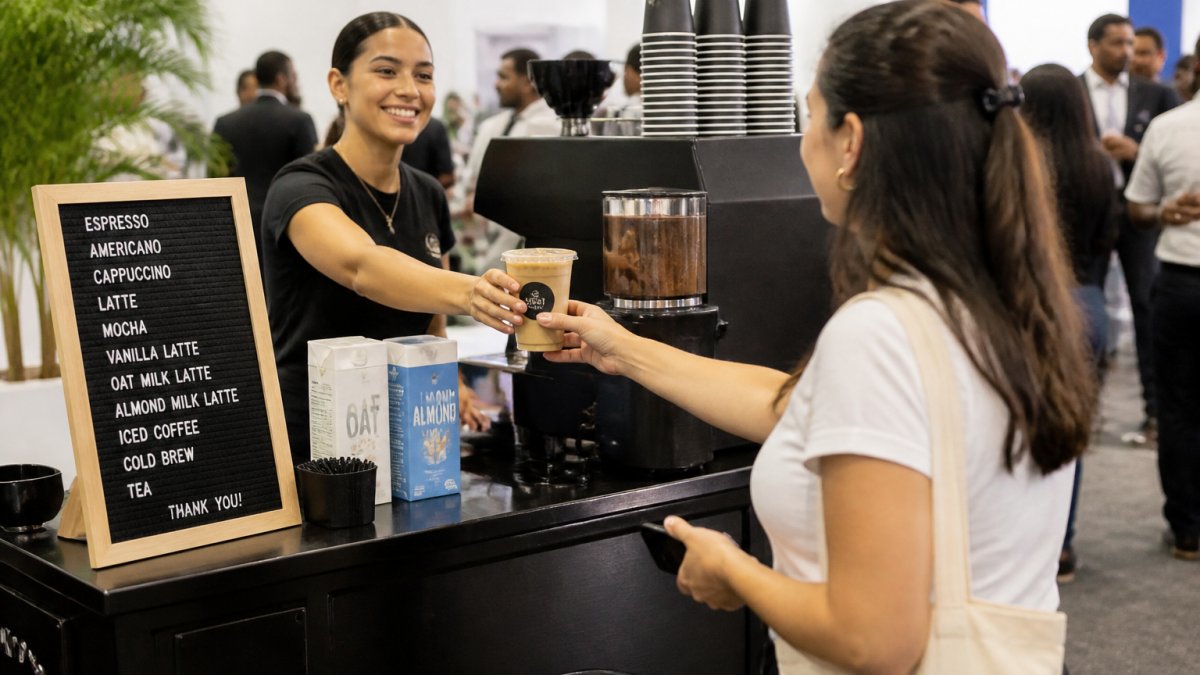
The menu that performs best at a busy booth is built around speed:
- Espresso and Americano for the fastest possible service
- Lattes and cappuccinos with whole, oat, and almond milk options
- Iced drinks for warm expo halls and afternoon crowds
Keep the specialty list to one or two drinks.
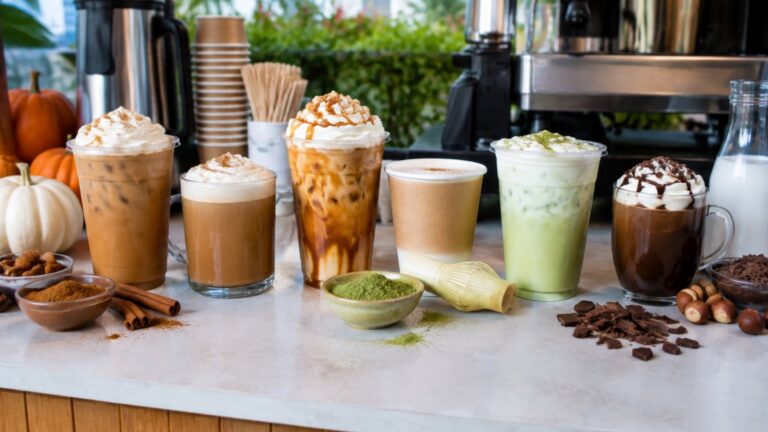
Non-coffee options matter more than most exhibitors expect. A matcha latte or flavored cold brew keeps the whole booth included, and oat and almond milk should be standard, not an upgrade.
Coffee Cart for Brand Activation: Cups, Cart, and Lead Capture
A coffee cart for brand activation does three jobs at once: it draws a crowd, puts your logo in people’s hands, and creates a natural moment to capture contact details.
Branded cups are the highest-return branding spend at a trade show.
Lead capture works best when it is tied to the drink, not bolted on. A few approaches that hold up:
- A short QR code on the cup or menu board that leads to a landing page
- A staff member asking one qualifying question while the drink is made
- A simple sign-up for a specialty drink, with the classic menu open to all
The qualifying question is the piece most teams skip. “What brought you to the show?” takes five seconds and tells you more than a badge scan.
Our baristas are trained to serve quickly and keep the line moving, which gives your team the opening to talk.
Conclusion
Trade show floors reward the booths that give attendees a reason to stop, and a well-planned espresso cart rental does exactly that.
That is the work Colada Kulture Co. does for every show. Our mobile coffee cart and trailer options fit compact booth footprints, our customizable packages cover espresso, matcha, and seasonal flavors with whole, oat, and almond milk, and our professional baristas keep the drinks fresh and the line moving.
Frequently Asked Questions
How much does espresso cart rental for trade show events cost?
Pricing depends on guest count, hours of service, menu, staffing, and cart branding, so there is no single figure. Multi-day expos usually cost more than a single afternoon because of staffing and restocking. Ask for an itemized quote that separates the cart, baristas, drinks, branded cups, and any delivery or setup fees. Get the quote in writing with the service window and drink cap stated, then compare packages on inclusions rather than headline price alone.
How many drinks per hour can a cart serve, and how many should I plan for?
A well-staffed cart can typically pour 120 or more drinks per hour, but that depends on menu size and how many baristas are working. For planning, assume 50 to 60 percent of booth visitors will take a drink, and expect a short rush right after doors open and around mid-morning breaks. Share your expected attendance with the rental company so they can recommend one cart or multiple carts and the right staffing level.
How far in advance should I book a coffee cart for a trade show?
Book four to six weeks ahead for a single-day corporate event, and eight to twelve weeks for a multi-day expo or a large activation. Show dates cluster, so carts and skilled baristas get locked in early, especially in peak conference season. If your event needs custom cart branding or branded cups, add two to three weeks for design and print approval. Last-minute bookings are sometimes possible, but menu and branding options narrow.
Can the cart handle custom drinks and branded cups for our booth?
Yes. Most rental companies offer a customizable menu that can include espresso drinks, cold brew, matcha lattes, and seasonal flavors, with whole, oat, and almond milk. Branding usually covers the cart panels, a menu board, and branded cups or sleeves. Send your logo and brand colors when you request the quote, and confirm approval timelines for printed items. Ask whether non-coffee options like hot chocolate or tea are available for attendees who do not drink coffee.