
Table of Contents
- Why Coffee Lines Become Bottlenecks at Conferences
- Calculating Coffee Service Requirements for Conferences
- Step-by-Step: Setting Up Coffee Stations That Prevent Long Lines
- Event Coffee Catering Logistics: Timing, Replenishment, and Venue Coordination
- Mobile Coffee Cart Benefits for Events: On-Demand Service That Eliminates Queues
- Queue Management Technology and Staggered Break Strategies
- Reducing Waste and Improving Sustainability Beyond Disposables
- Common Mistakes That Make Coffee Lines Worse
- Frequently Asked Questions
Last Updated: October 1, 2026
Why Coffee Lines Become Bottlenecks at Conferences
A conference coffee break looks simple until 400 people decide they want espresso at the same time. Coffee lines are the single most predictable bottleneck in event catering, and they almost never come down to coffee quality.
They come down to flow. One service point, one speed, and one narrow window of demand will always create a queue.
Here’s what most planners get wrong: they treat the coffee break as a menu problem instead of a logistics problem. The fix is operational, not culinary. Below, we’ll show you exactly how to size, position, and staff your coffee service so attendees spend their break networking instead of waiting.
Calculating Coffee Service Requirements for Conferences
The right way to plan coffee service is to work backward from your headcount, not forward from your menu. Estimate how many cups you’ll pour, then size stations, staff, and supplies to match that number.
The Gallon-to-Cup Ratio Every Planner Should Know
Plan on roughly 20 to 25 cups per gallon of brewed coffee, assuming an 8-ounce pour. Most attendees take one cup per break, and a meaningful share take two.
Use this simple planning table:
| Attendees | Cups per Break | Gallons per Break | Stations Needed |
|---|---|---|---|
| 50 | 50-75 | 3-4 | 1 |
| 150 | 150-225 | 8-10 | 2 |
| 300 | 300-450 | 15-20 | 3 |
| 500 | 500-750 | 25-30 | 4 |
Peak Demand Windows and How to Plan Around Them
Peak demand hits in the first 10 minutes of every scheduled break. If your break is 20 minutes long, expect most of your volume in the first half.
Plan around that window with three moves:
- Open stations 5 minutes before the break is announced
- Pre-pour a batch of black coffee and iced options
- Staff up for the first 10 minutes, then scale down
Step-by-Step: Setting Up Coffee Stations That Prevent Long Lines
Here’s the setup that consistently keeps service speed high, even at events with several hundred guests.
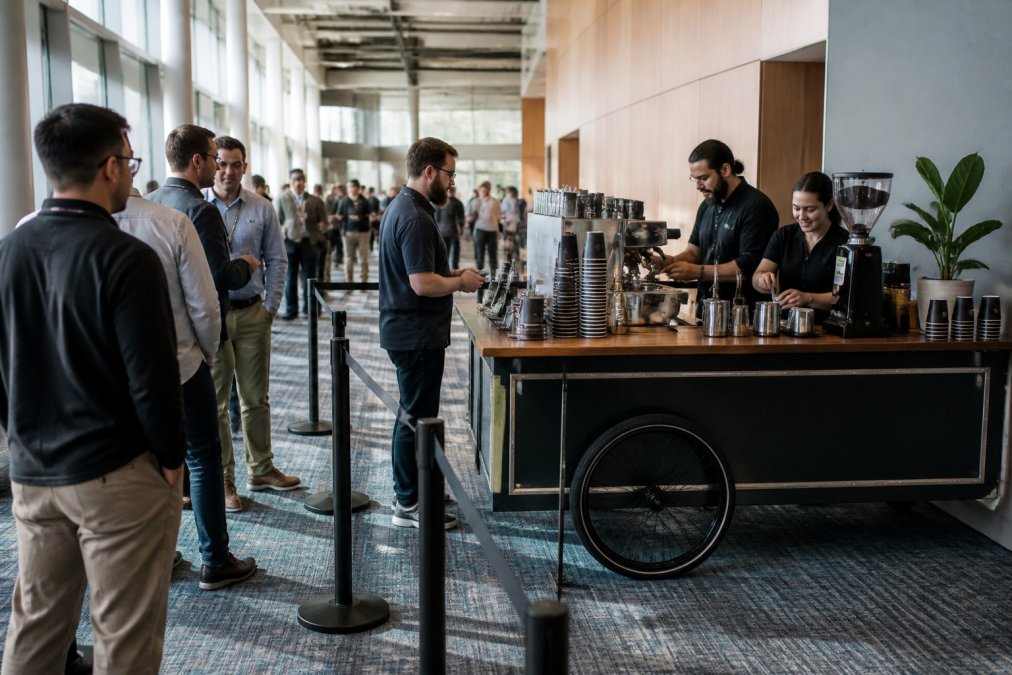
- Map attendee flow before you place a single station. Put stations where people already walk, not in dead corners.
- Split service into two lanes per station: one for drip and iced coffee, one for espresso drinks.
- Pre-stage cups, lids, and stirrers at both ends so guests don’t backtrack.
- Set milk and sugar on a separate table, away from the pickup point.
- Mark the queue with floor decals or rope so the line forms in one direction.
- Assign one staff member to restock only, so baristas never leave the bar.
- Test the full setup 30 minutes before doors open.
Physical Layout Optimization for Maximum Attendee Flow
The biggest layout mistake is a single-file line feeding a single pickup point. Split the flow instead.
Place your bus bin and trash at the exit of the station, not the entrance. Guests naturally drop cups on their way out, and you avoid a second crowding point where the line starts.
Staffing Ratios That Keep Service Speed High
A practical ratio is one barista per 75 to 100 guests per break for espresso service, and one per 150 guests for batch-brewed drip only.
Event Coffee Catering Logistics: Timing, Replenishment, and Venue Coordination
Event coffee catering logistics live or die on timing and venue coordination. A great menu with a late setup still produces a long line.
| Time | Action | Owner |
|---|---|---|
| 30 min before break | Full restock, pre-pour batch | Restock lead |
| Break start | All baristas on bar | Service lead |
| +10 min | Top up milk, cups, ice | Restock lead |
| +20 min | Begin breakdown of slow items | Service lead |
Mobile Coffee Cart Benefits for Events: On-Demand Service That Eliminates Queues
Mobile coffee cart benefits for events come down to one thing: distribution. Instead of one fixed station, you place service where guests already are.
The fastest way to kill a coffee line is to stop funneling everyone to one spot. Multiple smaller service points beat one large station almost every time.
Queue Management Technology and Staggered Break Strategies
Every competitor tells you to “stagger breaks.” Almost none explain how to stagger them without creating a second rush, or which queue technology actually pays off at conference scale versus which is a gimmick. That operational detail is the whole game.
Staggered breaks: the math and the mechanics
Staggering works because peak demand is concentrated, not because total demand drops. Your job is to spread the same volume across more minutes.
How to stagger without causing a pileup:
- Stagger by track, floor, or session room, never by arbitrary halves. Groups that already sit together and exit together are the easiest to release on different schedules.
- Use a 10- to 15-minute offset. Shorter offsets blur together; longer offsets push the last group past the break window.
- Announce the offset in three places: the printed schedule, the session-room screen, and a sign at the break area. The most common staggering failure is two groups showing up at once because only one group got the memo.
- Keep the coffee window open longer than the session gap. If the break is 20 minutes, hold service for 25 so the staggered tail has room to clear.
Staggering only works if the groups can actually be held. If your session rooms empty into a shared hallway at the same moment, the offset is cosmetic. Confirm with session moderators that they will release on schedule before you build the plan around it.
Queue technology: what actually helps at conference scale
Not every tool earns its place. Here is how the common options behave in a real break window:
- Live queue counters or wait-time signage. Useful when you have three or more stations and guests can physically choose between them. The sign only helps if the stations are within sight of each other; otherwise guests cannot act on the information.
- Pre-order and scheduled-pickup apps. Strongest for the first break of the day, when attendees are willing to plan ahead. Adoption drops sharply after lunch, so do not size your staffing around app orders alone.
- Text or pager alerts. Effective for espresso drinks with long pull times, the guest leaves the queue and returns when the drink is ready. Requires a staffed handoff point so drinks are not sitting unattended.
- Digital signage showing the menu and wait at each station. Low-cost, low-risk, and it doubles as a way to steer guests toward the drip lane.
The combination that beats either tactic alone
Staggering reduces how many people want coffee at once. Distribution, multiple stations, mobile carts, and clear signage, reduces how far each person has to walk and how long they stand. Run both together and you rarely need the technology at all; run the technology without the layout and scheduling work, and you are optimizing a queue that should not exist.
Stagger the schedule to flatten the peak, distribute the stations to shorten the walk, and add wait-time signage only when guests have a real choice between stations. Technology is the last lever, not the first.
Reducing Waste and Improving Sustainability Beyond Disposables
Waste reduction starts with accurate consumption estimates, not with swapping cups. Over-ordering is the biggest source of waste at most events.
Three moves that cut waste without hurting service:
- Track cups poured per break and adjust the next order to match
- Offer a mug-return station with a small incentive
- Choose compostable or recyclable serviceware that your venue can actually process
Common Mistakes That Make Coffee Lines Worse
The mistakes that make coffee lines worse are almost always operational, and they’re easy to fix once you know them.
- One giant station instead of several small ones. Bigger doesn’t mean faster. It usually means a longer single line.
- Baristas leaving the bar to restock. Every trip away from the bar stalls service. Assign a dedicated restocker.
- Milk and sugar at the pickup point. This creates a second crowd right where guests are trying to exit.
- No pre-poured batch at break start. The first 10 minutes are your peak. Have drinks ready before the rush.
- Ignoring the venue’s power and access limits. A cart that can’t reach power or the loading dock will delay setup and the whole break.
- Understaffing espresso service. Espresso drinks take longer per cup. Staff to the menu, not just the headcount.
Frequently Asked Questions
What is the 15-15-15 coffee rule for events?
The 15-15-15 rule suggests that for every 15 minutes of a scheduled coffee break, you need approximately 15 percent of attendees to be served simultaneously, requiring about 15 square feet of service area per station. In practice, this means a 300-person conference should plan for at least two to three stations with multiple service points each. Pairing this rule with staggered break times and mobile coffee carts reduces the chance of a single bottleneck forming during peak demand.
How many coffee stations are needed for a 500-person conference?
For a 500-person conference, plan for at least four to six coffee stations distributed across the venue. The exact number depends on attendee flow patterns, peak demand windows, and whether you use bulk brewing or on-demand espresso service.
How does mobile coffee cart catering improve attendee flow?
Mobile coffee cart catering improves attendee flow by bringing the service directly to high-traffic areas rather than forcing everyone to one central location. Carts can be positioned near networking spaces, session exits, or registration areas so guests grab a drink without crossing the venue. On-demand espresso service also means drinks are made fresh per order.
What are the best ways to reduce wait times at event catering stations?
Reduce wait times by pre-pouring simple drinks like drip coffee and cold brew during known peak windows, assigning dedicated staff to milk and sugar stations so guests self-serve faster, and using a single-direction queue layout that prevents crossing traffic. Staggered break schedules by track or floor also flatten demand. If your venue allows it, a mobile cart near session exits captures attendees before they reach the main refreshment station.

