
Table of Contents
- Why Event Planners Are Booking Mobile Espresso Carts in 2026
- Guest Engagement and Satisfaction: The Experiential Marketing ROI
- Mobile Coffee Catering Cost: What Drives Your Quote
- How to Choose a Coffee Cart for Events: A 7-Point Checklist
- Corporate Event Coffee Catering Ideas That Drive Brand Visibility
- Custom Branding and Menu Flexibility for Dietary Needs
- Coffee Catering vs. Office Coffee Service: Which Fits Your Event?
- Sustainability and Eco-Friendly Practices at Mobile Coffee Bars
- What to Do Next
- Frequently Asked Questions
Last Updated: September 30, 2026
Why Event Planners Are Booking Mobile Espresso Carts in 2026
A mobile espresso cart is a self-contained coffee station that brings professional baristas, commercial-grade equipment, and a full drink menu directly to your venue. The benefits of hiring a mobile espresso cart for events come down to one thing: it turns a passive refreshment break into an active, social experience guests actually remember.
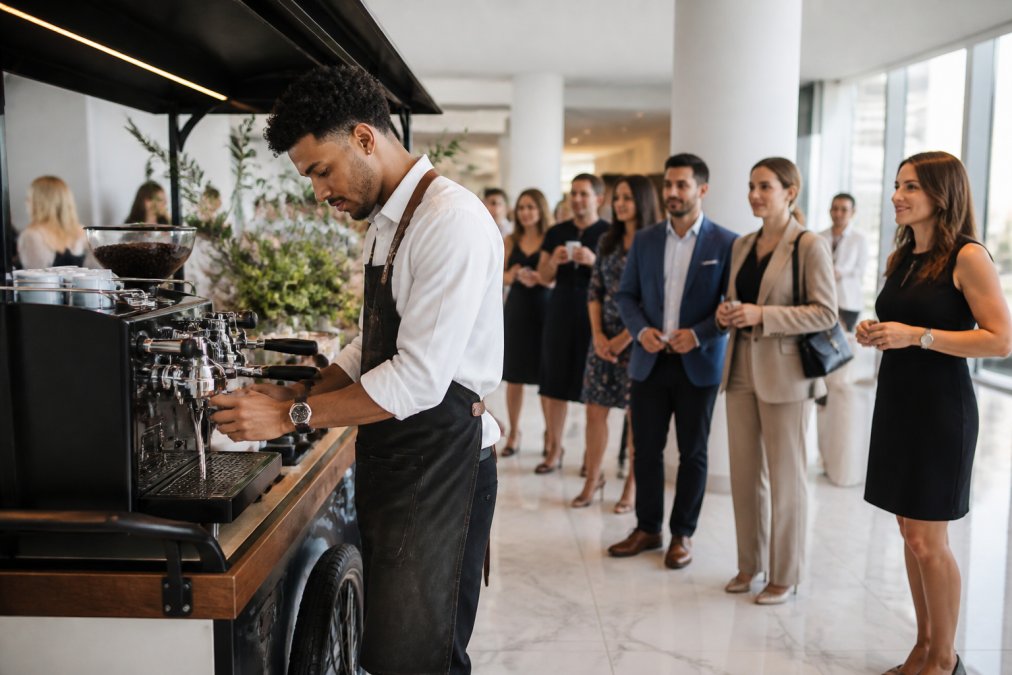
The shift is easy to explain. Planners now compete for attention, not just attendance. A coffee station that pulls fresh shots on site gives guests a reason to linger, talk, and post. At Colada Kulture Co., we’ve watched this play out across more than 35 weddings, corporate events, and private celebrations, and the pattern is consistent: the cart becomes the room’s center of gravity.
Below, we break down what actually drives the decision, from guest engagement and cost to power requirements and sustainability.
Guest Engagement and Satisfaction: The Experiential Marketing ROI
Experiential marketing works because it creates a physical touchpoint people participate in rather than watch. A mobile espresso cart fits that model perfectly: guests choose a drink, watch it being made, and walk away with something in hand. But for a marketing or events lead signing the invoice, “engagement” has to translate into numbers. Here is how to build that case.
The dwell-time mechanism
A coffee cart slows people down in a way a passed tray cannot. A guest who orders a drink stands at the cart for roughly two to four minutes, ordering, waiting, receiving, adding milk or sugar. That is a captive, happy audience. Multiply that by 150 guests and you have created several hundred minutes of intentional, in-person attention inside your event footprint.
The metrics worth tracking
You do not need a research budget to measure whether the cart earned its place. Most practitioners track a short list:
- Cups served. Your provider should report a final count. It is the cleanest proxy for participation.
- Average dwell time. Even a rough stopwatch sample during peak service gives you a defensible figure.
- Branded impressions. Cups served × average people who see a cup (the guest holding it, plus everyone they pass). A branded cup on a 200-guest event routinely travels through the entire room.
- User-generated content. Count event hashtag posts, tagged photos, and stories that feature the cart or cup. This is the number marketing teams care about most.
- Lead capture (for activations). If the cart doubles as a booth, a QR code on the cup or a sign-up card at pickup converts a beverage into a contact.
Why branded cups outperform signage
A banner sits in one place. A cup moves. Every branded cup is a small, portable billboard that a guest carries to their table, into the hallway, and out to the parking lot. At a product launch or conference, that reach is effectively free media, the marginal cost of the cup is already baked into the catering quote.
The photo-opportunity angle
A polished cart with a working barista is inherently photogenic. Guests photograph the pour, the cup, the cart, and themselves holding the drink. For brands, that is user-generated content at scale, content you did not have to art-direct, staff, or pay a photographer for. The practical move is to make the cart easy to photograph: good lighting, a clean backdrop, and a visible logo on the cart wrap and the cup.
The strongest ROI from a mobile espresso cart is not the coffee itself. It is the dwell time, the branded impressions, and the user-generated content the cart generates around it. Track cups served and tagged posts, and you have a defensible number to bring to next year’s budget conversation.
How to frame the ROI conversation
When you present the cart internally, lead with the outcome, not the beverage. “We served 240 drinks, generated an estimated 1,400 branded cup impressions, and collected 38 tagged posts” lands differently than “we hired a coffee cart.” The cart is the mechanism; the attention is the deliverable.
Mobile Coffee Catering Cost: What Drives Your Quote
Mobile coffee catering cost depends on guest count, service duration, menu complexity, staffing, and travel distance. Most providers quote per event rather than per cup, so the total reflects the scope of service, not just the volume of coffee poured.
Here’s what moves a quote up or down:
| Cost Driver | What It Covers | Typical Impact on Quote |
|---|---|---|
| Guest count | Cups served, milk and syrup volume | Higher count, higher total |
| Service duration | Barista hours on site | Longer blocks cost more |
| Menu complexity | Signature drinks, matcha, seasonal items | Specialty menus add labor |
| Staffing | Number of baristas for line speed | More staff, faster service |
| Travel and setup | Distance, loading access, setup time | Remote or difficult venues cost more |
| Branding | Custom cups, signage, cart wraps | One-time design and print cost |
The cheapest quote usually reflects a thinner package: fewer baristas, a limited menu, or a shorter service window. Compare quotes on what’s included, not just the bottom line.
How to Choose a Coffee Cart for Events: A 7-Point Checklist
Knowing how to choose a coffee cart for events comes down to verifying seven things before you sign. Run every provider through this list:
- Menu range: Does it cover espresso, matcha, cold brew, and seasonal drinks?
- Milk options: Are whole, oat, and almond milk included at no extra charge?
- Barista credentials: Are staff trained and experienced with high-volume service?
- Power and water: Can the cart run on your venue’s available power?
- Setup footprint: Does the cart fit your space and loading access?
- Branding options: Can cups, signage, or the cart itself carry your branding?
- References: Can they connect you with past clients?
Power, Plumbing, and Setup Footprint Requirements
Power and plumbing are the two requirements that sink events most often, and they’re the ones planners ask about last. Confirm them first.
Corporate Event Coffee Catering Ideas That Drive Brand Visibility
The branded activation. Custom cups, a cart wrap, and a signature drink named for your product. Guests carry your brand around the room.
Custom Branding and Menu Flexibility for Dietary Needs
Menu flexibility is where a good mobile espresso cart separates itself from a basic coffee urn. A full-service cart can typically offer espresso drinks, matcha, cold brew, and seasonal flavors, prepared hot or iced on request.
Name one signature drink after your event or product. Guests order it by name, which means they say your brand out loud, sometimes dozens of times in an evening.
Coffee Catering vs. Office Coffee Service: Which Fits Your Event?
Coffee catering and office coffee service solve different problems. Office coffee service is a recurring supply arrangement: equipment, beans, and maintenance delivered on a schedule for daily staff use. Coffee catering is a one-time, staffed service built around a specific event.
| Factor | Coffee Catering | Office Coffee Service |
|---|---|---|
| Format | Staffed cart, on-site baristas | Self-serve equipment |
| Duration | Single event, set hours | Ongoing daily use |
| Menu | Custom, specialty drinks | Standard coffee and pods |
| Branding | Custom cups and cart signage | Rarely branded |
| Best for | Weddings, launches, conferences | Daily office coffee |
Sustainability and Eco-Friendly Practices at Mobile Coffee Bars
Sustainability at a mobile coffee bar comes down to three choices: what you serve in, what you send to landfill, and what you leave behind. Compostable or recyclable cups, bulk milk service instead of single-serve pods, and careful water use all reduce an event’s footprint.
Compostable cups only break down in the right waste stream. If the venue sends everything to one bin, the compostable cup ends up in landfill anyway. Ask where the waste actually goes.
What to Do Next
Booking a cart is a decision about guest experience, not just beverage logistics. The planners who get the most from it treat the cart as part of the event design: they confirm power and setup early, choose a menu that fits their guests, and use branding to extend the moment past the room.
Frequently Asked Questions
What are the primary benefits of hiring a mobile espresso cart for events?
A mobile espresso cart adds a live, interactive beverage station that keeps guests lingering and talking. Unlike a silent coffee urn, guests watch their drinks being made, which creates a natural gathering point. For corporate events, the cart doubles as a branded physical touchpoint; for weddings, it adds a warm, premium detail guests remember. It also solves the problem of mediocre venue coffee without requiring you to staff or stock anything yourself.
How much do mobile espresso carts charge?
Pricing depends on guest count, service hours, menu complexity, and travel distance. Most vendors quote a flat event fee or a per-guest rate, and a standard service block runs three to four hours. Custom branding, specialty drinks, and additional baristas raise the total. Colada Kulture Co. provides event-based quotes, so request a quote with your date, venue, and headcount for exact pricing rather than relying on generic ranges.
Is a mobile espresso cart suitable for both indoor and outdoor events?
Yes, with the right planning. Indoor setups typically need a standard outlet, about 10 by 10 feet of floor space, and a clear path for the cart to reach the room. Outdoor events may require a generator or a nearby power drop, plus level ground and weather protection. Confirm your venue’s power requirements and loading dock access before booking, since high-rise offices and garden venues each present different logistical challenges.
How does professional coffee catering impact the overall event atmosphere?
A staffed espresso bar changes the rhythm of an event. Guests slow down, order something made just for them, and strike up conversations while they wait. That pause is what turns a crowded room into an actual gathering. Professional baristas also keep the line moving, so a 200-guest reception does not stall at the refreshment station. The result is a livelier room and a stronger guest experience overall.

