Last Updated: November 14, 2026
Quick Summary
To choose a mobile espresso bar vendor, first match the format to your event type, guest count, and venue, then compare itemized quotes and confirm backup plans in writing. Ask how many drinks per hour the team can serve, how many baristas stay for the full service window, and what happens if equipment fails.
- Write down your event type, guest count, service window, and whether it is indoors or outdoors before comparing vendors.
- Confirm venue loading zone dimensions, parking-to-setup distance, and electrical capacity before booking any unit.
- Compare quotes on normalized totals that include overtime, travel, add-ons, tax, and any service charge.
- Get the cancellation tiers, deposit refund rules, and weather or delay terms in writing before signing.
Table of Contents
- Start With Your Event Type, Guest Count and Setup Needs
- Questions to Ask a Coffee Cart Vendor Before You Book
- Understanding Mobile Coffee Cart Pricing and What Is Included
- Checking the Mobile Coffee Cart Menu, Dietary Needs and Staffing
- Booking Your Mobile Barista for Events With a Clear Contract
- Frequently Asked Questions
Start With Your Event Type, Guest Count and Setup Needs
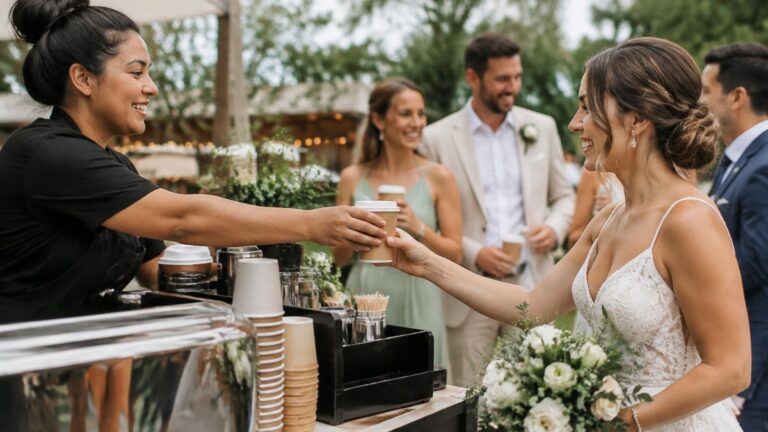
Choosing a mobile espresso bar vendor starts with three questions: your event type, expected guest count, and what setup your venue allows. A branded cart at a 75-person office lunch needs a very different plan than a two-hundred-guest wedding reception.
Write down the event type, guest count, service window, and whether it’s indoors or outdoors. Before committing to a unit, check the power requirements guide for what your setup will need. Those four details decide almost every other choice.
Mobile espresso bar, coffee cart or coffee truck
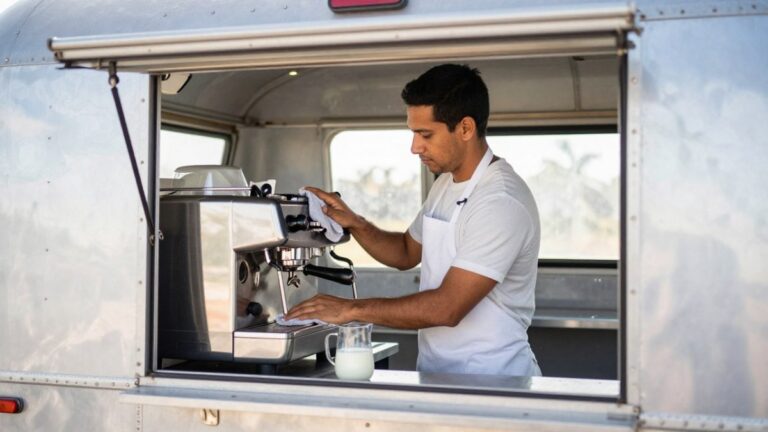
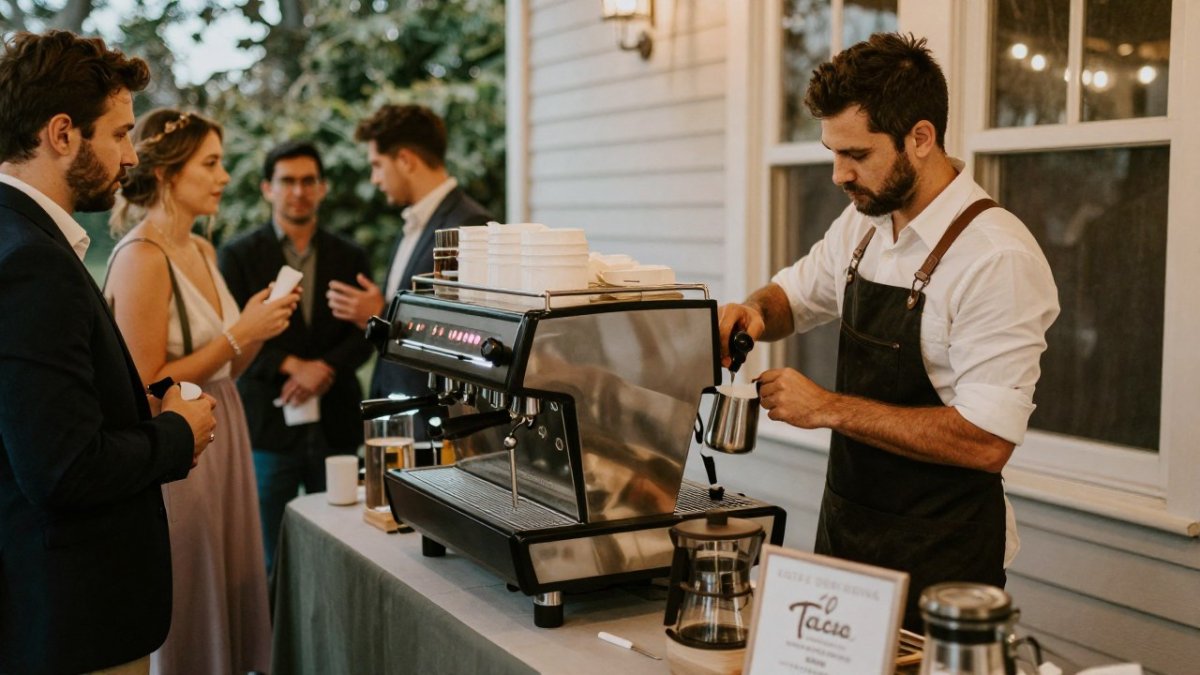
Three formats are common in the market. A mobile espresso bar is a compact counter setup that sits on a table or small platform. A coffee cart is a wheeled unit suited to indoor lobbies and brand activations. To weigh a cart against a truck on space, power, capacity and cost, see cart vs truck for private events.
Mobile espresso bar: Best for small corporate gatherings and intimate receptions with light guest flow.
Coffee cart: Best for product launches, lobby activations, and venues where a visible station matters.
Coffee truck or trailer: Best for large weddings, outdoor festivals, and high-volume events.
Ask each vendor which format they recommend for your guest count, and why. A vendor who pushes one format for every event may not be listening.
Venue footprint, power access and loading
Before booking, confirm how much space the unit needs and how it will reach your site. For guidance on space, power and setup in tight downtown sites, see the downtown venue catering guide.
Power is the other overlooked constraint. Ask what electrical capacity the equipment requires and whether the venue can supply it.
Watch out: a vendor who has never seen your venue may underestimate loading time. Get the setup and breakdown window in writing.
Questions to Ask a Coffee Cart Vendor Before You Book
The most useful questions test reliability, not style. Ask how many drinks the team serves per hour, how many baristas will be on site, and the backup plan if a machine fails. Ask for references from similar-sized events, and call them.
Use this checklist when you talk to any vendor:
- How many drinks per hour can the team serve at my guest count?
- How many baristas will be on site for the full service window?
- What is the backup plan if equipment fails?
- Can you provide references from similar events?
- Is the vendor licensed and insured for the venue?
- What happens if the event runs longer than scheduled?
- Who handles setup, breakdown and cleanup?
Use these questions to test a vendor’s reliability before you commit:
| Question | What it tests | Why it matters |
|---|---|---|
| How many drinks per hour can the team serve? | Capacity | Sets line length at your guest count |
| How many baristas stay for the full window? | Staffing | Keeps lines moving |
| What is the backup plan if equipment fails? | Contingency | Protects the service window |
| Can you provide references from similar events? | Track record | Confirms experience at your scale |
| Is the vendor licensed and insured for the venue? | Compliance | Venues often require proof |
| What happens if the event runs longer? | Overtime terms | Avoids surprise charges |
| Who handles setup, breakdown and cleanup? | Responsibilities | Clarifies labor and cleanup duties |
Understanding Mobile Coffee Cart Pricing and What Is Included
Mobile espresso bar pricing depends on several factors, and comparing quotes built on different assumptions can be misleading. Vendors commonly use one of three models.
The three common pricing models:
- Flat package: A set price for a defined service window (often two to four hours), a set guest count or drink cap, a specified menu, and a set number of baristas. Easiest to budget, but overage charges apply if you exceed the cap.
- Per-person or per-drink: A rate multiplied by expected guests or drinks served. Good for tight guest-count estimates, but the total moves if attendance runs high.
- Hourly plus minimum: An hourly rate with a minimum booking, plus staff and travel line items. Flexible for long events, but the minimum can make short windows expensive per hour.
Ask each vendor which model they use and request the quote broken into the same line items so you can compare totals.
Line items to require in every quote:
- Base service window and the exact overtime rate per additional hour or half-hour
- Number of baristas included and the cost of adding one
- Drink menu and any per-drink or per-guest cap, plus the overage rate
- Milk alternatives and whether they are included or an add-on
- Cups, lids, sleeves, napkins, stirrers, and any branded cup or signage cost
- Travel fee and how distance is calculated (flat zone fee vs. per-mile), plus parking or venue access fees
- Setup and breakdown time and whether it is billed
- Deposit amount, balance due date, and accepted payment methods
- Sales tax and whether the quote is tax-inclusive
- Gratuity expectations and whether a service charge is automatic
Normalize the total before you decide. Add base price, expected overtime, add-ons, travel, tax, and any service charge. Our article on hidden costs of hiring a mobile coffee bar shows which extras to look for beyond the advertised price.
Watch out: a quote that omits overtime, travel, or tax is not lower, it is incomplete.
Questions that expose hidden costs:
- What triggers an overtime charge, and what is the rate?
- Is there a minimum spend or minimum guest count, and what happens if attendance is lower?
- Does the travel fee change if the venue loading area is far from the setup spot?
- Are milk alternatives, custom syrups, or a signature drink included or extra?
- Is sales tax included in the quoted figure?
- What is the deposit, and is any portion refundable?
Get the answers in writing and attach the itemized quote to your comparison notes. Measured on the same line items, the decision becomes a straightforward cost-and-capability comparison.
Checking the Mobile Coffee Cart Menu, Dietary Needs and Staffing
The menu should match your guests and your brand.
Confirm the menu before the event, especially for specific needs. A brand activation may want a signature drink, while a wedding may need non-coffee options.
Ask directly about dietary needs and allergens: which milk alternatives are available, how drinks are prepared to avoid cross-contact, and whether allergens can be labeled on request.
Staffing shapes the guest experience as much as the menu. Ask how many baristas the team assigns per hundred guests. A well-staffed bar keeps lines moving; an understaffed one creates long waits.
Booking Your Mobile Barista for Events With a Clear Contract
Core terms to confirm in writing:
- Event date, arrival time, service window, and departure time
- Setup and breakdown windows, and who is responsible for each
- Drink menu, guest or drink cap, and overage terms
- Number of baristas and their scheduled hours
- Total price, itemized line items, deposit amount, and balance due date
- Payment methods and any late-payment terms
- Cancellation and rescheduling policy, including the refund schedule
- Weather, delay, and venue-access contingencies
- Insurance and licensing requirements
- Cleanup responsibilities and waste removal
Deposits and payment schedules. A deposit reserves the date, usually a percentage of the total with the balance due before the event.
Insurance and licensing. Many venues require a certificate of insurance naming the venue as additional insured, and some require a food-service permit.
Watch out: a contract silent on weather, delays, or equipment failure leaves the outcome to negotiation on event day.
A short pre-event confirmation checklist:
- Reconfirm arrival time, loading route, and on-site contact
- Confirm the power outlet location and capacity
- Confirm the final guest count and any menu changes
- Confirm the certificate of insurance has reached the venue
- Confirm the balance is paid and the receipt is on file
- Confirm the backup plan for equipment and staffing in one sentence
Booking a mobile barista is straightforward once the contract covers price, people, and contingencies.
Frequently Asked Questions
How much does mobile espresso bar catering cost?
Pricing depends on guest count, event length, drink menu, staffing, travel distance and whether you choose a cart or a larger trailer. Each event is different, so pricing is quoted individually. Ask every vendor for an itemized quote that lists staffing, equipment, setup and breakdown, supplies, and any add-ons such as branded cups. Visit the Colada Kulture Co. website to request a quote tailored to your date and headcount.
How far in advance should I book a mobile coffee cart?
Book as early as your date is firm, especially for weddings, product launches and peak seasons in South Florida, when vendors fill quickly. Confirm your venue’s access rules, power requirements and loading windows before you sign, because those details affect the setup plan. Ask the vendor how far ahead they need final guest counts and menu selections, and when any balance is due.
What should a mobile espresso bar catering contract include?
A solid contract names the event date, arrival and departure times, setup and breakdown windows, guest count, drink menu, staffing levels, power and water needs, and the total price with payment dates. It should also cover cancellation terms, rescheduling, what happens if the vendor is late, and liability and insurance coverage. Read it carefully and ask questions about anything that is vague before you sign.