Table of Contents
- Step 1: Assess Guest Count and Event Duration
- How Much Coffee for 100 Guests and Beyond
- Step 2: Understand Mobile Coffee Cart Rental Requirements
- Step 3: Design Corporate Event Coffee Menu Ideas
- Step 4: Plan Your Service Flow and Logistics
- Step 5: Hire Professional Baristas and Confirm Staffing
- Step 6: Establish Branding and Customization Options
- Step 7: Plan for Contingencies and Sustainability
Last Updated: August 20, 2026
Step 1: Assess Guest Count and Event Duration
The foundation of any successful corporate coffee catering plan starts with understanding who you’re serving and for how long. Guest count determines volume, while event duration shapes your service model. A 50-person morning briefing requires a completely different setup than a 200-person all-day conference.
Ask your event coordinator three critical questions: How many attendees will you have? What’s the event duration? When do you expect peak coffee demand? Most corporate events see spikes at arrival (first 30 minutes) and mid-afternoon (around 3 PM). A four-hour event with 100 guests might see 60 drinks in the first hour, then 15-20 drinks per hour afterward.
Document these details in writing before contacting a mobile coffee cart provider. This prevents mismatches between expectations and what arrives on event day.
How Much Coffee for 100 Guests and Beyond
The standard estimate is one drink per guest during a two-hour window, but corporate events typically see 60-75% of attendees ordering a beverage. A 100-person event usually needs 60-75 drinks prepared.
For longer events, adjust upward. An all-day conference with 100 guests might require 120-150 total drinks across the day. A half-day event needs 80-100 drinks. The key variable is event duration and whether attendees have other beverage options. If your event includes a full meal, coffee demand drops. If it’s a networking event with no food, coffee becomes a primary engagement point.
Communicate these estimates to your mobile coffee cart provider. They’ll confirm whether their equipment and staffing can handle your volume.
Step 2: Understand Mobile Coffee Cart Rental Requirements
A mobile coffee cart is a piece of commercial equipment with specific operational needs. Understanding these requirements prevents last-minute surprises.
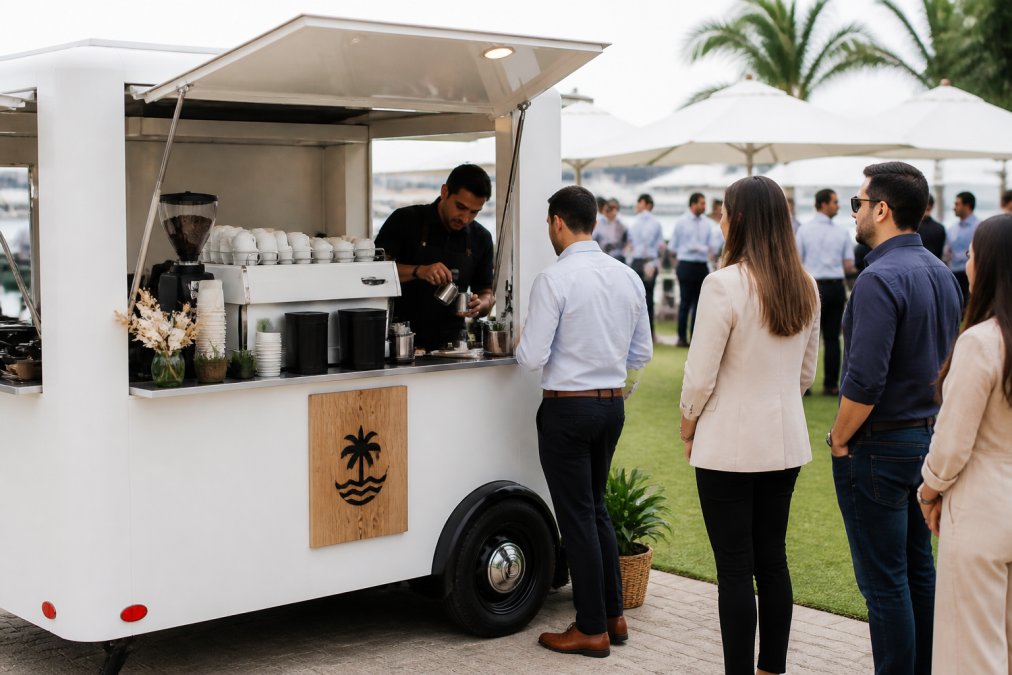
Mobile coffee carts come in two configurations: compact carts (ideal for 50-150 guests) and full trailers (best for 150+ guests). Compact carts are more flexible for venue access but have smaller capacity. Trailers offer higher throughput and menu variety but need dedicated parking and level ground.
Power and Water Needs
Most mobile coffee carts draw 20-30 amps at 120 volts minimum, with some commercial-grade machines requiring 30-50 amps. If your venue can’t supply that, you’ll need a generator, which adds cost and logistics.
Water is equally critical. A typical cart uses 3-5 gallons per hour during peak service. Some carts carry onboard tanks, while others require a direct water connection. Ask your provider whether they bring their own water supply or need you to arrange a hookup.
Check with your venue’s facilities team at least four weeks before your event. Ask: Where are the nearest electrical outlets? What amperage is available? Is there a water connection point? Document answers in writing to prevent setup failures.
Venue Layout and Load-In Access
The mobile coffee cart needs level ground, uneven surfaces cause espresso machines to malfunction and create safety hazards. It also needs adequate clearance for guests to approach safely, with a minimum 6-foot radius around the cart.
Load-in and load-out access is critical. How will the cart enter your venue? For ground-floor outdoor events, this is straightforward. For high-rise buildings, rooftop events, or venues with narrow hallways, access becomes complex. Some buildings have weight restrictions on elevators or loading dock limitations.
Visit your venue in person and walk the route the cart will take. Measure doorways, hallways, and parking areas. Share photos and measurements with your mobile coffee cart provider. They can tell you immediately if access is feasible.
Step 3: Design Corporate Event Coffee Menu Ideas
The menu is where corporate coffee catering becomes memorable. Start with essentials: espresso-based drinks (lattes, cappuccinos, macchiatos), cold brew, and black coffee. These cover 80% of preferences. Then add two signature options that differentiate your event, a branded "Launch Latte" for a product launch or matcha lattes for a wellness-focused event.
Milk options matter significantly. Offer whole milk, oat milk, and almond milk at minimum. At least 30-40% of guests will request non-dairy options. Ask your provider which alternatives they stock.
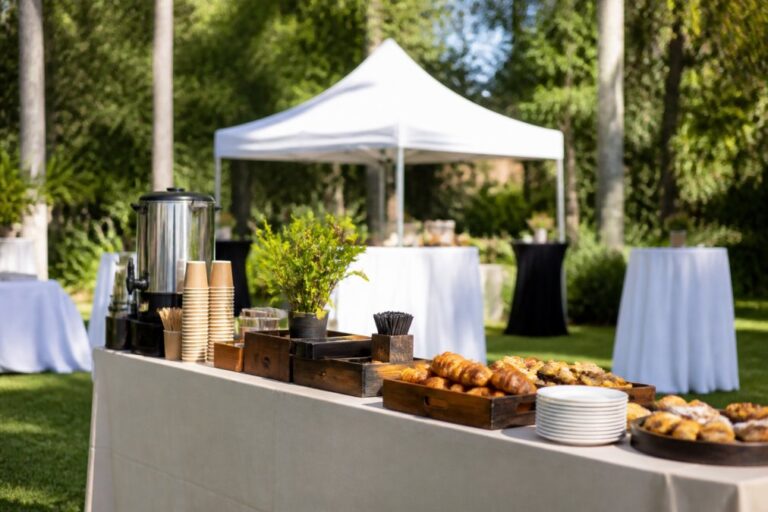
Pastries and small bites amplify the experience. A croissant, muffin, or biscotti paired with espresso transforms the coffee station into a mini-café. For mobile corporate events, grab-and-go pastries work better than sit-down items.
Address dietary restrictions. Ask your event coordinator about documented allergies or preferences. Sugar-free syrups, dairy-free options, and gluten-free pastries should be available if needed.
Step 4: Plan Your Service Flow and Logistics
Service flow determines whether your coffee station enhances or disrupts your event. Position the mobile coffee cart where it’s visible but not blocking traffic patterns. For corporate events, this usually means near the entrance or in a central lobby area. Avoid placing it in front of restrooms or emergency exits.
Guests should approach from one side of the cart, place orders, and exit from the opposite side. This prevents congestion and allows baristas to work efficiently. For more than 100 guests, deploy two baristas to reduce wait times. A single barista handles 40-60 drinks per hour comfortably; beyond that, service slows.
Peak demand typically occurs at 8-9 AM, 12-1 PM (if no lunch service), and 3-4 PM. Brief baristas on expected volume and ask them to prep extra shots and milk during these windows.
Communicate coffee service details to guests beforehand. Include it in your event agenda: "Coffee service available at [location] from [time] to [time]."
Step 5: Hire Professional Baristas and Confirm Staffing
The quality of your corporate coffee catering depends almost entirely on the barista. When booking with a mobile coffee cart provider, ask about barista qualifications. How long have they been making specialty coffee? Do they have certifications (SCA, Specialty Coffee Association)? Request specific names of baristas assigned to your event.
For events over 150 guests, confirm at least two baristas. Two baristas handle 80-120 drinks per hour comfortably. Three baristas are ideal for 200+ guest events.
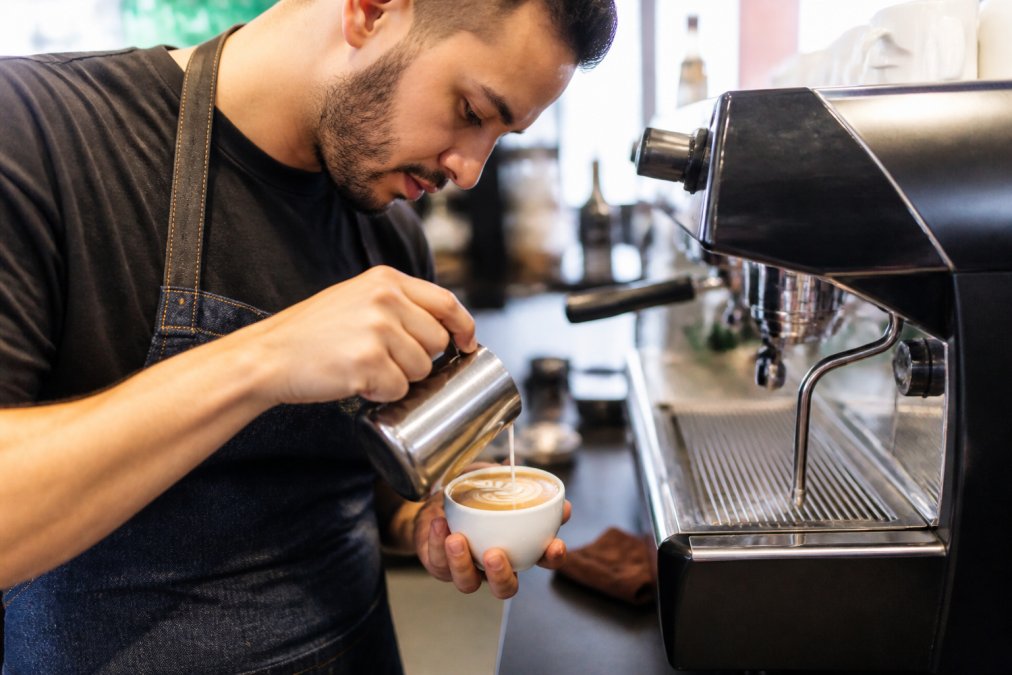
Schedule a pre-event call with your assigned barista team. Discuss your menu, expected volume, dietary restrictions, and special requests. A barista who knows your event’s context will anticipate needs and deliver better service.
Confirm arrival and setup times in writing. Most carts need 30-45 minutes to set up and test equipment. Request arrival 45 minutes before your event start time.
Step 6: Establish Branding and Customization Options
Corporate coffee catering is a branding opportunity. The mobile coffee cart can carry your company logo, event theme, or brand colors. Drinks can feature custom labels, branded cups, or signature syrups tied to your event.
Ask your provider what branding options they offer. Do they provide custom signage? Can they print branded cups with your logo? Can they create signature drinks named after your event? At Colada Kulture Co., we specialize in crafting custom specialty coffee experiences that reflect your brand identity, from espresso blends to matcha drinks to cold brew variations that feel uniquely yours.
Branded cups are worth the investment. They create a keepsake that guests take with them, extending your brand visibility beyond the event. Signature drinks tied to your event theme add personality and transform coffee service from transactional to memorable.
Discuss customization details at least three weeks before your event. Branded materials need lead time to produce, and signature drink recipes should be tested before event day.
Step 7: Plan for Contingencies and Sustainability
Even well-planned events encounter unexpected challenges. Ask your mobile coffee cart provider: What happens if the espresso machine breaks? Do they have backup equipment on-site? How do they handle unexpected high volume? A professional provider will have answers and backup machines.
Weather is critical for outdoor events. What’s your plan if it rains? Does the cart have weather protection? Can it be relocated quickly? For outdoor events, arrange a covered backup location or tent coverage.
Sustainability matters increasingly to corporate clients. Ask your provider about waste management. Do they use compostable cups and lids? How do they handle milk waste? Can they minimize single-use plastics?
For high-profile events, request proof of liability insurance and food safety certifications. Build a 10-15% buffer into your guest count estimate to account for underestimation and repeat customers.
Schedule a pre-event walkthrough with your provider and venue coordinator. Walk the setup location, confirm power and water access, review the service timeline, and address questions. This 30-minute conversation prevents miscommunication.
Planning corporate coffee catering requires attention to logistics, staffing, and experience design. When done well, a mobile coffee cart becomes the centerpiece of your event, creating a memorable experience that guests remember long after. Colada Kulture Co. specializes in turning these logistics into seamless, beautifully executed specialty coffee experiences. Ready to elevate your next corporate event? Request a quote and let’s design something unforgettable for your guests.
| Planning Element | Key Consideration | Impact on Success |
|---|---|---|
| Guest count and duration | Determines volume and staffing needs | Prevents undersized or overstaffed setup |
| Power and water access | Essential utilities for cart operation | Avoids last-minute generator/hookup costs |
| Venue layout and load-in | Physical space and equipment access | Ensures smooth setup and safe guest flow |
| Menu design | Reflects brand and accommodates preferences | Creates memorable, shareable experience |
| Barista qualifications | Skill level and experience | Guarantees consistent quality under pressure |
| Branding options | Custom cups, signage, signature drinks | Extends brand visibility and guest engagement |
| Contingency planning | Equipment backup and weather protection | Maintains service reliability if issues arise |
Frequently Asked Questions
How much coffee do I need for 100 guests at a corporate event?
Plan for 1.5 to 2 cups per guest during a 2-hour event, which means 150-200 cups total. For longer events (4+ hours), increase to 2.5 cups per person. Account for peak demand in the first 30 minutes and slower service toward the end. A professional mobile coffee cart with trained baristas can typically serve 80-120 drinks per hour, so staffing and equipment must match your guest count and event duration.
What are the key mobile coffee cart rental requirements I need to check with my venue?
Verify power availability (most carts require 20-30 amps), water access, and load-in/load-out space and timing. Check venue restrictions on cart placement, whether they allow external vendors, and if parking is available near the service area. Confirm floor weight capacity if your event is indoors, and ask about weather protection needs. High-rise office buildings may have strict loading dock hours and electrical requirements that affect setup feasibility.
What specialty drinks should I include in my corporate event coffee menu?
Offer espresso-based drinks (lattes, cappuccinos, Americanos), cold brew, and non-coffee options like matcha lattes to accommodate all preferences. Include dairy alternatives such as oat and almond milk. Consider seasonal or branded specialty drinks that align with your event theme or company identity. For product launches and brand activations, custom-named drinks create memorable experiences and social media engagement. Confirm dietary restrictions and preferences with your event planner beforehand.
How far in advance should I book a mobile coffee cart for my corporate event?
Book 4-8 weeks ahead for premium services, especially during peak seasons. Provide your guest count, event date, venue address, power and water details, and desired menu customizations when requesting a quote. Confirm staffing, load-in timing, service duration, and any branding or signage requirements. Request references from other corporate events or weddings the vendor has served to verify reliability and quality.
This article was written using GrandRanker