
Table of Contents
- Understanding Electrical Load for Food Truck Catering
- Food Truck Electrical Load Calculation
- Food Truck Generator Sizing Guide
- Shore Power vs. Generator for Food Trucks
- NEMA Plugs, Amperage, and Voltage Standards
- Safety, Compliance, and Power Cord Gauge Selection
- Managing Power Load Balance During Multi-Appliance Events
- Conclusion
Last Updated: August 16, 2026
Managing electrical power for a food truck catering operation is fundamentally about matching your equipment’s demands to your available power supply. Understanding how to manage catering power requirements prevents equipment failures, fire hazards, and service interruptions mid-event.
At Colada Kulture Co., we’ve set up mobile coffee carts at events across South Florida. The power management piece separates smooth operations from logistical nightmares. This guide walks you through calculating electrical load, selecting the right generator or shore power setup, understanding NEMA connectors, and keeping everything running safely when multiple appliances demand power at once.
Understanding Electrical Load for Food Truck Catering
Electrical load is the total amount of electrical power your equipment draws when operating. Underestimate it, and your generator shuts down mid-service. Overestimate it, and you’re paying for unused capacity.
Common Equipment and Power Demands
A typical catering food truck runs several high-demand appliances simultaneously. The challenge isn’t identifying individual equipment, it’s understanding that not everything runs at full capacity all the time. An espresso machine heats water constantly but only extracts shots intermittently. A refrigerator cycles on and off based on internal temperature.
Common catering equipment wattage ranges:
- Espresso machine: 2,000-4,500 watts
- Commercial refrigerator: 600-1,200 watts
- Griddle or flat-top: 3,000-6,000 watts
- Microwave oven: 1,000-1,500 watts
- Beverage warmer: 500-1,500 watts
- Point-of-sale system and lighting: 200-500 watts
The actual load your truck draws depends on which equipment runs simultaneously and at what intensity.
Continuous Load vs. Surge Capacity
Continuous load is what your equipment draws during normal operation over extended periods. Surge capacity is the temporary spike when equipment first powers on.
An espresso machine’s heating element might draw 3,500 watts continuously once warmed up, but spike to 4,200 watts when first powered on. A refrigerator compressor creates a similar surge when the thermostat triggers it to cycle on.
Your power source must handle both. A generator rated for 7,000 watts of continuous power might only deliver 8,500 watts of surge capacity. If your equipment’s combined surge load exceeds that rating, the generator shuts down or the circuit breaker trips.
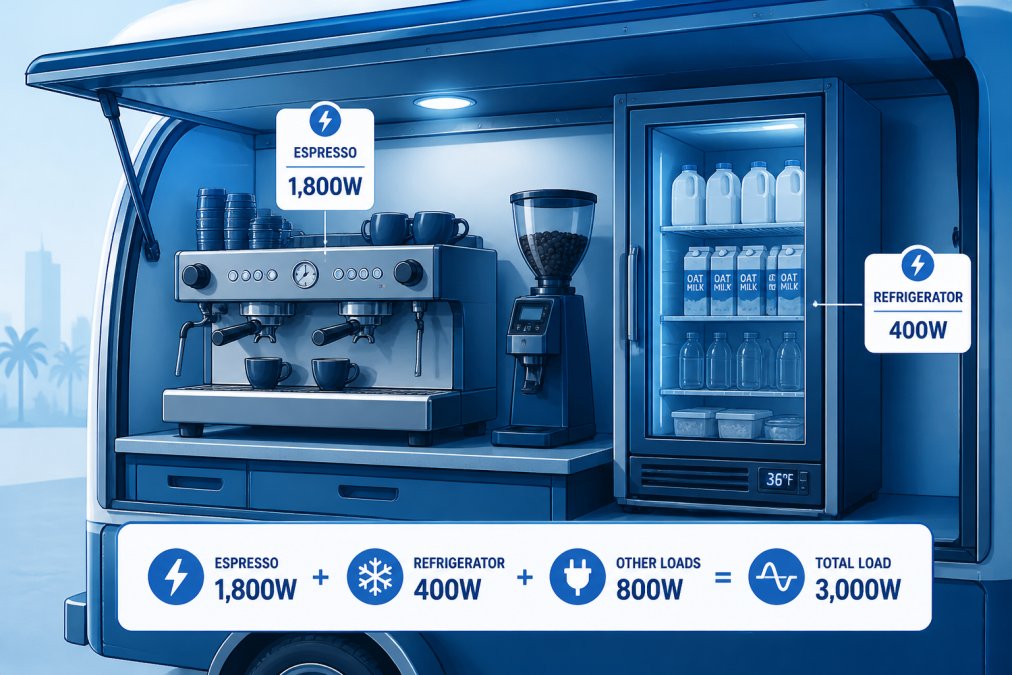
Food Truck Electrical Load Calculation
Calculating your actual electrical load requires listing every appliance, its wattage, and how often it runs at full power during peak service.
Step-by-Step Wattage Assessment
Start by documenting every electrical device in your truck. Find the wattage on the equipment’s nameplate or manual. If unavailable, multiply voltage by amperage: 120 volts × 10 amps = 1,200 watts.
List equipment in two categories: always-on and intermittent. Always-on equipment includes refrigeration and point-of-sale systems. Intermittent equipment includes the espresso machine, griddle, and beverage warmers.
| Equipment | Wattage | Always-On | Intermittent |
|---|---|---|---|
| Espresso Machine | 3,500 | No | Yes |
| Refrigerator | 900 | Yes | No |
| Griddle | 4,500 | No | Yes |
| POS System | 200 | Yes | No |
| Lighting | 300 | Partial | Yes |
| Total | 9,400 | 1,100 | 8,300 |
Your always-on load is 1,100 watts. Your intermittent load is 8,300 watts, added when service starts.
Accounting for Peak Usage Periods
Peak usage periods are when your truck draws maximum power. During peak periods, assume multiple appliances run simultaneously at full capacity. Your espresso machine pulls 3,500 watts while the griddle pulls 4,500 watts while the refrigerator cycles on. That’s 8,000 watts plus your always-on load of 1,100 watts = 9,100 watts total.
Add a 20% safety margin to account for surge capacity and unexpected simultaneous usage. Multiply your peak load by 1.2: 9,100 × 1.2 = 10,920 watts. This is your target generator or shore power capacity.
Food Truck Generator Sizing Guide
Once you know your electrical load, you can size a generator appropriately. A generator undersized for your needs will shut down under load.
Matching Generator Capacity to Your Setup
Your target capacity from the load calculation is your starting point. If you calculated 10,920 watts, you need a generator rated for at least that continuous output.
Generators are rated by continuous wattage (what they can sustain indefinitely) and surge wattage (what they can deliver for brief periods). A 12,000-watt continuous generator might have a 14,000-watt surge rating.
For catering power food trucks, choose a generator with at least 20% more continuous capacity than your peak load calculation. If your peak load is 10,920 watts, target a 13,000-watt continuous generator. This gives you headroom for unexpected loads and equipment degradation over time.
Portable generators suitable for food truck catering typically range from 6,000 to 15,000 watts continuous. Consider fuel type and runtime. Gasoline generators are portable and affordable but require frequent refueling during long events. Propane generators run cleaner and can use larger external tanks for extended runtime. Diesel generators offer the best fuel efficiency for high-load, long-duration events.
Inverter Generators vs. Standard Models
Inverter generators produce cleaner, more stable electrical output than standard generators. They use electronic regulation to maintain consistent voltage and frequency, which is critical for sensitive equipment like espresso machines and point-of-sale systems.
Standard generators produce raw AC power with voltage fluctuations. This works fine for griddles and basic equipment but can damage sensitive electronics over time. An espresso machine’s control board or a credit card reader can fail prematurely under unstable power.
Inverter generators cost 30-50% more than standard models of equivalent capacity, but they’re worth the investment for catering operations. Your equipment will operate more reliably and you’ll avoid failures during events.
Shore Power vs. Generator for Food Trucks
Many catering venues offer electrical service through shore power connections. Shore power eliminates the need for onboard generator fuel, reduces noise, and provides unlimited runtime.
When to Use Shore Power at Events
Shore power is ideal when your venue provides a dedicated electrical service at the truck’s parking location. Wedding venues, corporate campuses, and established event spaces often have outdoor electrical pedestals or indoor outlets rated for commercial equipment.
Before relying on shore power, verify the service capacity with the venue. Ask specifically for the amperage available and whether it’s 120V single-phase or 240V three-phase service. A standard residential outlet (120V, 15-20 amps) provides only 1,800-2,400 watts, barely enough for a single espresso machine. A 50-amp 240V service provides 12,000 watts, which handles most catering setups.
Transitioning Between Power Sources
Some events require transitioning from generator to shore power or vice versa. This transition must happen cleanly without dropping power to sensitive equipment.
A transfer switch handles this automatically. It monitors both power sources and switches between them when one fails or when you manually select a different source. Without a transfer switch, you’d have to manually unplug from one source and plug into another, risking equipment damage and service interruption.
For catering power food trucks, install a transfer switch if you plan to use both generators and shore power at different events. Manual transfer switches are affordable ($200-500) and suitable for food trucks.
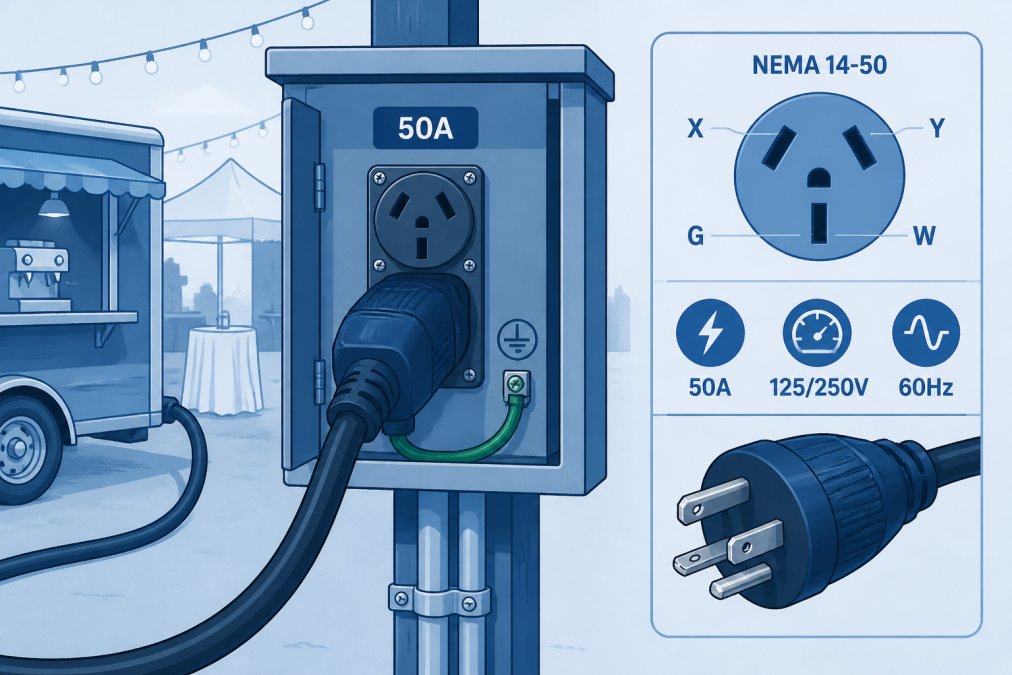
NEMA Plugs, Amperage, and Voltage Standards
NEMA (National Electrical Manufacturers Association) defines standard electrical connectors used in North America. Understanding NEMA ratings ensures your food truck’s power cord matches the available electrical service.
Standard Connector Types for Catering Equipment
NEMA 5-15 is the standard household outlet: 120V, 15 amps, 1,800 watts maximum. Unsuitable for catering equipment beyond a small beverage warmer.
NEMA 5-20 is a 120V, 20-amp outlet: 2,400 watts. Still limited for commercial catering.
NEMA 14-30 is 240V, 30 amps: 7,200 watts. Common at RV parks and some outdoor event venues.
NEMA 14-50 is 240V, 50 amps: 12,000 watts. The standard for food truck catering. Provides adequate capacity for espresso machines, refrigeration, griddles, and POS systems simultaneously. Most commercial event venues with outdoor electrical service offer NEMA 14-50 connections.
Your food truck should be equipped with a NEMA 14-50 inlet on its exterior. Keep a heavy-gauge power cord rated for 50 amps in your truck. A 50-amp cord rated for 100 feet of distance is standard.
120V vs. 240V Power Distribution
120V single-phase power is standard residential service. It’s available everywhere but limits capacity to about 2,400 watts per circuit.
240V three-phase power is standard commercial service. It delivers double the voltage, allowing the same amperage to deliver double the power. A 50-amp 240V service delivers 12,000 watts. A 50-amp 120V service delivers 6,000 watts.
For catering power food trucks, 240V is essential. Your onboard electrical panel should have a 240V main breaker and separate circuits for high-load equipment. The espresso machine and griddle should each have dedicated 240V circuits. Lighting, POS system, and auxiliary equipment can share 120V circuits.
Safety, Compliance, and Power Cord Gauge Selection
Electrical safety in a food truck catering operation isn’t optional. Fire codes, health permits, and electrical codes all govern how you manage power.
Fire Safety and Electrical Code Requirements
Local fire codes regulate electrical installations in mobile food service units. Most jurisdictions require that food trucks meet the National Electrical Code (NEC) standards. The NEC specifies minimum wire gauge, circuit protection, grounding, and overcurrent protection for mobile equipment.
A fire marshal inspection may occur before your first event at a venue. They’ll verify that your electrical system is properly grounded, that overcurrent protection is adequate, and that power cords aren’t damaged or improperly routed.
Common fire code violations include undersized power cords, daisy-chained extension cords, wet or damaged power cords, inadequate grounding, and overloaded circuits. Avoid these by installing a proper electrical system from the start. Hire a licensed electrician to install your food truck’s main panel, circuit breakers, and outlets.
GFCI Protection and Grounding
GFCI (Ground Fault Circuit Interrupter) protection is required for all outlets in wet locations. A food truck’s counter and sink area qualifies as a wet location. GFCI outlets detect ground faults and shut off power within milliseconds, preventing electrocution.
Grounding connects your electrical system to the earth, providing a safe path for fault current. All outlets, appliances, and metal frames must be properly grounded. Use grounded power cords, never defeat the ground pin by using an adapter.
Choosing the Right Power Cord Gauge
Power cord gauge (wire thickness) determines how much current it can safely carry without overheating. Undersized cords create fire hazard.
For a 50-amp service (NEMA 14-50), use 6 AWG (American Wire Gauge) copper wire minimum. For distances up to 50 feet, 6 AWG is adequate. For distances of 50-100 feet, use 4 AWG. For distances over 100 feet, use 2 AWG.
Never use extension cords rated for household use for your food truck’s main power. These cords overheat under sustained 40-50 amp load. Use marine-grade or RV-rated cords designed for continuous high-current draw.
Managing Power Load Balance During Multi-Appliance Events
When multiple appliances run simultaneously, managing power load balance prevents breaker trips and equipment shutdowns.
Prioritizing Equipment and Staggering Usage
During peak service periods, you can’t run everything at full power simultaneously. Prioritize equipment by importance to guest experience.
Priority 1: Espresso machine and beverage brewing. Guests came for coffee.
Priority 2: Refrigeration. Food safety depends on this.
Priority 3: Point-of-sale system and payment processing.
Priority 4: Griddle or food warming equipment.
Priority 5: Lighting and auxiliary equipment.
During peak periods, avoid running the griddle and espresso machine simultaneously if your available power is tight. Brew espresso for 10 minutes, then pause brewing while the griddle handles food prep. This requires communication with your service team before the event.
Monitoring Real-Time Power Consumption
Modern generators and electrical panels include digital displays showing real-time power consumption. Check these displays during your event setup and periodically during service.
If you’re running at 80% of available capacity during normal service, you have only 20% headroom for unexpected loads. Aim to run at 60-70% of available capacity during peak periods. If you’re consistently exceeding 80% of capacity, you’re undersized and need a larger power source for future events.
Managing electrical power for food truck catering requires understanding your equipment’s demands, sizing your power source appropriately, and maintaining discipline during service. The difference between a smooth event and a disaster often comes down to whether you calculated your load correctly and planned for peak usage periods. At Colada Kulture Co., we’ve learned that getting this right from the start prevents the stress of mid-event power failures and ensures your guests experience the quality service they expect. Request a quote and let our team help you plan the electrical infrastructure for your next event.
Frequently Asked Questions
How many amps does a food truck catering setup typically need?
Most mobile catering operations for coffee and light food service require 30-50 amps at 120/240V. A typical espresso machine draws 15-20 amps, refrigeration adds 10-15 amps, and additional equipment like grills or warmers can push you toward 50 amps. Calculate your specific load by listing each appliance's wattage and converting to amps using the formula: Amps = Watts ÷ Volts. This determines whether you need a 30-amp or 50-amp service, often called a NEMA 14-30 or NEMA 14-50 connection.
What's the difference between shore power and a generator for food truck catering?
Shore power connects your food truck directly to a venue's electrical panel via a transfer switch and power cord, providing unlimited power without fuel costs or noise. Generators offer independence but require fuel, produce noise and emissions, and have capacity limits. For events at fixed venues with electrical infrastructure, shore power is more reliable and cost-effective. For remote locations or mobile setups, a properly sized generator (typically 7-15 kW for catering) is essential. Many operations use both: shore power when available, generators as backup.
How do I calculate the total wattage my catering operation needs?
List every appliance you'll run simultaneously: espresso machine (3,000-4,000W), refrigerator (600-1,200W), water heater (4,000-5,500W), grinder (400-600W), and point-of-sale systems (200-300W). Add 20% for surge capacity when motors start. For example: 4,000 + 1,000 + 4,500 + 500 + 250 + 20% buffer = approximately 10,500 watts or 44 amps at 240V. This calculation determines your generator size and whether your venue's electrical service can support your setup.
What safety regulations apply to food truck electrical systems?
Food trucks must comply with National Electrical Code (NEC) standards, including proper grounding, GFCI protection for all circuits, correctly sized circuit breakers, and power cord gauges rated for the amperage being drawn. Local fire departments enforce health permit requirements that include electrical safety inspections. Transfer switches must be installed to prevent backfeeding when switching between shore power and generators. Improper wiring or overloaded circuits create fire hazards. Always have a licensed electrician inspect your setup before operating, especially at new venues.
This article was written using GrandRanker