
Table of Contents
- Why Mobile Coffee Carts Are Reshaping Event Beverage Catering in 2026
- Mobile Coffee Cart Rental Cost: What Actually Drives the Price
- How to Plan Coffee Service for Weddings Without the Chaos
- Hiring Professional Baristas for Events: What Separates Good From Great
- Calculating Beverage Quantities per Guest (The Formula Most Planners Skip)
- Permits, Liquor Licensing, and Alcohol Liability for Mobile Bars
- Alcohol-Free and Mocktail Trends Reshaping Event Beverage Catering Menus
- Conclusion: Building a Beverage Experience Guests Actually Remember
- Frequently Asked Questions
Last Updated: October 3, 2026
Why Mobile Coffee Carts Are Reshaping Event Beverage Catering in 2026
Event beverage catering has quietly undergone a reset. The open bar still has its place, but a growing share of couples, corporate planners, and brand teams now build the drink program around a single high-engagement station: the mobile coffee cart. According to IBISWorld’s coffee and snack bar industry overview, specialty coffee demand has climbed steadily as consumers treat espresso drinks as an everyday ritual rather than an occasional treat.
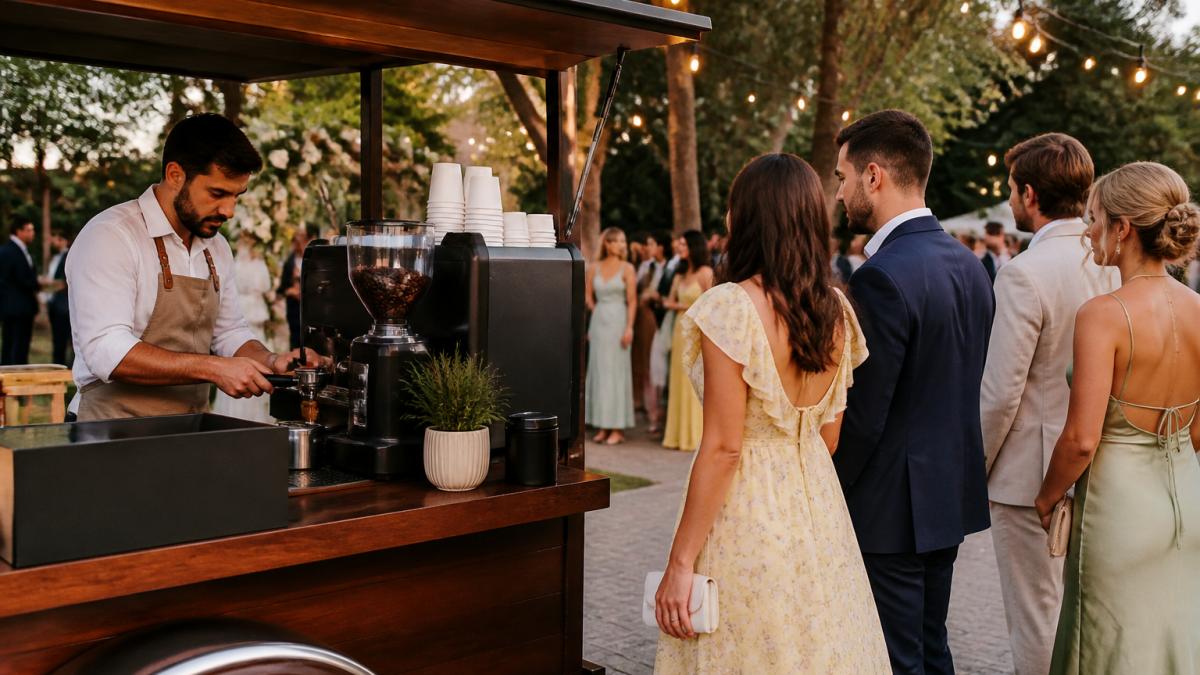
The Shift From Traditional Bars to Specialty Coffee Experiences
Mobile coffee cart catering is the practice of bringing a full espresso setup, trained baristas, and a customized drink menu directly to an event venue, preparing each beverage to order on site. Unlike drop-off thermos service, a cart is a live station with its own bar setup, glassware, and staff.
Three forces drive the change:
- Guests drink less alcohol but still want a premium, made-to-order experience
- Coffee stations photograph well, which matters for brand activations and social sharing
- A cart serves guests across the whole event, not just the cocktail hour
The result is that event beverage catering now competes on experience, not just volume.
The strongest beverage programs in 2026 pair one anchor station (coffee or cocktails) with a lighter secondary option.
Mobile Coffee Cart Rental Cost: What Actually Drives the Price
Mobile coffee cart rental cost depends on four variables: guest count, service duration, menu complexity, and venue logistics. There is no single list price, because a 75-guest office appreciation and a 300-guest gala require different staffing, equipment, and setup time.
Guest Count, Service Duration, and Menu Complexity
Here is how each factor moves the number:
| Cost Driver | What It Changes | Planner’s Rule of Thumb |
|---|---|---|
| Guest count | Cups served, milk volume, barista count | Add one barista per 60-75 guests |
| Service duration | Staff hours, refills, machine uptime | Two hours covers most receptions |
| Menu complexity | Syrups, alt milks, signature drinks, matcha | Cap the menu at 6-8 drinks |
| Venue logistics | Power, water, load-in distance, permits | Confirm access before booking |
A common mistake is shopping on headline rate alone. Ask every vendor three questions: how many baristas, how many group heads, and what is the load-in window.
If a venue has strict power requirements or limited loading dock access, confirm the cart’s electrical draw and footprint before signing. A cart that cannot reach the service area turns a premium experience into a hallway problem.
How to Plan Coffee Service for Weddings Without the Chaos
Learning how to plan coffee service for weddings comes down to timing. The cart should open when guests need it most, not when it suits the vendor.
Timing, Venue Logistics, and Guest Flow
A workable wedding coffee timeline:
- Confirm the venue’s power, water, and load-in access during booking
- Schedule setup 60-90 minutes before guest arrival
- Open the cart during cocktail hour or immediately after dinner
- Position it away from the bar to split traffic, not stack it
- Keep a second service window open during late-night dancing
Guest flow matters more than most planners expect. Two short lines move faster than one long one, and a cart placed near the exit catches guests on their way out. For a full breakdown of venue requirements, the U.S. Small Business Administration’s event and vendor guidance is a useful starting reference for contracts and logistics.
Hiring Professional Baristas for Events: What Separates Good From Great
Hiring professional baristas for events is a throughput problem disguised as a personality question. A charming barista who pulls 40 drinks an hour will still bury a 200-guest reception, and a fast barista who never makes eye contact turns a premium station into a vending machine. Vendors who get repeat bookings solve for both with numbers, not vibes.
The Staffing Math Most Quotes Hide
A single barista on a two-group espresso machine can realistically produce 50-70 milk-based drinks per hour once you account for dialing in, milk steaming, and cup handling. A single-group or prosumer machine drops that to roughly 25-35 drinks per hour.
A workable staffing formula:
- One barista per 60-75 guests for a two-hour window on a two-group machine
- Add a floater (runner) once you pass 150 guests to restock milk, cups, and syrups
- Add a second barista, not a second machine, when the bottleneck is milk steaming
That setup and breakdown time is billable labor, planners who forget it get surprised by the final invoice.
What to Ask Before You Book
Five questions separate a real event operation from a weekend side hustle:
- How many group heads on the machine, and what is the model?
- How many baristas for my guest count, and is the floater included or an add-on?
- What is the load-in window, and does the quote include setup and breakdown labor?
- Who dials in the grinder, and when, before doors or during service?
- Can you share two references from events within the last six months at a similar guest count?
The answers tell you whether the vendor has run a line at your size.
Scheduling, Breaks, and the Labor Reality
For service longer than four hours, plan a second barista to rotate in or split the shift. Confirm whether the vendor classifies staff as employees or independent contractors, that affects who carries workers’ compensation exposure if someone is injured on site.
Ask for a certificate of insurance that lists general liability limits and, if alcohol is served, liquor liability. A vendor who can produce it in minutes is a vendor who has done this before.
Training and Guest Interaction Are Separate Skills
The best event baristas do three things consistently:
- Dial in the grinder before doors open, not during the first rush
- Batch milk steaming during peak windows so shots and milk finish together
- Reset the bar every 20 minutes, wipe, restock, empty the knock box, so the station never looks abandoned
Speed and warmth are trainable, but trained differently. Ask how the vendor onboards staff and whether they run practice services before a live event.
Staff to the drink, not the guest. Match the staffing to the expected drink volume, not the headcount on the invite list.
Calculating Beverage Quantities per Guest (The Formula Most Planners Skip)
Calculating beverage quantities per guest separates a smooth event from a mid-reception supply run. The working formula for coffee service is roughly 1.2 to 1.5 drinks per guest for a two-hour window, adjusted up for morning events and down for late-evening service.
For a 150-guest reception, plan for 180 to 225 drinks. That translates to:
- 8-10 gallons of milk, split across whole, oat, and almond
- 3-4 pounds of coffee beans
- One barista per 60-75 guests
Alcohol-free events and morning corporate gatherings push those numbers higher. Evening galas with a full bar push them lower. Build in a 10% buffer and you will rarely run short.
Permits, Liquor Licensing, and Alcohol Liability for Mobile Bars
Permits and liquor licensing are where mobile bar plans stall. If a cart serves alcohol, the operator typically needs a liquor license for the jurisdiction, and the venue may require its own permit or insurance certificate.
For coffee-only service, requirements are lighter but not zero: health department rules on food and beverage handling still apply, and some venues ask for a certificate of insurance regardless of the menu.
Never assume a venue’s existing liquor license covers an outside vendor. If the cart serves alcohol under someone else’s license, the liability can land on the host.
Alcohol-Free and Mocktail Trends Reshaping Event Beverage Catering Menus
Alcohol-free menus have moved from an afterthought to a design choice, and vendors winning corporate and wedding bookings in 2026 treat zero-proof as a full program, not a pitcher of lemonade on the side. The sober-curious shift is real: more guests either do not drink or are cutting back, and a host offering only water and soda reads as behind the times.
Building a Zero-Proof Program That Reads as Intentional
A zero-proof program works when it mirrors the structure of a cocktail menu: a signature, a couple of classics, and a seasonal. Three formats that hold up across event types:
- Espresso-forward: cortados, flat whites, shaken espresso mocktails, espresso tonic
- Tea and botanical: iced matcha, hojicha, butterfly pea and citrus infusions, herbal spritzes
- Seasonal signatures: spiced cold brew in fall, citrus espresso in summer, lavender honey in spring
The mistake is treating zero-proof as a subtraction. A guest ordering a zero-proof drink should get the same glassware, garnish, and presentation as a cocktail guest, that parity makes the program feel designed rather than defaulted.
Cost and Quantity: Zero-Proof Is Not Automatically Cheaper
Planners often assume dropping alcohol cuts the beverage budget. It can, but not always. A well-built zero-proof menu uses fresh citrus, house syrups, premium mixers, and specialty coffee, and those inputs carry real cost.
The quantity math differs too. Zero-proof guests tend to drink more total beverages than alcohol drinkers because they are not pacing themselves. For a two-hour window, plan 1.5 to 2 zero-proof drinks per non-drinking guest, versus roughly 1 to 1.5 for a guest with a full bar available.
Sustainability as a Menu Decision, Not a Slogan
Sustainability ties directly into the zero-proof shift, and it is where the strongest vendors differentiate. Concrete practices that hold up to a client’s questions:
- Reusable glassware and metal straws instead of single-use plastic
- Compostable cups and lids where reusable is not feasible, with a clearly marked bin
- Locally sourced milk and produce to cut transport emissions and support regional suppliers
If a client asks for proof, point to third-party certifications rather than vendor claims. A vendor who can name the certification behind a claim has actually built the practice.
Compostable cups only compost if they reach a commercial facility. Ask the vendor where the waste actually goes before you put sustainability in the event brief.
Pairing Zero-Proof With Coffee and Cocktail Stations
The strongest beverage programs do not force guests to choose between an alcohol bar and a coffee cart. They run both, with the zero-proof menu bridging them: a cocktail for one guest, an espresso mocktail for another, a botanical spritz for a third. That range is what guests remember, and what keeps the host from fielding questions about whether there is anything besides water.
Treat zero-proof as a third station, not a substitute. The hosts who get the most compliments on their beverage program are the ones who gave non-drinkers the same menu design attention as drinkers.
Conclusion: Building a Beverage Experience Guests Actually Remember
The hardest part of event beverage catering is not the coffee. It is matching the station, staffing, and menu to the room you are actually serving.
That is the work Colada Kulture Co. does. We bring mobile coffee cart and trailer options, customizable packages, and a drink menu spanning espresso, matcha, and seasonal flavors, with whole, oat, and almond milk included.
Request a quote from Colada Kulture Co. and build a beverage experience your guests bring up long after the last cup.
Frequently Asked Questions
How much does event beverage catering cost for a 50-person event?
Pricing depends on guest count, service duration, menu complexity, and whether you need staffing and rentals. Colada Kulture Co. provides custom quotes based on your specific event details, so request a quote with your date and guest count for accurate pricing.
What is the difference between full-service bar catering and coffee cart services?
Full-service bar catering includes alcohol, bartenders, liquor licensing, and alcohol liability insurance, which adds significant cost and regulatory requirements. Coffee cart services focus on espresso, matcha, cold brew, and specialty drinks with trained baristas, glassware, and on-site preparation. Many events now offer both: a coffee cart during cocktail hour and a bar later in the evening.
How do I calculate the amount of coffee and beverages needed for an event?
A practical starting point is 1.5 to 2 drinks per guest for a 2-hour service window, and 2.5 to 3 drinks per guest for events lasting 4 hours or more. For a 100-guest wedding with a 3-hour coffee service, plan for 200 to 250 drinks. Factor in that iced drinks and matcha lattes often have higher take rates in warmer months. Your caterer should help you finalize quantities based on your specific menu and guest profile.
Are there specific permits required for mobile beverage catering at private venues?
If alcohol is involved, you need a liquor license and alcohol liability insurance, and some venues require a certified bartender on site. Always confirm venue requirements, local health department rules, and any fire or power regulations before booking your beverage caterer.

