Table of Contents
- Why Coffee at Trade Shows Beats Almost Every Other Booth Giveaway
- Trade Show Booth Engagement Ideas That Start With a Cup
- Branded Coffee Cups for Events: Small Object, Long Recall
- Coffee Catering for Trade Shows: Logistics and Budget Basics
- Trade Show Lead Generation Ideas That Don’t Kill the Hospitality
- How to Measure Whether Coffee Actually Moved Your Booth Numbers
- Accessibility, Dietary Needs, and Waste: Getting the Details Right
- Conclusion: Choosing the Right Coffee Activation for Your Booth
- Frequently Asked Questions
Last Updated: October 4, 2026
Why Coffee at Trade Shows Beats Almost Every Other Booth Giveaway
Coffee at trade shows works because it turns a 30-second badge scan into a genuine conversation. A cup gives attendees a reason to stop, a warm drink gives them a reason to stay, and a barista gives your team a natural opening line.
Most giveaways get dropped in a tote bag and forgotten. Coffee gets consumed on the spot, in front of your booth, while your team talks.
That difference matters. A giveaway ends an interaction. A drink starts one.
The 7 benefits we cover below explain why coffee outperforms pens, stress balls, and printed brochures, and how to run a coffee activation without blowing your budget or losing leads.
Coffee is the rare booth giveaway that creates a conversation instead of closing one. You are not buying drinks. You are buying minutes of attention.
Trade Show Booth Engagement Ideas That Start With a Cup
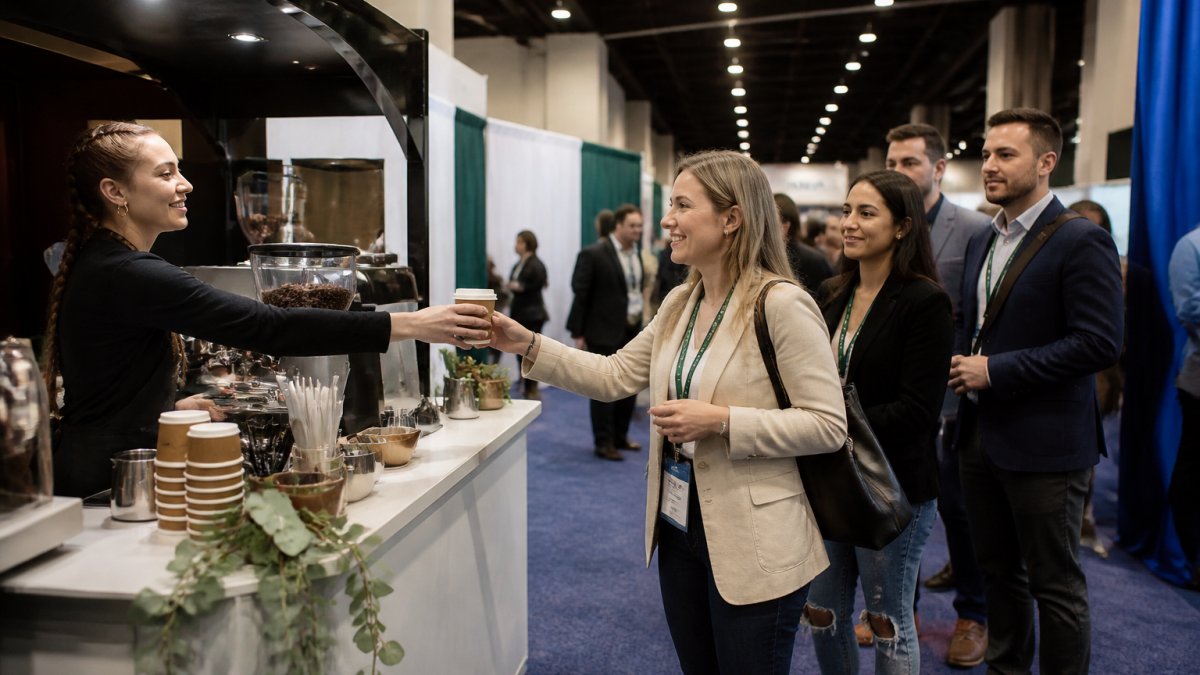
The best trade show booth engagement ideas share one trait: they give attendees a task that takes a few minutes. Coffee does exactly that. Ordering a drink, waiting for it, and taking the first sip fills a natural pause that your team can step into.
Menu Variety as an Engagement Tool
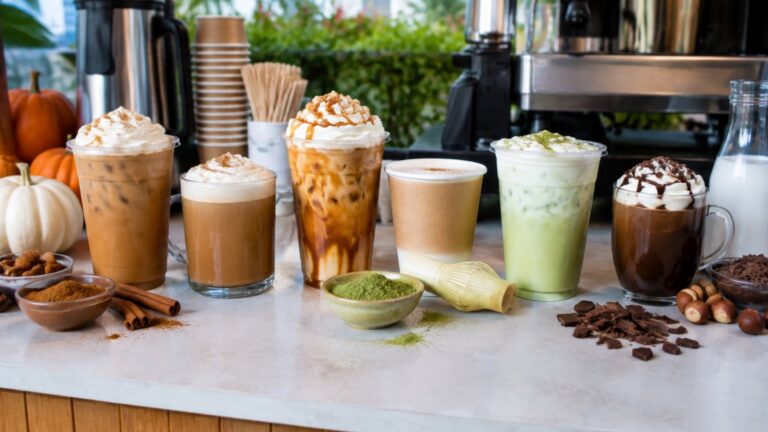
A short menu invites questions. A long one creates decisions. Offer four to six drinks: espresso, a milk-based option, cold brew, matcha, and one seasonal item. Guests ask what the seasonal drink is. That question is your opening.
Barista Theater and the Line You Actually Want
A visible line signals popularity. It also stalls traffic if it grows past about eight people. The fix is speed, not fewer guests. Two baristas working a two-group machine can keep a queue moving while keeping the show going.
Branded Coffee Cups for Events: Small Object, Long Recall
Branded coffee cups for events do something a banner cannot: they travel. An attendee carries your logo across the hall, into a session, and past a dozen other booths. Every one of those moments is free brand visibility.
The cup itself should be simple. Logo, one line of copy, and a QR code that points somewhere useful. Skip the paragraph of text nobody reads while walking.
- Use 8 oz or 12 oz cups for espresso drinks and 16 oz for cold drinks
- Keep the logo large and centered, not wrapped around the seam
- Add a QR code that links to a booking page or a lead form
- Choose a compostable or recyclable cup where the venue allows it
Personalization lifts recall further. Writing a guest’s name on the cup costs two seconds and makes the drink feel made for them, not handed to them.
Coffee Catering for Trade Shows: Logistics and Budget Basics
Coffee catering for trade shows succeeds or fails on logistics, not on the beans. Before you book anything, confirm three things with the venue: power, floor space, and what the contract allows.
Power, Space, and Venue Rules
Most convention centers require a licensed vendor and a certificate of insurance. Many also require a dedicated 20-amp circuit for espresso equipment. Ask about loading dock access and the distance from the dock to your booth. A long haul across a show floor slows setup and adds labor.
Skipping the venue’s vendor approval process is the most common mistake we see. It can get your cart turned away at the loading dock on setup day, with no time to fix it.
Serving Capacity: The Number Most Exhibitors Get Wrong
Plan your equipment around peak-hour throughput, not total attendee count.
That math tells you what to staff. If your booth sees 300 attendees during a two-hour morning rush, one barista cannot serve them all, you either add a second barista, add a self-serve drip station as a pressure valve, or accept a shorter queue and let some guests walk. Decide which trade-off you want before the show, not during it.
Water, Waste, and the Details Nobody Plans For
Espresso machines need a water source and a drain, or a self-contained system with a fresh-water tank and a wastewater tank. Confirm which setup the venue allows.
Waste adds up fast. A two-day show serving 600 drinks generates 600 cups, 600 lids, sleeves, stirrers, and milk cartons. Many venues now require vendors to sort compostable cups from landfill waste and to haul out their own grounds. Ask where the grounds go, some venues allow them in compost, others require you to pack them out.
What Drives the Cost Up or Down
Pricing depends on guest count, service hours, menu complexity, and travel distance. A two-hour activation with one barista costs less than a full-day setup with two. Custom cups, branded signage, and specialty syrups add to the total.
A useful way to budget is cost per cup. Add your vendor fee, staffing, cups, milk, syrups, and any venue power or waste fees, then divide by the number of drinks you expect to serve. That number is the real cost of the activation, and it is the number you compare against the value of a single qualified lead from your booth.
| Cost Driver | Lowers the Cost | Raises the Cost |
|---|---|---|
| Service hours | 2-hour window | Full show day |
| Staffing | One barista | Two or more baristas |
| Menu | Espresso and drip | Matcha, cold brew, seasonal drinks |
| Cups | Plain stock cups | Custom-printed cups |
| Location | Local setup | Long travel distance |
| Water/waste | Self-contained tanks | Venue plumbing and haul-away fees |
Ask for a quote based on your actual guest count and hours. Colada Kulture Co. builds packages around the event, so you are not paying for capacity you will not use.
Trade Show Lead Generation Ideas That Don’t Kill the Hospitality
The fastest way to ruin a coffee activation is to make the drink conditional on a form. Guests feel the trap, and the line stops moving.
Trade show lead generation ideas that work with coffee keep the two activities separate but linked. Serve the drink first. Then invite the guest to scan a QR code for a follow-up, enter a raffle, or book a demo. The drink earns the attention; the ask comes after.
- Print the QR code on the cup sleeve, not on a sign nobody reads
- Have one team member dedicated to scanning and talking, not pouring
- Offer a reason to scan: a giveaway entry, a discount, a booked meeting
Put your best talker at the pickup end of the cart, not the order end. That is where guests are standing still, cup in hand, with nothing else to do.
How to Measure Whether Coffee Actually Moved Your Booth Numbers
Measuring coffee-driven booth performance comes down to five numbers: cups served, badges scanned, conversations over 60 seconds, meetings booked, and cost per qualified lead. Track them separately, because each one fails in a different way.
The Five Numbers and What Each One Tells You
- Cups served per hour. This is your traffic signal. It shows when the booth is busiest and whether your staffing matches demand. If cups served spikes and conversations drop, you are running a beverage stand, not a booth.
- Badge scans at the cart. Scan at the point of service, not at the booth entrance. A scan at the entrance counts people who walked past; a scan at the cart counts people who stopped.
- Conversations over 60 seconds. Have one team member tally these by hand or on a simple counter app. A 60-second threshold separates a polite thank-you from a real conversation.
- Meetings booked. Count demos, calendar invites, or follow-up calls scheduled on the show floor. This is the number your sales team actually cares about.
- Cost per qualified lead. Divide total activation cost by the number of qualified leads. Compare that figure against your cost per lead from the same show without coffee, or from a previous show.
How to Attribute a Lead to the Coffee
Attribution is the hard part. A guest who takes a cup and later books a demo did not necessarily convert because of the coffee. Two simple methods make the link clearer:
- Tag the source. When a team member scans a badge at the cart, note “coffee cart” in the CRM or lead app. When the same contact books a meeting, the source travels with them.
- Run a split test. At one show, run the coffee activation for half the day and a standard booth setup for the other half. Compare scans, conversations, and meetings between the two windows. It is imperfect, but it is more honest than guessing.
What the Numbers Look Like When Something Is Wrong
- Cups high, scans low: your ask is too aggressive, too hidden, or buried on a sign nobody reads.
- Scans high, conversations short: your team needs a better opening line, or the cart is understaffed and guests are being rushed.
- Conversations high, meetings low: your qualification questions are not moving people toward a next step.
- Meetings high, cost per lead high: your activation is working, but you are over-serving for the lead volume it produces.
Run the same activation at two shows and compare the five numbers side by side. That is the only honest way to know whether the investment paid off.
Accessibility, Dietary Needs, and Waste: Getting the Details Right
Inclusive service is not a nice-to-have. It decides whether a chunk of your booth traffic can participate at all.
Offer whole, oat, and almond milk as standard, not as an upgrade. Keep a decaf option available. Label everything clearly so guests with dairy or nut allergies can choose safely. For cold drinks, offer a caffeine-free option like a fruit-based refresher.
Waste management matters too. Many venues now require vendors to sort compostable cups from landfill waste. Confirm the rules before you order supplies, and bring clearly marked bins if the venue does not provide them.
Booths that expect a mixed crowd across age groups, dietary needs, and caffeine preferences. A menu with dairy-free milk and a decaf option serves more guests with no extra staffing.
Conclusion: Choosing the Right Coffee Activation for Your Booth
A coffee activation is not a gimmick. It is a hospitality play that gives attendees a reason to stop, stay, and remember your booth. The brands that get it right treat coffee as a service, not a giveaway.
Colada Kulture Co. builds mobile coffee cart and trailer setups for corporate events, product launches, and brand activations. Our packages include a customizable drink menu with espresso, matcha, and seasonal flavors, whole, oat, and almond milk options, and trained baristas who keep the line moving. We also offer flexible add-ons like pastries and cold brew.
If you want a booth that people actually walk into, request a quote and let us build the activation around your event.
Frequently Asked Questions
What are the benefits of serving coffee at a trade show?
Coffee gives attendees a reason to stop, not just walk past. It creates a natural conversation opener, keeps visitors at your booth longer, and pairs with branded cups that travel the show floor after they leave. A cup in someone’s hand also makes your space feel like hospitality rather than a pitch, which lowers the pressure on both sides and makes follow-up conversations easier to start.
How much coffee should you plan for a trade show?
Ask your coffee catering for trade shows provider to confirm cup sizes, ice needs for cold drinks, and refill timing so you are not restocking mid-rush.
Can branded coffee cups help promote a company at a trade show?
Yes. Branded coffee cups for events work as walking billboards because attendees carry them through aisles, into sessions, and back to their hotels. Keep the logo large and readable from a few feet away, and skip heavy text that nobody reads while walking. A simple cup design with your name, a short tagline, and a QR code tends to outperform a cluttered one.
Should you hire a barista for a trade show booth?
Hiring trained baristas usually beats self-serve setups when you want speed and quality. A barista can pull espresso, steam milk, and customize drinks without a bottleneck, and they handle the machine, cleanup, and restocking so your team stays free to talk to visitors. For smaller booths, a limited menu of drip coffee and cold brew can work with fewer staff.