Last Updated: November 6, 2026
Quick Summary
The best espresso machines for coffee trailers are commercial one-group units built for continuous duty, not home machines. They must hold steam pressure and recover fast through a rush, and most single-group commercial machines run on 220V with a dedicated 20A circuit, though you should confirm the load on the data plate.
- A one-group commercial machine suits most trailers and single-barista setups.
- Size the generator for total connected load plus a startup surge margin.
- Include a sediment filter and carbon stage, plus a softener for hard water.
- Budget for the grinder, filtration, electrical work, and generator, not just the machine.
- Measure footprint, counter weight capacity, and overhead clearance before ordering.
Table of Contents
- What Separates a Coffee Trailer Espresso Machine From a Home Unit
- The Coffee Trailer Equipment Checklist Before You Buy a Machine
- One-Group vs. Two-Group Commercial Espresso Machine: Matching Capacity to Volume
- Espresso Machine Power Requirements for a Coffee Trailer
- Water Supply, Drainage, and the Coffee Trailer Water Filtration System
- Top Espresso Machines for Coffee Trailers: Pros, Cons, and Pricing
- Total Cost of Ownership and Trailer Fit: What the Sticker Price Hides
- Request a Quote for Your Mobile Espresso Setup
- Frequently Asked Questions
What Separates a Coffee Trailer Espresso Machine From a Home Unit
The best espresso machines for coffee trailers are commercial units built for continuous duty, not home machines with a bigger badge. A home machine is designed for a few drinks a day with long rests between them. A trailer machine must pull shot after shot through a two-hour rush, hold steam pressure, and recover fast enough to keep the line moving.
A home unit is not built for that load, while a commercial machine is designed to hold temperature and keep pouring.
Duty Cycle, Recovery, and Steam Capacity
Duty cycle is how long a machine can run before it needs to rest. Home machines are rated for light, intermittent use. Commercial machines are built to run all day.
Recovery is how quickly the boiler returns to brewing temperature after a shot or steam cycle, keeping output consistent when orders stack up.
Steam capacity decides how fast your barista finishes milk drinks.
The Coffee Trailer Equipment Checklist Before You Buy a Machine
A machine is one part of a working trailer, and buying it before planning the rest is a common mistake. Work through this coffee trailer equipment checklist first, because every item affects which machine you can run.
- Espresso machine sized to your expected drink volume
- Commercial grinder matched to the machine
- Water filtration system and pressure regulator
- Fresh water tank and a separate wastewater tank
- Drainage line and a safe discharge point
For everything beyond the machine, see our guide to essential equipment for mobile coffee trailers.
One-Group vs. Two-Group Commercial Espresso Machine: Matching Capacity to Volume
A one-group commercial espresso machine suits most trailers. A two-group machine only pays off when your volume genuinely needs two baristas pulling shots at once.
Here is how the two compare in practice:
| Factor | One-Group Machine | Two-Group Machine |
|---|---|---|
| Best for | Trailers, carts, single barista | High-volume events, two baristas |
| Footprint | Compact, fits tight counters | Needs a longer, reinforced counter |
| Power draw | Lower, easier on a generator | Higher, needs a dedicated circuit |
| Steam capacity | One steam wand, steady output | Two wands, faster milk at peak |
| Service capacity | Moderate, steady flow | High, handles long lines |
| Cost | Lower entry point | Higher purchase and install |
A one-group machine keeps a single barista moving at a comfortable pace and fits the tight footprint of a coffee trailer or coffee cart. A two-group machine earns its space only when you regularly face long lines and can staff a second barista.
Espresso Machine Power Requirements for a Coffee Trailer
Espresso machine power requirements for a coffee trailer sink more builds than any other detail. A commercial machine draws serious current, and the trailer’s electrical system must be planned around it before you buy. Most commercial single-group machines run on 220V and want a dedicated 20A circuit, but confirm the exact load on the machine’s data plate.
Add up the full load: machine, grinder, refrigeration, lights, and any water heater. The total, not just the machine, decides your circuit and generator sizing.
Startup Load vs. Operating Load
Every espresso machine has two electrical demands, and confusing them is how trailers trip breakers. The operating load is the steady current while holding temperature and brewing. The startup load is the brief surge when the heating element, pump motor, or compressor kicks on.
A common pattern is to size the circuit for the machine’s rated amperage and the generator for the total connected load plus a startup margin. If the data plate says 20A at 220V, that is the circuit requirement, not the generator requirement.
What Else Shares the Electrical Supply
A trailer’s electrical panel is a shared resource, and the espresso machine is usually the largest single load on it. Before you commit to a machine, list every device that will run during peak service:
- Espresso machine (heating element and pump)
- Commercial grinder (burr motor)
- Refrigeration (compressor startup is a surge load)
- Water heater or boiler for tea and Americanos
- Lights, POS system, and phone chargers
Add the running amps for each, then add the largest startup surge. That total is what your generator or shore power connection must support. A machine that fits your budget but pushes the total over your generator’s continuous rating is the wrong machine for your trailer.
Generator Sizing and Shore Power
Size your generator above your total connected load, with headroom for startup surge. A generator running at its limit will trip or brown out mid-service, and a brownout can damage a machine’s electronics.
Watch out: plugging a 220V commercial machine into an undersized circuit is the fastest way to trip a breaker mid-rush. Verify voltage and amperage on site before the event, not the morning of.
Water Supply, Drainage, and the Coffee Trailer Water Filtration System
A coffee trailer water filtration system protects both the espresso and the machine. Scale and sediment are the quiet killers of commercial espresso equipment, and unfiltered water shortens the life of boilers and valves.
Decide between direct plumbing and a fresh water tank. Direct plumbing ties you to a venue’s water line, convenient when it exists but not always available.
Filtration should include a sediment filter and a carbon stage at minimum, with a softener if your water is hard.
Top Espresso Machines for Coffee Trailers: Pros, Cons, and Pricing
These are the machines that come up most often when trailer operators compare options. Prices below are retailer listings from the supplied research and may change, so confirm current pricing with the seller before you buy.
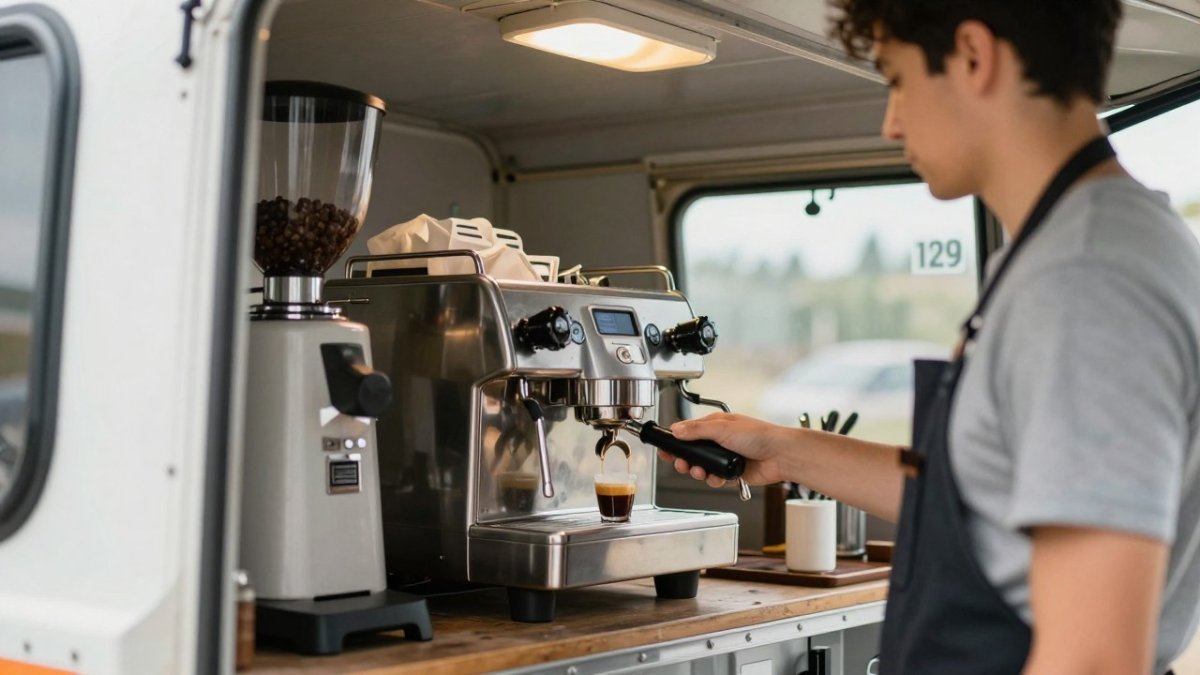
Nuova Simonelli Appia Life Compact
A compact commercial machine listed for coffee trucks, trailers, and mobile cafes. The one-group model carries a 5-liter steam boiler and volumetric dosing, which keeps shot portions repeatable.
Pros: commercial format, volumetric dosing, solid steam boiler.
Cons: power and dimensions unconfirmed in listings.
Best for: trailer operators who want repeatable shots from a compact commercial unit.
Skip if: you need documented electrical specs before purchase.
Sanremo Zoe Compact
A compact commercial machine positioned for mobile use. Ask the seller for the full spec sheet before ordering.
Pros: commercial positioning.
Cons: limited published specs.
Best for: operators comparing machines from a mobile-equipment retailer.
EVO 1 Group
A one-group machine. The one-group format suits a single-barista setup. The supplied results do not identify the manufacturer or further specs, so confirm both with the seller.
Pros: one-group format.
Cons: manufacturer and specs not stated in the listing.
Best for: mobile businesses that want a one-group machine built for trailer duty.
La Marzocco Linea Classic S 2 Group
A two-group commercial machine. The two-group configuration suits higher-volume service and a second barista. Confirm pricing, trailer dimensions, power, and water requirements with the seller before you commit.
Pros: commercial positioning, two-group capacity.
Cons: no published price, unverified trailer fit.
Best for: higher-volume trailer operations with the space and power for two groups.
Skip if: you run a single barista in a compact trailer.
Total Cost of Ownership and Trailer Fit: What the Sticker Price Hides
The purchase price is the smallest part of the real cost. Total cost of ownership includes the grinder, filtration, electrical work, generator, installation, and ongoing maintenance. Add those up before comparing machines on price alone.
The Full Cost Stack
A commercial espresso machine is one line item in a trailer build, and the supporting equipment often costs as much as the machine itself. A realistic cost stack includes:
- Espresso machine, the sticker price you see in listings
- Commercial grinder, a matched burr grinder is not optional; a machine without a capable grinder cannot produce consistent shots
- Water filtration and pressure regulator, sediment, carbon, and softening stages, plus the housing and fittings
- Electrical work, panel, dedicated circuit, wiring, and any generator or shore power connection
- Generator, sized to total load, not just the machine
- Installation and commissioning, plumbing, drainage, mounting, and a test run
Budget for the full system, not just the machine: the grinder, filtration, and electrical work add meaningful cost on top of the machine itself.
Trailer Fit: Space, Weight, and Movement
Trailer fit matters as much as cost.
Three fit factors deserve specific attention in a trailer:
Counter space and dimensions. A one-group machine is compact, but it still needs clearance for the portafilter, steam pitcher, and barista movement. Measure the machine’s width, depth, and height against your counter and overhead cabinets before ordering.
Weight distribution. A commercial espresso machine is heavy, and its weight sits on one section of the counter.
Secure mounting and movement wear. A trailer moves between events, and vibration loosens fittings, shifts components, and stresses plumbing connections.
To benchmark what a full mobile setup costs at events, see our guide to mobile espresso bar rental cost.
Request a Quote for Your Mobile Espresso Setup
The right machine matches your volume, power, water, and space, and that is a planning conversation, not a shopping one.
Our mobile coffee cart and trailer options come with customizable catering packages for any occasion, a drink selection that includes espresso, matcha, and seasonal flavors, and whole, oat, and almond milk options.
If you are planning staffing for a trailer of your own, you can book a mobile barista for your event. And if you want to see a concrete trailer offering in this market, explore our mobile coffee trailer rental in Miami to request details.
The hardest part of a coffee trailer is not picking a machine. It is making the machine, power, water, and staff work together on event day. That is the part we handle.
Frequently Asked Questions
Should a coffee trailer use a one-group or two-group espresso machine?
It depends on your realistic peak volume. A one-group machine suits trailers serving roughly 40 to 60 drinks per hour, which covers most weddings and small corporate events. A two-group machine handles higher throughput and lets two baristas work at once, but it draws more power and takes more counter space. Match the group count to your busiest hour, not your average day, and leave headroom for recovery between shots.
What power supply does a commercial espresso machine need in a coffee trailer?
Most compact commercial machines run on 220V and need a dedicated circuit, often 20A or higher depending on the boiler. Confirm the machine’s amp draw before you finalize your electrical panel, and size your generator above the combined load of the machine, grinder, refrigerator, and lights. A machine that trips a breaker mid-event is the most common failure point in mobile setups, so verify the spec sheet rather than assuming.
What water filtration system does a coffee trailer espresso machine need?
A carbon and sediment filter is the minimum, and a softener is worth adding if your fill water is hard. Filtration protects the boiler from scale, which shortens machine life and throws off brew temperature. Plan a filter housing that fits your water tank or direct-plumbing line, plus a drain line for the drip tray and backflush. Test your water source before choosing a filter so you buy the right cartridge.
How do you secure an espresso machine in a mobile coffee trailer?
Bolt the machine to the counter through its feet or a mounting bracket, and add a lip or rail so it cannot slide during transport. Keep the machine low and centered over the axle to limit vibration, and let it cool before you move the trailer. Vibration loosens fittings and can damage the pump, so check connections after every tow and run a test shot before service.