Last Updated: October 31, 2026
Quick Summary
A mobile coffee trailer needs a commercial espresso machine and matched commercial grinder, batch brewers or urns, cold brew taps, a freshwater tank with filtration and a wastewater tank, sinks and a pitcher rinser, refrigeration and an ice machine, and a generator or shore power connection. Build the checklist in order: brew equipment, water, power, cold storage, then smallwares and POS.
- Size the freshwater tank for your busiest service window plus a reserve margin, not an average day.
- Size the wastewater tank at least as large as the freshwater tank and empty it after every event.
- Use a sediment filter ahead of a carbon block and keep a spare cartridge on the trailer.
- Size the generator against running watts plus the largest single startup surge.
- Place the espresso machine, grinder, and tamping station in one triangle so baristas never walk to make a drink.
Table of Contents
- The Core Brew Equipment That Defines Your Menu
- Your Coffee Trailer Equipment Checklist for the Whole Build
- The Coffee Trailer Water System: Tanks, Filtration, and Drainage
- Coffee Trailer Power Requirements and Generator Sizing
- Refrigeration, Ice, and Cold Storage That Keep Up With Service
- Layout, Installation, and Securing Equipment for the Road
- Coffee Trailer Startup Costs and Where the Money Goes
- Planning Your Trailer Build With a Catering Partner
- Frequently Asked Questions
The Core Brew Equipment That Defines Your Menu
The espresso machine and grinder pairing is the single most important equipment decision for a mobile coffee trailer, because it determines your drink menu, your service speed, and your power draw. To see how a real mobile coffee trailer rental is equipped and reviewed, read this breakdown.
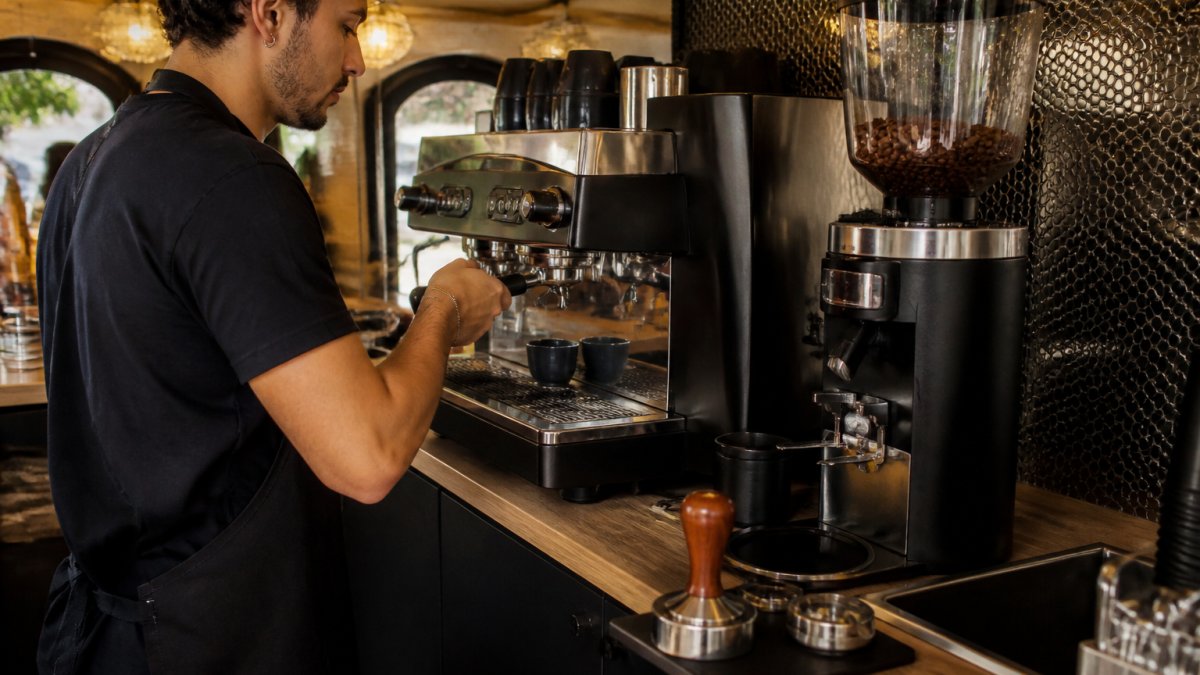
Espresso Machines and Grinder Pairing
Match the grinder to the machine, not the other way around. A low-profile espresso machine fits under a trailer counter and still delivers commercial output. Pair it with a single or dual espresso grinder so you can dial in espresso and decaf separately.
Batch Brewers, Urns, and Cold Brew Taps
Not every guest wants espresso. Batch brewers and coffee urns cover drip coffee at volume, while cold brew taps handle the iced demand that runs year-round in warm climates. Pastry displays round out the menu and keep guests at the counter longer.
Your Coffee Trailer Equipment Checklist for the Whole Build
A coffee trailer equipment checklist should group purchases by function so nothing gets ordered out of sequence. Build the list in this order: brew equipment, water, power, cold storage, then smallwares and POS. Here is a typical checklist:
- Commercial espresso machine, low-profile
- Commercial espresso grinder, plus a backup hopper
- Batch brewer or coffee urn
Missing one item, especially on the water or power side, can stall an entire build.
The Coffee Trailer Water System: Tanks, Filtration, and Drainage
A coffee trailer water system has three jobs: store fresh water, filter it for taste and machine protection, and capture wastewater legally. Each job has a sizing question behind it, and getting the sizing wrong shows up as either a mid-event water run or a failed health inspection.
Sizing the Freshwater Tank
Size the freshwater tank against your expected drink volume, not against the tank that fits the space. A workable planning method is to estimate water use per drink and multiply by your busiest service window.
- Espresso and espresso-based drinks use relatively little water per shot, but the machine’s brew and steam use adds up across a busy hour.
- Batch brew and drip coffee use more water per cup than espresso.
- Rinsing, pitcher rinsing, and handwashing draw water continuously and are easy to underestimate.
A common planning approach is to size for the busiest service window and add a reserve margin rather than sizing to an average day. If your menu is espresso-heavy, a smaller tank can work; if you pour batch brew or run a high-volume iced menu, plan larger.
Filtration That Protects the Machine
Filtration does two jobs: it improves taste and it protects the espresso machine from scale and sediment. A typical setup uses a sediment filter ahead of a carbon block, and many operators add a water softener or scale-reduction stage if the local water is hard. Replace filter cartridges on the manufacturer’s schedule, a clogged filter drops flow and can starve the machine.
Wastewater and Drainage
The wastewater tank must hold everything that goes down the drain, because most venues will not let you discharge onto their property. Size it at least as large as the freshwater tank, and larger if your menu involves heavy rinsing or pitcher cleaning. Route drains with a trap and an air gap where the health code requires one, and make sure the tank is vented so it does not back up.
Health-Code Checklist
Requirements vary by jurisdiction, but a common pattern includes:
- A handwashing sink with hot and cold water, soap, and single-use towels, separate from the warewashing sink
- A three-compartment sink or an approved alternate for washing, rinsing, and sanitizing
- An air gap or backflow prevention device on the freshwater fill
Confirm the local health department’s water and wastewater requirements before you finalize tank sizes and sink layout. Retrofitting plumbing after the trailer is built is one of the most expensive mistakes in a mobile coffee build.
A pitcher rinser belongs on the bar side, not tucked away, because it keeps bar speed up between shots and reduces the water wasted on manual rinsing. Treat the water system as a single design, tank, filter, pump, sinks, and wastewater, and size each part against the same service-volume estimate.
Here are the water system sizing and filtration facts the article lays out.
| Item | Value or rule | Note |
|---|---|---|
| Freshwater tank sizing | Busiest service window plus reserve margin | Smaller tank works for espresso-heavy menus |
| Wastewater tank sizing | At least as large as freshwater tank | Larger if menu involves heavy rinsing |
| Filtration setup | Sediment filter ahead of carbon block | Add softener or scale reduction for hard water |
| Filter cartridge changes | On the manufacturer’s schedule | Keep a spare cartridge on the trailer |
| Wastewater tank emptying | After every event | Vent the tank so it does not back up |
| Handwashing sink | Hot and cold water, soap, single-use towels | Separate from the warewashing sink |
| Warewashing | Three-compartment sink or approved alternate | Washing, rinsing, and sanitizing |
| Freshwater fill | Air gap or backflow prevention device | Confirm local health department requirements |
Coffee Trailer Power Requirements and Generator Sizing
Power is the equipment decision that most often forces a trailer redesign after the shell is already built, because the espresso machine alone can dictate whether you need a generator, a shore-power pedestal, or both. The fix is to run a real load calculation before you buy anything.
How to Total Your Load
Build a simple wattage worksheet with three columns: running watts, startup (surge) watts, and duty cycle (how many minutes per hour the item actually runs). List every powered item on the trailer, espresso machine, grinder, batch brewer, refrigerator, ice machine, water pump, tankless water heater if you have one, interior and exterior lights, POS terminal, card reader, and any blenders or cold-brew taps.
- Running watts come from the equipment data plate or the manufacturer’s spec sheet. Use the nameplate figure, not the marketing number.
- Startup watts matter for anything with a compressor or motor, refrigerators, ice machines, water pumps, and grinders can briefly draw two to three times their running wattage when they kick on. A common planning pattern is to size the generator against the sum of running watts plus the largest single startup surge, not the sum of every surge at once.
- Duty cycle keeps you honest. A refrigerator cycles on and off; an espresso machine’s heating element cycles too. Multiplying running watts by duty cycle gives a realistic continuous load rather than a worst-case number that pushes you into an oversized generator.
Shore Power, Batteries, or a Generator
Each option carries a different tradeoff, and many trailers end up with two of the three.
- Shore power is the cheapest per event when the venue has it, but amperage varies widely. Confirm the pedestal’s amperage and voltage before you commit, and ask whether it is on a dedicated circuit. Older commercial buildings and event venues frequently offer less than the trailer needs, and a long extension run adds voltage drop that can nuisance-trip the espresso machine.
- A generator gives you independence but adds noise, fuel, maintenance, and weight. Size it above your calculated continuous load with headroom, a generator run at its limit will trip under load and shorten its own life. Keep the espresso machine on its own circuit so a grinder or refrigerator startup does not brown out a shot.
- Battery and inverter systems are quiet and fume-free but require careful capacity planning and a charging strategy between events. They suit lower-draw menus and shorter service windows better than a high-volume espresso trailer.
Before you buy a generator, confirm the espresso machine’s actual amperage draw at your planned voltage. A machine that needs a dedicated circuit on shore power will need the same dedicated circuit on a generator, and that single number often decides the generator size.
Practical Sizing Rules
The espresso machine and the refrigeration/ice group often each benefit from their own circuit, and lights, POS, and pumps can share a third. Label every circuit at the panel so a barista can reset a tripped breaker without guessing. If the venue offers shore power, confirm the amperage in writing before the event rather than on arrival, a trailer that assumed 50 amps and finds 30 will not run its full menu.
Refrigeration, Ice, and Cold Storage That Keep Up With Service
Cold storage is where underbuilt trailers fail first. An undercounter refrigerator holds milk, cold brew concentrate, and perishables within arm’s reach of the bar. An ice machine keeps iced drinks moving without constant restocking. Milk storage matters more than operators expect: whole, oat, and almond milk all need chilled space, and running out mid-event is a service problem, not a stocking problem.
Layout, Installation, and Securing Equipment for the Road
Workstation layout decides your bar speed. Place the espresso machine, grinder, and tamping station in one triangle so a barista never walks to make a drink. Put the sink and rinser behind the bar, and the POS where guests order. Readers deciding on trailer format can find a comparison of cart versus truck layouts and their equipment implications for private events.
Coffee Trailer Startup Costs and Where the Money Goes
Coffee trailer startup costs split across four buckets: brew equipment, water and plumbing, power, and the trailer shell itself. Espresso machines and grinders take the largest share of the brew budget. Water tanks, filtration, sinks, and drainage add a meaningful second chunk. Power, whether a generator or a shore connection, is a third. For a full cost-benefit view, read whether mobile coffee is worth the cost.
Planning Your Trailer Build With a Catering Partner
A catering partner who already runs trailers can help with the equipment list, the power calculation, and the health-code details. Start by confirming what a standard mobile coffee catering package includes, then follow the practical steps for how to hire mobile coffee catering.
Building a trailer that performs under real event pressure is harder than picking a machine from a catalog. Colada Kulture Co. handles the equipment, the menu, and the service so you get a coffee experience that runs smoothly from first guest to last.
Frequently Asked Questions
What equipment do you need for a mobile coffee trailer?
At minimum, a mobile coffee trailer needs a commercial espresso machine, a commercial espresso grinder, water filtration, freshwater and wastewater tanks, a handwashing sink, refrigeration, and enough electrical capacity to run it all. Add batch brewers, cold brew taps, a pastry display, and smallwares like tampers, knock boxes, and pitchers depending on your menu. Build the list from your drink menu outward so you do not buy equipment you will never use.
How do mobile coffee trailers get water and power?
Most trailers carry a freshwater tank and a separate wastewater tank, with a pump system feeding a filtration unit before water reaches the espresso machine. Power comes from a generator, shore power at the venue, or a battery bank, and the choice depends on your coffee trailer power requirements. Add up the amp draw of every appliance running at once, then size your supply with headroom so the espresso machine and refrigerator can run together without tripping breakers.
What espresso machine is best for a coffee trailer?
A low-profile commercial espresso machine with a heat-exchange or dual-boiler design suits most trailers because it fits under counter height and recovers quickly between shots. Pair it with a commercial espresso grinder so grind consistency keeps up with volume. Match the machine to your busiest expected hour, not your average day, and confirm its power draw fits your generator or shore power setup before you commit.
How much does it cost to equip a mobile coffee trailer?
Coffee trailer startup costs vary widely with menu ambition and whether you buy new or used. Pricing depends on quantity, dates, and delivery, so request a quote from Colada Kulture Co. for current pricing. Build a line-item budget that separates core brew equipment from smallwares and compliance items, then get quotes on the big three: espresso machine, grinder, and power supply.
What permits and inspections might a mobile coffee trailer need?
Mobile food units typically need a health department permit, a commissary or base-of-operations arrangement, and inspections covering plumbing, handwashing, and wastewater disposal. Requirements differ by state and county, so confirm the rules with your local health authority before you finalize the build. Plan your sink, tank, and drainage layout around those requirements early, because retrofitting plumbing after the trailer is built costs far more than designing it correctly the first time.