Last Updated: November 5, 2026
Quick Summary
A mobile espresso business wins bookings by planning its marketing before the first event, answering who it serves, how those clients find it, and how it measures results. Most owners should fund two or three channels properly, track each inquiry’s source, and review the plan monthly. Local search, event partnerships, referrals and social media are the core channels.
- Write a one-page plan that answers who you serve, how they find you, and how you prove it works.
- Review the marketing plan on the first Monday of each month because routes change quickly.
- Cut any channel that produces no inquiries in 60 days and move the money elsewhere.
- Track cost per booked event and repeat visit rate alongside inquiry count and booking value.
- Give each campaign a full 30 days and a written pass/fail line before judging it.
Table of Contents
- Start With a Mobile Coffee Business Marketing Plan
- Getting Found Through Local Search and Google Business Profile
- Winning Event Bookings for Your Coffee Cart Business for Events
- Running Social Media Marketing That Fills Your Route Schedule
- Keeping Customers Coming Back With Loyalty and Seasonal Offers
- Measuring Attribution and Booking Your First Campaign
- Frequently Asked Questions
Start With a Mobile Coffee Business Marketing Plan
A mobile espresso business wins more bookings when it plans its marketing before the first event. A clear plan keeps your time, money, and social posts pointed at the same goal. Without one, most owners spend their weekends chasing random leads and hoping one of them sticks.
Think of the plan as a simple map. It answers three questions: who you serve, how they find you, and how you know it is working. The mobile espresso business owner who can answer those three questions can make a sharp decision in minutes.
- Who: Corporate planners, engaged couples, and brand managers
- How: Local search, referrals, event partners, and social media
- Proof: Bookings, repeat clients, and reviews
Write those three answers into a one-page plan and date it. Review it on the first Monday of each month, because a route schedule changes faster than a storefront’s does. If a channel has not produced a single inquiry in 60 days, cut it and move the money.
Setting a Monthly Marketing Budget
A marketing budget keeps spending honest. Set a fixed monthly amount before you buy ads, print flyers, or pay for a booking platform. Many small operators start with a small share of expected monthly revenue and adjust after a few months of results.
A workable starting split for a cart doing a mix of public stops and private events:
- Local search and profile upkeep: the smallest slice, mostly your time plus occasional photography
- Paid social or local ads: the largest slice, because it is the easiest to turn off when a month is slow
- Print and event collateral: menus, signage, and business cards for planners who still file paper
- Booking platform or scheduling software: a fixed cost that belongs in the budget, not in a separate line
- Contingency: a small reserve for a weather-forced reschedule or a last-minute event push
Watch out: spreading a small budget across too many channels leaves none of them strong enough to work. Pick two or three channels and fund them properly.
Choosing KPIs You Can Actually Track
Pick a few numbers you can check every week. Good starting points are inquiry count, quote-to-booking rate, and average booking value. Track where each inquiry came from so you know which channel earns the most business.
Add two mobile-specific metrics that storefront guides skip:
- Repeat visit rate: the share of clients who book a second event within 12 months
- Cost per booked event: total channel spend divided by events that channel produced
Keep the list short. Five metrics you check weekly beat twenty you never open. A simple spreadsheet with one row per inquiry, a source column, a status column, and a booked-value column is enough to run the whole plan. Sort by source at month end and you have your budget decision for the next month.
Turning the Plan Into a 90-Day Calendar
A plan that lives only in your head dies in week three. Put it on a calendar with three layers: route days, content days, and outreach days. Route days are fixed by your schedule. Content days are when you shoot and post. Outreach days are when you email planners, follow up on quotes, and ask for reviews.
A common pattern is to batch content on one slow weekday and schedule posts for the week, so a busy event weekend never leaves your feed empty. Build the calendar backward from your known busy seasons so outreach lands two to three months before planners finalize vendors.
Getting Found Through Local Search and Google Business Profile
Most people planning an event search for a local vendor on their phone. A complete Google Business Profile helps your mobile espresso business appear in those searches. Add your service area, photos of your cart, your business hours, and recent event photos.
Ask recent clients for reviews, and reply to every one. Reviews that mention specific events, such as a wedding or a product launch, help nearby planners picture your service. Keep your name, phone number, and service area the same across every listing, because mismatched details confuse search engines and customers alike.
Winning Event Bookings for Your Coffee Cart Business for Events
Event bookings are often the largest source of revenue for a mobile espresso business. Planners want a vendor who is reliable, easy to schedule, and who looks good in photos.
For a deeper look at how to market your cart to event organizers, read our Mobile Espresso Bar Event Marketing Guide. It covers how to package your offer so planners say yes faster.
Building a B2B Lead Funnel for Corporate Clients
A lead funnel moves a corporate buyer from first contact to a signed booking. Start with a simple landing page that lists your packages and a short inquiry form. Follow up within one business day, because planners often contact several vendors at once.
Corporate buyers usually want to know whether a premium service is worth it for their group size. Explain which package suits a smaller office gathering and which suits a large product launch. Our guide on whether interactive food stations are worth it for corporate events can help you answer that question clearly.
Pitching Weddings and Private Celebrations
Couples book based on look, feel, and trust. Share photos of your cart styled for different themes. Explain your drink menu, including espresso, matcha, and oat or almond milk options.
For couples comparing options, a clear overview helps. Our wedding coffee catering guide explains what to expect from setup to menu, and our mobile barista service guide for private parties shows how these services are organized for clients.
Running Social Media Marketing That Fills Your Route Schedule
Social media works best when it shows your cart in real settings. Post short videos of drinks being made, photos from recent events, and quick updates about where you will be next. Tag venues and partners so their followers see your work.
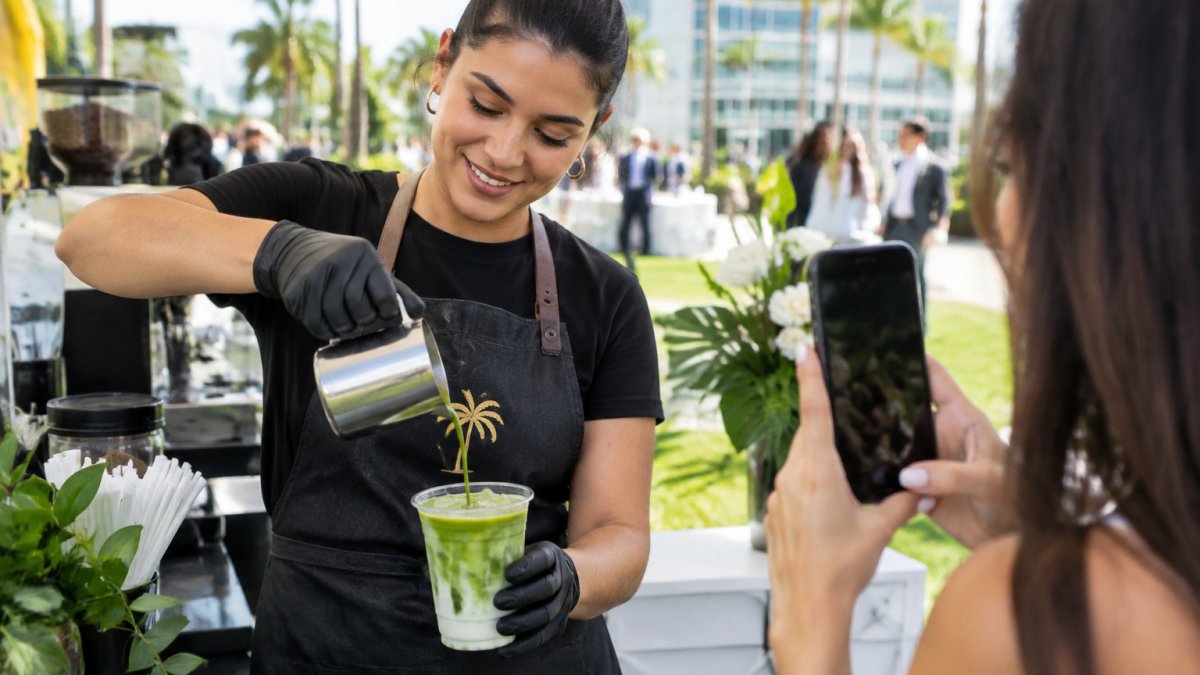
!A barista in a branded apron pouring an iced matcha latte at a bright outdoor corporate event, with a guest holding a phone to photograph the drink
Keep a steady posting schedule that matches your route. Announce weekend locations on Thursday, and share a recap photo after each event. Consistent posts keep your name visible when planners start searching.
Keeping Customers Coming Back With Loyalty and Seasonal Offers
Repeat clients are cheaper to win than new ones. Offer a simple loyalty perk, such as a discount on the next event booking for clients who return. Thank past clients with a short email that mentions their last event.
Seasonal offers give you a reason to reach out. Holiday party season, spring wedding season, and back-to-school corporate events each create demand. Plan one seasonal promotion per quarter so your calendar stays full between big bookings.
Measuring Attribution and Booking Your First Campaign
Attribution tells you which marketing effort led to each booking. Ask every new inquiry how they heard about you, and record the answer next to the booking. Over a few months, patterns appear, and you can shift money toward the channels that work.
Self-reported answers are a start, but they are fuzzy. A planner who saw a post, then got a referral, then searched your name will usually name only one of the three. Add trackable markers so the data does not depend on memory.
Trackable Markers for a Mobile Operator
- QR codes: one code per placement, printed on cart signage, menus, and event flyers, each pointing to a landing page that logs the source
- Offer codes: a short code tied to a specific event or partner, such as a seasonal booking perk, so redemptions show which placement drove the booking
- Event-specific links: a unique URL for each market, wedding expo, or office building, used in follow-up emails and social bios
- Booking-form source field: a required dropdown on the inquiry form asking how the client found you, with the same options every time so the data stays sortable
Keep the naming consistent. If one code is labeled by venue and another by month, the report becomes unreadable. Pick one convention and stick to it.
Running a Post-Event Review
After each event, spend ten minutes on a short review before the details fade. Record the number of drinks served, the number of QR scans or code redemptions, the inquiries generated, and the bookings that followed within 30 days. Compare that against the cost of the placement, including your time and any booth fee.
A placement that produces a crowd but no inquiries is a marketing cost, not a marketing win. A smaller event that produces two corporate leads may be worth more than a large one that produces none. The review is what turns a busy calendar into a profitable one.
Booking Your First Campaign
Start your first campaign small. Choose one channel, one audience, and one offer. Run it for 30 days, check your KPIs, and keep what works. Once you see a clear result, repeat the process with the next channel.
Before you spend, set the pass/fail line in writing. For example: the campaign must produce a set number of inquiries and at least one booked event within 45 days, or the budget moves to the next channel. Write the line down before the campaign starts, because it is easy to rationalize a weak result after the fact.
Watch out: judging a campaign in the first week leads to cutting channels that were still building reach. Give a channel a full 30 days and a clear offer before you decide.
Track which channel produced each booking with a few simple markers, and check results against a pass/fail line you set in advance.
| Marker | Purpose | Note |
|---|---|---|
| QR codes | Logs the source of each scan | One code per placement |
| Offer codes | Shows which placement drove a booking | Tie each code to one event or partner |
| Event-specific links | Tracks each market, expo or office | Used in follow-up emails and bios |
| Booking-form source field | Records how the client found you | Required dropdown with fixed options |
Frequently Asked Questions
What are the best marketing strategies for a mobile espresso business?
The strongest approach combines three channels: a Google Business Profile so nearby customers and planners can find you, a steady stream of event bookings through direct outreach to corporate offices and wedding planners, and social media content that shows drinks being made at real events. Keep a monthly budget and track which channel produces booking inquiries so you can shift spending toward what works. Pricing for these services depends on the event date, guest count, and delivery location, so request a quote from Colada Kulture Co. for current rates.
How do you promote a mobile coffee cart?
Start by making the cart easy to book and easy to find. Claim and complete your Google Business Profile with service area, photos and hours, then ask recent event clients for reviews. Post short video clips of the cart in action on Instagram and TikTok, tagging venues and planners who hosted you. Partnering with event venues, florists and photographers also brings referrals that paid ads rarely match in quality.
How can a mobile espresso business get repeat customers?
Repeat business comes from follow-up and consistency. After each event, send a thank-you message with a request for a review and an invitation to book the next occasion. Seasonal menu updates and limited-time drinks give past customers a reason to rebook.
How can a mobile coffee business attract more event bookings?
Focus on the buyers who plan events for a living: corporate event planners, HR teams, marketing agencies and wedding planners. Build a short booking page that makes it easy to request a quote. Track inquiries by source so you know which outreach produces confirmed bookings.
Ready to put these strategies to work? Request a quote from Colada Kulture Co. to see how our mobile espresso bars can elevate your next wedding, corporate event, or brand activation in Miami and South Florida. Pricing depends on your event size, date, and delivery needs, so contact us for a tailored estimate.