Table of Contents
- Mobile Coffee Cart vs. Traditional Catering: A Cost-Benefit Analysis
- Mobile Coffee Cart Catering Prices: What You’ll Actually Spend
- Corporate Event Coffee Service Requirements: Space, Power, and Setup
- Mobile Espresso Bar vs. Coffee Cart: Which Fits Your Event?
- Service Speed and Guest Experience: Can It Handle Your Crowd?
- Insurance, Liability, and Hidden Logistics for Corporate Venues
- Calculating ROI: When a Mobile Coffee Cart Makes Financial Sense
Last Updated: August 14, 2026
Mobile Coffee Cart vs. Traditional Catering: A Cost-Benefit Analysis
When planning a corporate event, the coffee decision shapes the entire attendee experience. A mobile coffee cart operates on fundamentally different economics than traditional full-service catering. A professional mobile espresso bar serves 100+ guests within a 2-hour window, while traditional catering teams often struggle with bottlenecks when coffee competes for attention with other food stations.
The cost-benefit analysis hinges on three factors: guest count, event duration, and venue constraints. For smaller gatherings under 75 people, traditional catering might seem cheaper on paper. But once you factor in service time, staff allocation, and quality differential, a mobile coffee cart often delivers better ROI. Guests remember exceptional coffee.
Where traditional catering wins is scale. For 500+ people across a full day with multiple food stations, integrating coffee into broader catering makes logistical sense. But for typical corporate events, product launches, team appreciation gatherings, client mixers, a mobile coffee cart delivers superior guest engagement at lower operational cost.
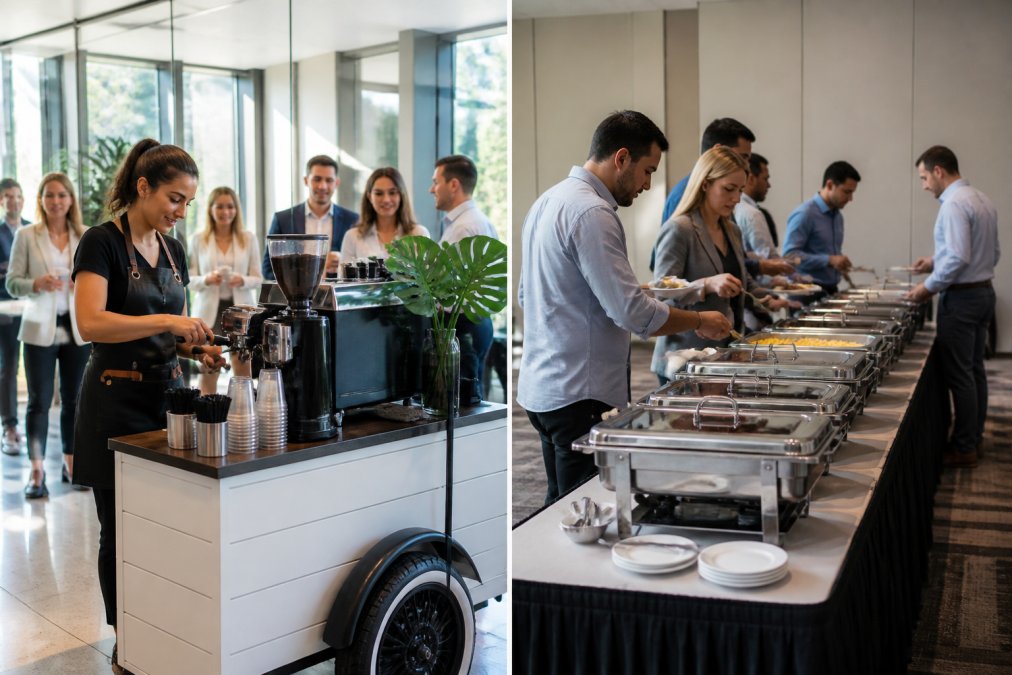
Colada Kulture Co. specializes in this positioning: they bring specialty coffee expertise to corporate venues without requiring full catering infrastructure. Their mobile setup handles customization, oat milk, almond milk, matcha lattes, seasonal flavors, that generic catering operations can’t match. A trained barista creating latte art and remembering drink preferences changes how guests perceive the event.
The mobile cart approach offers flexibility. You’re not locked into a catering company’s standard menu. Want branded cups? A cold brew station? Specialty drinks aligned with your event theme? A mobile coffee cart provider adapts. Traditional catering requires negotiation and often charges premium fees for customization.
Mobile Coffee Cart Catering Prices: What You’ll Actually Spend
Pricing for mobile coffee cart corporate events varies based on guest count, event duration, and service scope. Most providers structure quotes around event parameters: hours, expected guests, and customization level.
When evaluating quotes, understand what’s included. Some providers bundle staffing, equipment, setup, and breakdown into a flat rate. Others charge separately for travel, premium ingredients, or extended hours. A common misconception is that mobile coffee cart prices are standardized. They’re not. Latte’Da Mobile Espresso in Colorado uses hourly rates with a 2-hour minimum. Victory Coffee Cart in Houston prices differently for bottomless drink service versus limited-cup models.
For corporate events, budget considerations include:
- Base service fee (typically covers 1-2 hours, one barista, standard drink menu)
- Per-guest add-ons (if applicable)
- Premium ingredients or specialty menu items
- Travel fees (especially for venues outside standard service areas)
- Extended hours or weekend premiums
- Custom branding (cups, signage, cart wrapping)
A mobile coffee cart provider often delivers better value than traditional catering when focused on beverage service. You’re not paying for kitchen overhead, multiple staff members, or food prep costs.
When requesting quotes, specify your exact guest count, event duration, and venue details. Also ask whether pricing includes travel, setup time, and breakdown. Some quotes that look cheaper initially balloon once you add those components.
Corporate Event Coffee Service Requirements: Space, Power, and Setup
Before booking, understand your venue’s constraints and whether a mobile coffee cart can operate there.
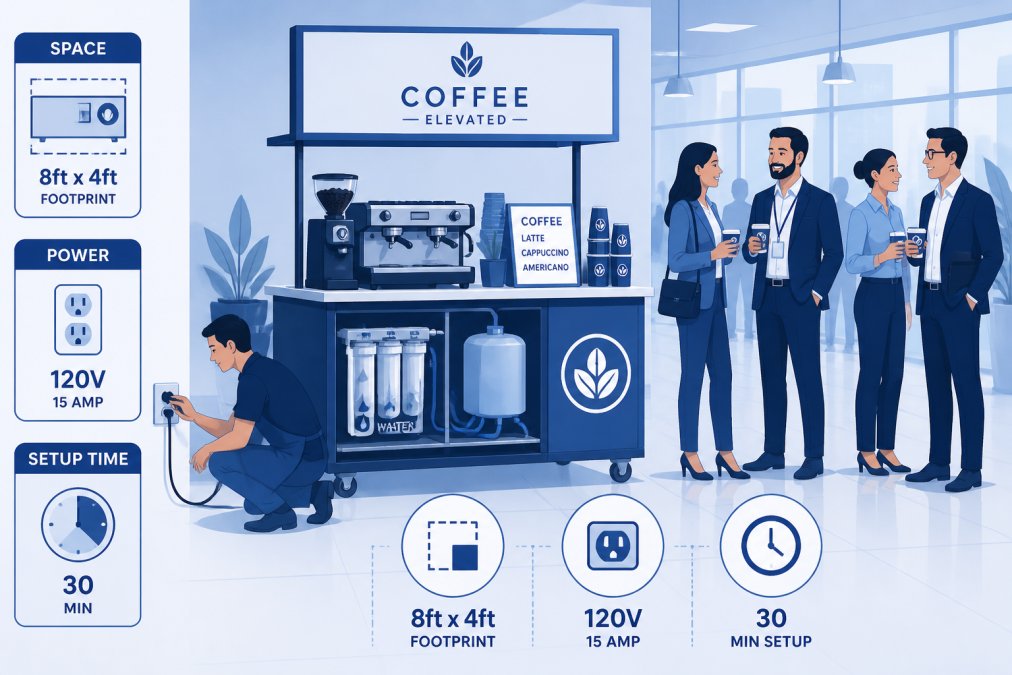
Space requirements depend on cart size. A standard mobile coffee cart needs roughly 8×8 to 10×10 feet for the cart itself, plus additional space for guest queuing. Colada Kulture Co. offers both mobile coffee cart and trailer options, allowing you to choose the setup that fits your venue dimensions.
Power supply is non-negotiable. Espresso machines, grinders, and water heating systems require consistent electricity. Most mobile setups need either a standard 110V outlet within 50 feet of the service location, or access to a generator. Before booking, confirm with your venue facilities team where power is available and whether it can handle the load.
Water access matters significantly. Espresso machines require filtered water. A mobile coffee cart needs either a water line connection or a self-contained water tank system. If your venue lacks convenient water access, the provider needs to bring water or use a tank-based system, which affects setup complexity and cost.
Indoor versus outdoor venues require different considerations. Outdoor events need weather protection (tent, canopy, or weather-resistant cart design) and stable ground surface. Indoor venues need to accommodate cart dimensions, manage electrical safely, and ensure adequate ventilation if using generators.
Setup time typically ranges from 30-60 minutes depending on cart complexity and venue accessibility. Schedule a site visit or detailed phone consultation before finalizing your booking. Walk through your venue, identify power sources, measure available space, and discuss any venue restrictions with both your facilities team and your coffee service provider.
Mobile Espresso Bar vs. Coffee Cart: Which Fits Your Event?
A mobile espresso bar typically refers to a more permanent installation: a dedicated counter or bar structure with professional-grade espresso machines and full barista stations. These create a destination experience where guests watch the barista work and feel like they’re at a specialty coffee shop. The aesthetic impact is significant, an espresso bar becomes a focal point encouraging social gathering.
A mobile coffee cart is more compact and portable, designed for flexibility and movement within a venue. It’s faster to deploy and easier to fit into space-constrained venues. The trade-off is a more casual aesthetic compared to the elevated experience of a dedicated bar.
For corporate events, the choice depends on your objectives. If you want to create an elevated, memorable experience that encourages networking, a mobile espresso bar delivers better results. Guests perceive it as premium. If your venue is compact, your event is shorter, or you need flexibility to move the setup between spaces, a mobile coffee cart works better.
A full espresso bar with multiple machines and baristas handles higher throughput during peak times. A mobile cart with a single barista typically serves 30-50 drinks per hour comfortably. For events with 100+ guests, confirm the provider’s throughput capacity.
Consider the visual branding opportunity. Both setups can be customized with your company logo, colors, and branded cups. An espresso bar creates more visual impact because it’s a larger, more prominent fixture.
Service Speed and Guest Experience: Can It Handle Your Crowd?
Professional baristas working from a mobile setup typically serve 40-60 drinks per hour under normal conditions. During peak demand (the first 30 minutes), expect slightly lower throughput. Experienced providers manage this by pre-positioning cups, pre-steaming milk, and simplifying the ordering process.
The guest experience depends on queue management, drink quality consistency, barista friendliness, and whether the service feels premium or rushed. A mobile coffee cart that maintains professionalism under pressure creates positive event memories.
Providers who invest in barista training and quality control maintain consistency during high-volume periods. Ask potential providers: How many drinks per hour can they consistently serve? What’s their backup plan if demand exceeds projections? Have they worked events similar in size to yours? References from other corporate events provide real-world data on whether they deliver under pressure.
Insurance, Liability, and Hidden Logistics for Corporate Venues
Most corporate venues require proof of liability insurance before allowing any vendor on-site. A reputable mobile coffee cart provider carries general liability insurance covering their equipment, staff, and potential incidents. They should provide a Certificate of Insurance naming your company as an additional insured.
Corporate venues often have specific requirements:
- Background checks for staff entering secure facilities
- Restricted access areas or times
- Parking and loading dock procedures
- Setup and breakdown time windows
- Cleaning and waste management protocols
Communicate these requirements to your coffee service provider early. Reputable providers have experience navigating corporate venue logistics.
Waste management is a practical consideration often overlooked. A mobile coffee cart generates cups, lids, straws, milk cartons, and grounds. Ask whether your provider handles waste removal or whether your venue is responsible. Some providers use compostable cups and implement recycling protocols.
Professional providers have contingency plans. What if the espresso machine malfunctions mid-event? Do they have backup equipment? What if a barista calls in sick? Do they have a replacement?
Calculating ROI: When a Mobile Coffee Cart Makes Financial Sense
Determining whether a mobile coffee cart investment delivers value requires calculating actual ROI, not just comparing line-item costs.
If you’re hosting 150 people and a mobile coffee cart costs $1,200, that’s $8 per person. Compare that to traditional catering: a full-service caterer might charge $12-15 per person for beverage service. On cost alone, the mobile cart wins.
ROI extends beyond cost per guest. Consider engagement metrics: How many guests use the service? (Mobile carts typically see higher participation.) Does the service create a memorable experience that reinforces your brand? Does it generate social media content? Does it facilitate networking?
For corporate brand activations or product launches, these engagement metrics translate to business value. A memorable coffee experience becomes part of the event story. Guests share photos on social media, generating additional brand visibility.
For employee appreciation events, the ROI includes retention and morale metrics. Employees notice when a company invests in quality details. A premium mobile coffee cart signals that the company values employee wellbeing.
For client-facing events, the ROI includes relationship-building value. Clients remember exceptional experiences. A well-executed mobile coffee service reinforces your organization’s attention to quality.
A mobile coffee cart corporate events investment makes financial sense when your event prioritizes experience quality over cost minimization, when guest engagement matters, when brand perception is important, or when venue constraints make traditional catering impractical. For most mid-size corporate events (75-300 guests), a professional mobile coffee service delivers superior ROI.
Choosing the right beverage service for your corporate event shapes how guests remember the experience. A mobile coffee cart corporate events setup from a provider like Colada Kulture Co. transforms coffee service from a logistical checkbox into a memorable brand touchpoint. Their professional baristas deliver freshly prepared specialty drinks, espresso, matcha lattes, and cold brew with customizable milk alternatives and seasonal flavors. The result is an elevated event experience that reinforces your organization’s commitment to quality. Request a quote from Colada Kulture Co. and discover how a premium mobile coffee service can enhance your next corporate gathering.
| Metric | Mobile Coffee Cart | Traditional Catering |
|---|---|---|
| Setup Time | 30-60 minutes | 1-2 hours |
| Cost per Guest | Pricing depends on quantity, dates, and delivery. | Pricing depends on quantity, dates, and delivery. |
| Service Capacity | 40-60 drinks/hour | Variable |
| Customization Options | High | Moderate |
| Space Requirements | 8×8 to 10×10 feet | 15×15+ feet |
| Guest Engagement | High | Moderate |
| Venue Flexibility | High | Low |
| Professional Presentation | Premium | Standard |
Frequently Asked Questions
How many guests can a mobile coffee cart serve per hour?
A mobile coffee cart with one skilled barista typically serves 40-60 drinks per hour, depending on drink complexity and line management. With two baristas, throughput can reach 80-120 drinks per hour. For corporate events with 100+ guests, professional mobile coffee cart services plan service duration based on expected guest count and drink selection to ensure efficient flow without bottlenecks.
What are the corporate event coffee service requirements for indoor office spaces?
Most indoor corporate venues require a standard 110V electrical outlet within 50 feet of the setup location. High-rise offices may have strict loading dock access and power limitations. Confirm water access, drainage options, and whether the venue allows portable equipment. Professional mobile coffee cart services handle logistics planning and can work with venue restrictions, but early coordination prevents setup delays on event day.
Is a mobile espresso bar better than a standard coffee cart for corporate events?
A mobile espresso bar typically offers higher-quality specialty drinks and professional presentation, making it better for brand-focused events and networking functions. A standard coffee cart may be more cost-effective for larger groups or casual office appreciation events. The choice depends on your event's tone, guest count, budget, and whether custom branding and premium quality are priorities for your corporate gathering.
What hidden costs should I expect when hiring a mobile coffee cart?
Beyond the base service fee, watch for travel fees beyond a certain radius, extended setup time charges, additional staffing for large crowds, premium ingredient upgrades, and custom branding options. Some vendors charge separately for pastries, specialty syrups, or alternative milks. Request a detailed quote that itemizes all costs upfront to avoid surprises and ensure the total investment aligns with your event budget.
This article was written using GrandRanker