Table of Contents
- Understanding Event Coffee Catering Service Requirements
- Space and Footprint Requirements for Mobile Coffee Carts
- Power and Electrical Needs for Event Coffee Setup
- Water Access and Plumbing Requirements
- Coffee Catering Permits and Licenses You’ll Need
- Health Code for Mobile Coffee Carts and Compliance
- Insurance and Liability Documentation Requirements
- Load-In, Load-Out, and Event Logistics Planning
Last Updated: August 1, 2026
Understanding Event Coffee Catering Service Requirements
Planning an event with specialty coffee service requires navigating logistical, regulatory, and operational considerations. Event coffee catering service requirements span physical space, electrical infrastructure, permits, insurance documentation, and load-in logistics. Most event planners discover these requirements the hard way, a week before the event, when they realize their venue lacks the dedicated electrical circuit needed or their caterer doesn’t carry required liability insurance.
This guide covers space and footprint requirements, power and electrical needs, water access, permits and licenses, health code compliance, insurance documentation, and load-in and load-out logistics. Each section addresses real pain points and provides actionable steps to confirm requirements with your venue and catering partner before signing a contract.
Before contacting coffee catering services, call your venue and ask three questions: (1) What electrical outlets or circuits are available and where? (2) What are the water and drainage options? (3) What permits, insurance, and documentation do you require from vendors? Having these answers in writing prevents surprises later.
Space and Footprint Requirements for Mobile Coffee Carts
Mobile coffee carts come in different sizes. A standard mobile coffee cart typically requires 8-12 linear feet of space and 4-5 feet of depth, giving customers room to line up while baristas have adequate working space. Compact tabletop espresso bars need only 3-4 feet of counter space and can sit on an existing table, ideal for venues with tight spatial constraints. Full-size coffee trailers need 20-30 feet of linear space and 8-10 feet of depth, plus parking space nearby.
Account for guest flow beyond the cart’s footprint. A well-designed service area includes 6-10 feet of queue space in front of the cart and buffer space on the sides. For events expecting 200+ guests, consider two separate coffee stations to reduce wait times.
The surface matters too. Concrete or asphalt is ideal; grass or uneven surfaces create operational challenges. Some venues require protective flooring under carts to prevent ground damage. Confirm this requirement with your venue coordinator.
Measure your venue’s doorways, hallways, and intended cart location before booking. A cart that’s 4.5 feet wide won’t fit through a 4-foot doorway. Mobile coffee carts sometimes need to be wheeled through buildings to reach outdoor spaces, and a measurement error can force you to cancel service or set up suboptimally.
Power and Electrical Needs for Event Coffee Setup
Commercial espresso machines require 208-240 volts and draw between 20-50 amps depending on size and capability. This cannot be plugged into a standard 120-volt household outlet. Your venue must provide either a dedicated 20-amp circuit at 208-240 volts, or the catering company must bring a generator capable of supplying that voltage and amperage.
Before booking, contact your venue and ask: (1) Do you have a 208-240 volt outlet available in or near the event space? (2) Is that outlet on a dedicated circuit? (3) How many amps does that circuit provide? (4) Do you allow vendors to run generators?
Many venues have limited electrical infrastructure, especially outdoor spaces or non-traditional venues. If your venue lacks adequate power, your catering partner will need a generator, adding cost, requiring additional space, and creating noise. Some venues prohibit generators entirely, making coffee catering impossible without a different service model.
According to National Electrical Code standards for commercial food service, dedicated circuits are required for high-draw appliances. A shared circuit can cause breakers to trip repeatedly during service, shutting down your coffee station mid-event.
Get your venue’s electrical specifications in writing before booking. Ask for a site plan showing outlet locations, voltage, and amperage. Share this with your catering company so they can confirm their equipment will work.
Water Access and Plumbing Requirements
Espresso machines require constant water supply for extraction and steam wand cleaning. There are two options: direct connection to your venue’s plumbing, or a self-contained water tank system. Direct plumbing is ideal if your venue has an outdoor faucet or indoor water line near the service area. Most venues lack convenient water access, so most coffee carts operate with self-contained systems.
Self-contained systems hold 10-20 gallons of water. For a 4-hour event serving 100-150 guests, a 15-gallon tank is typically sufficient. For larger events (200+ guests), you may need two tanks. Ask your catering partner how many tanks they bring standard and what additional costs apply if your event requires more.
Water filtration matters. Espresso machines have internal filtration systems designed for already-clean water. If your venue’s tap water is high in minerals or sediment, the machine’s filters can clog, reducing water flow and affecting espresso quality. Most professional catering companies use pre-filtered water in their tanks to prevent this issue.
Waste water disposal is equally important. Espresso machines produce waste water from backflushing, steaming milk, and cleaning equipment. If your cart has a waste tank, the catering company handles disposal after the event. If your venue requires direct drain access, your cart needs to connect to a floor drain or sink. Confirm your venue’s waste water policy before booking.
Coffee Catering Permits and Licenses You’ll Need
Operating a mobile coffee cart at an event requires permits and licenses that vary by location and event type. Most U.S. jurisdictions require at least a health permit from the local health department, and possibly a temporary food service permit if operating outside a licensed commercial kitchen.
Before booking your catering company, ask which permits they hold and which permits the event itself requires. Then contact your local health department and venue coordinator to confirm. Don’t assume the catering company has all necessary permits, it’s your responsibility as the event organizer to verify that everyone operating at your event is properly licensed.
According to FDA Food Code guidelines for mobile food service, mobile food units must meet specific sanitation and operational standards. Your catering company should provide proof of compliance, typically documented through health department inspections.
Most established coffee catering services have their permits in order and can provide copies to your venue. However, some smaller or newer operators may not. This is a red flag. Operating without proper permits puts your event at legal risk and can result in fines or the vendor being shut down mid-event.
Request a copy of your catering company’s health permit and any relevant mobile food service licenses before signing your contract. Ask when the permits expire and confirm they’re current. A vendor operating with expired permits is a serious liability issue for your event.
Health Code for Mobile Coffee Carts and Compliance
Health codes for mobile coffee service are strict. Your catering company must comply with local health department regulations regarding food safety, equipment sanitation, and operational procedures.
Key health code requirements typically include: (1) A three-compartment sink or equivalent system for washing, rinsing, and sanitizing equipment; (2) Hot water supply at least 120 degrees Fahrenheit for cleaning and sanitizing; (3) Proper food storage and temperature control if serving food items; (4) Hand washing facilities or hand sanitizer stations; (5) Documented cleaning and sanitization procedures; (6) Proper disposal of waste water and trash.
Your catering company’s equipment must be approved by the health department. Commercial espresso machines, grinders, and milk steamers used in mobile food service need to meet NSF (National Sanitation Foundation) standards. If a catering company uses equipment that hasn’t been certified for food service, that’s a compliance violation.
Health inspectors can show up at events unannounced. If your catering company fails inspection, they can be shut down immediately. Ask potential catering partners for proof of recent health inspections and documentation of any compliance violations, they should have none, or only minor items that were corrected.
Insurance and Liability Documentation Requirements
Your venue almost certainly requires proof of insurance from any vendor operating at your event. This is not optional. Most venues won’t allow a vendor to set up without a Certificate of Insurance (COI) on file.
The insurance your coffee catering company needs is general liability coverage, which protects against claims of bodily injury or property damage caused by the vendor’s operations. Typical coverage amounts are $1 million per occurrence and $2 million aggregate, though your venue may have different requirements. Some venues also require workers’ compensation insurance if the vendor has employees.
Request a Certificate of Insurance from your catering company at least two weeks before your event. The COI should list your venue as an "additional insured," which means the venue is covered under the catering company’s policy if something goes wrong. Don’t accept a COI that doesn’t include this language.
Common liability scenarios that insurance covers: a guest is burned by hot espresso, a cart tips over and damages venue property, a barista slips and falls, or a guest has an allergic reaction to a drink ingredient. Liability insurance protects everyone involved.
GEICO’s food vendor insurance guide outlines the types of coverage food service vendors typically need. General liability is the baseline. Some catering companies also carry product liability insurance and commercial auto insurance.
Verify that your catering company’s insurance is active and current before the event. A vendor with expired insurance should not be allowed to operate.
Request a Certificate of Insurance naming your venue as additional insured at least two weeks before the event. Confirm the coverage amounts meet your venue’s requirements. A missing or inadequate COI is grounds to cancel a vendor contract.
Load-In, Load-Out, and Event Logistics Planning
The physical process of getting a coffee cart into your venue, setting it up, operating it, and removing it requires careful coordination. Poor logistics planning can delay your event start time, damage venue property, or prevent proper setup.
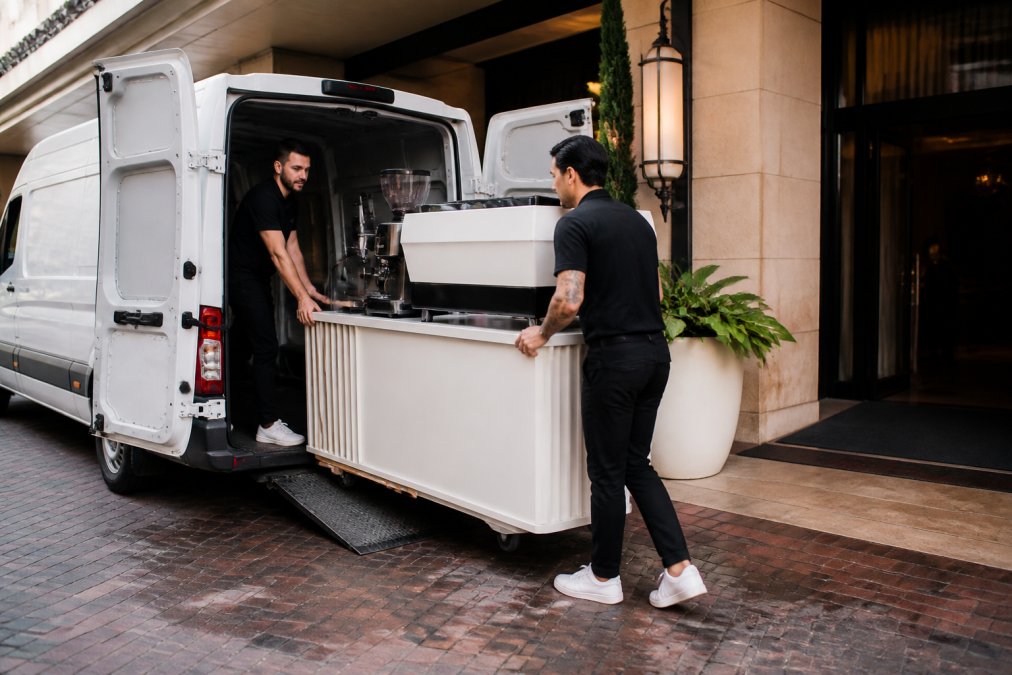
Start by confirming the load-in route with your venue. Walk the path from where the catering company’s vehicle will park to where the coffee cart will be positioned. Measure doorways, hallways, and tight turns. Confirm that the cart can travel this route without damage. Some venues have weight restrictions on certain floors or pathways, confirm that the cart’s weight is within limits.
Coordinate load-in timing with your venue. Most venues want vendors to arrive and set up during a specific window, typically 1-2 hours before guests arrive. Provide the catering company with the exact arrival time, parking location, entrance to use, and a venue contact person.
Setup time for a mobile coffee cart typically takes 30-45 minutes, including positioning, connecting water and power, testing the espresso machine, and preparing the service area. Tabletop espresso bars may take only 15-20 minutes.
For most events, the service window is 2-4 hours. Confirm with your catering company what service window they’re planning and whether this aligns with your event schedule. If your event runs longer than expected, confirm in advance whether the catering company can extend service.
A single barista can typically handle 30-40 guests per hour during peak service. If you’re expecting 200 guests over a 3-hour window, that’s roughly 65 guests per hour, requiring two baristas to avoid long lines. Discuss expected guest count with your catering company and confirm adequate staffing.
Load-out happens after the event ends. The catering company breaks down equipment, removes waste water and trash, and loads the cart back into their vehicle. This typically takes 20-30 minutes. Coordinate with your venue to ensure they have access to the service area during breakdown.
| Logistics Element | Typical Timeline | What to Confirm |
|---|---|---|
| Load-in window | 1-2 hours before event | Arrival time, parking, entrance, contact person |
| Setup time | 30-45 minutes | Electrical/water connections, testing |
| Service window | 2-4 hours | Start/end times, barista staffing, guest volume |
| Peak service period | 30-60 minutes | Barista-to-guest ratio, drink capacity |
| Load-out time | 20-30 minutes | Breakdown timing, waste disposal access |
Communication is key to smooth logistics. Provide your catering company with a detailed event timeline at least one week before the event. Include load-in time, service window, expected guest count, and any special venue requirements. Give them a direct contact number for someone at the venue who can answer questions on event day.
If your event is outdoors, confirm that your catering company’s equipment can operate in expected weather conditions. Extreme heat can affect espresso extraction quality. Rain requires protective coverings or tent setup. Cold temperatures can slow water heating. Discuss weather contingencies with your catering company in advance.
Planning event coffee catering requires attention to dozens of details, but the complexity breaks down into manageable categories: space, power, water, permits, compliance, insurance, and logistics. Missing any one of these creates problems on event day. Working with an experienced catering partner like Colada Kulture Co. simplifies this process, they handle permits, bring properly certified equipment, carry comprehensive liability insurance, and coordinate seamlessly with your venue. Their team manages the technical requirements so you can focus on creating a great event. Request Quote and eliminate the guesswork from your event’s coffee service.
Frequently Asked Questions
What permits and licenses do I need for event coffee catering in the US?
Event coffee catering requires a food service license from your state health department, a mobile food vendor permit, and sometimes a temporary food facility permit for the specific event venue. Local health departments in Florida also require proof of a commissary kitchen for equipment cleaning and food prep. Requirements vary by county and municipality, so contact your local health department and city clerk's office for exact regulations. Colada Kulture Co. handles compliance documentation as part of our service.
How many baristas do I need for my event, and what's the ideal service window?
A standard barista-to-guest ratio is one barista per 30-50 guests for optimal throughput. For 100 guests, plan two baristas; for 200+, consider three or more stations. Peak service hours typically occur in the first 30 minutes and during natural breaks (mid-morning, after lunch). Service windows vary: corporate events average 1-2 hours, weddings 2-4 hours. Factors like drink complexity, guest expectations, and venue layout affect staffing needs. Our professional baristas optimize service flow to minimize wait times during your event.
What power and electrical requirements do mobile coffee carts need?
Most commercial espresso machines require 20-30 amps on a dedicated circuit with 110-120V standard outlet access. High-volume setups may need two 20-amp circuits. Verify your venue's electrical capacity before booking, high-rise offices and outdoor venues often have limited power access. Some vendors offer generator-powered options for events without adequate electrical outlets. Confirm voltage requirements with your catering provider and alert venue management at least two weeks before your event to ensure proper infrastructure.
What's included in event coffee catering cost, and how is pricing structured?
Event coffee catering pricing depends on guest count, drink menu complexity, event duration, venue location, and staffing requirements. Factors include equipment rental or owned setup, barista labor, specialty beverages (matcha, cold brew), milk alternatives, pastries, and liability insurance. Most providers offer quote-based pricing rather than fixed rates. Contact Colada Kulture Co. for a customized quote based on your specific event needs, guest count, and service preferences.
What water and plumbing access do I need for a mobile coffee cart?
Mobile coffee carts require access to clean, potable water for espresso machines and drink preparation, typically 10-20 gallons per 100 guests for a 2-hour event. You'll need either a water hookup (spigot or hose connection) or the ability to fill onsite with bottled water. Wastewater disposal for used water and milk residue is equally critical, venues must provide drain access or allow portable waste containers. Confirm water and drainage access with your venue 3-4 weeks before the event to avoid setup complications.
Do I need special insurance for event coffee catering services?
Yes. Event coffee catering requires general liability insurance (minimum $1 million coverage recommended), commercial auto insurance if using a vehicle, and workers' compensation for staff. Most venues require a Certificate of Insurance (COI) naming them as an additional insured before setup. Providers like GEICO offer food vendor insurance packages covering customer injuries, property damage, and employee protection. Ask your catering provider to provide a COI 10 days before your event, this is standard practice.
What sustainability and waste management requirements apply to mobile coffee carts?
Event venues increasingly require waste management plans addressing single-use cups, lids, straws, and milk packaging. Many South Florida venues mandate compostable or recyclable cups. Plan for separate waste streams: compost, recycling, and trash. Milk waste and espresso grounds require proper disposal. Consider reusable cup programs or eco-friendly alternatives. Check your venue's sustainability policies early in planning. Responsible waste management reduces environmental impact and aligns with modern event standards, especially for premium weddings and corporate brand activations.
This article was written using GrandRanker