Table of Contents
- Is Experiential Marketing Worth the Cost? The Short Answer
- What Experiential Marketing Costs in 2026
- Experiential Marketing ROI: How the Math Actually Works
- How to Measure Brand Activation Success
- Experiential Marketing Campaign Examples That Paid Off
- How Experiential Marketing Compares to Other Channels
- When Experiential Marketing Is Not Worth the Cost
- Frequently Asked Questions
Last Updated: October 11, 2026
Is Experiential Marketing Worth the Cost? The Short Answer
Experiential marketing is the practice of creating live, in-person brand experiences that let customers touch, taste, and interact with a product rather than just see an ad for it.
A single activation can consume a large share of a quarterly marketing budget, and results are easy to misread if you only count foot traffic. Below, we’ll show you how to price an activation, where hidden costs hide, and the break-even math that tells you whether to book it or walk away.
What Experiential Marketing Costs in 2026
Experiential marketing costs are driven by four moving parts: the physical setup, the staff, the consumables, and the venue logistics. There is no single industry price tag, and any vendor quoting one flat number before asking about your location and guest count is guessing.
Most planners underestimate staffing and consumables. The cart or booth is the visible expense; staffing, power, and permits are where budgets quietly break.
Event Industry Council guidance on event budgeting
Line-Item Costs You Need to Plan For
Build your budget around these categories rather than a single quote:
- Rental or build: The cart, trailer, booth, or pop-up structure itself. A basic branded cart rental typically runs lower than a custom trailer build, and a multi-day activation usually costs less per day because setup and teardown are amortized.
- Staffing: Trained baristas, brand ambassadors, or setup crew, usually billed hourly with a minimum shift. Expect a higher blended rate for food or beverage service, plus a separate rate for setup and breakdown labor.
- Consumables: Cups, lids, milk alternatives, syrups, and product samples. This is the line item that scales most directly with guest count, so it is also the easiest to model per head.
- Logistics: Delivery, loading dock access, and breakdown time. Urban venues with restricted dock windows can add a meaningful surcharge.
- Power and utilities: Generators or venue power hookups, which vary widely by building. A generator plus fuel is often cheaper than a venue electrical drop, but only if the site allows generator noise and exhaust.
- Permits and insurance: Health permits and event liability coverage where required. These are fixed costs, so they hurt small activations proportionally more than large ones.
- Branding: Custom signage, cup sleeves, and menu displays. One-time design costs can be reused across activations, lowering the effective cost per event over a campaign.
The most common budget mistake is forgetting the loading dock. High-rise venues with limited dock access often require a scheduled delivery window and a certificate of insurance on file. Miss that step and your setup crew waits in the lobby while guests arrive.
How Cost Scales With Guest Count
The most useful number to negotiate is cost per guest, not total cost. A small activation with a few dozen guests carries a high cost per guest because fixed costs, permits, insurance, delivery, setup labor, are spread across very few people.
To model this: estimate fixed costs (rental, permits, insurance, delivery, setup labor) and variable costs (consumables and hourly service labor per guest), then divide the sum by expected attendance. Run the same math at half and double your attendance.
Risk, Accessibility, and Contingency Budgets
Set aside a contingency line of 10 to 15 percent of your total activation budget. Weather, venue power failures, and last-minute guest count changes are normal, not exceptional.
Insurance deserves its own line. General liability coverage is standard, and some landlords require additional insured endorsements naming the property owner.
Accessibility matters too: an activation that only works for standing guests excludes part of your audience. Plan for seating, clear pathways, and a menu that accommodates dietary needs.
A Note on Cancellation and Change Fees
Vendor contracts commonly include cancellation windows and change fees rarely discussed in the pitch. Ask three questions before signing: how many days before the event can you cancel or reduce headcount without penalty, what happens if the venue cancels on you, and whether a weather postponement triggers a new setup fee. The answers can swing the true cost of an activation and belong in your contingency math, not a footnote.
Experiential Marketing ROI: How the Math Actually Works
Experiential marketing ROI is calculated by dividing the total value generated by the total cost of the activation. Most teams go wrong on the value side, counting only immediate sales and ignoring the leads, content, and earned media the event produces.
Here’s the framework we recommend:
- Total cost: Every line item above, including contingency
- Direct revenue: Sales or bookings traced to the activation
- Pipeline value: Qualified leads multiplied by your average conversion rate
- Content value: Photos and video you’d otherwise pay to produce
- Earned media: Social sharing and word of mouth you can reasonably attribute
Add those five, then divide by total cost. A ratio above 1 means the activation returned more than it cost.
Break-Even Scenarios for Different Budgets
Break-even depends on your margins, not your budget size. A healthy-margin product can break even on far fewer transactions than a low-margin one.
Run the calculation at three attendance levels, conservative, planning, and optimistic, and at two conversion assumptions.
For a corporate event with a few hundred attendees, the break-even point is usually reached through a mix of direct sales and qualified leads rather than sales alone.
A Like-for-Like Comparison With Other Channels
Experiential is rarely the cheapest way to reach a person. The honest comparison isn’t cost per impression, digital wins that every time, but cost per qualified outcome against the same objective.
| Objective | Experiential | Paid social | Influencer | Traditional event |
|---|---|---|---|---|
| Cost per person reached | High | Low | Low to medium | Medium |
| Cost per qualified lead | Often competitive | Variable, depends on targeting | Variable, depends on audience fit | Usually high |
| Depth of interaction | High | Low | Low to medium | Medium |
| Content generated | High, owned | Low | Medium, often licensed | Low |
| Follow-up required | High | Low | Medium | High |
Most teams find experiential is expensive per person but competitive per qualified lead, because attendees have already opted in. Paid social is cheap per impression but needs strong creative and targeting to convert. Influencer work sits in between and depends on audience fit.
Attribution Limits You Should Acknowledge Up Front
Attribution is the weakest link in experiential ROI, and pretending otherwise undermines the calculation. A guest who tries your product and buys three weeks later may never be traceable to the event. A viral post may drive sales you can’t connect to a single person.
The practical response is a mix of methods: unique codes or QR destinations tied to the activation, a post-event survey asking how guests heard about you, and a control group in a matched market where the activation didn’t run.
Ask your vendor for a per-guest estimate rather than a flat fee. It makes break-even math far easier and exposes quotes that look cheap until you divide by headcount.
When the Numbers Say No
If your break-even requires more conversions than realistic attendance can produce, and pipeline and content value don’t close the gap, the activation isn’t worth the cost at that budget. The right move is usually to shrink the footprint, fewer guests, simpler menu, shorter service window, rather than cancel outright, since fixed costs make small activations expensive and variable costs make large ones expensive. Find the size where cost per guest is lowest and break-even is achievable, and build from there.
How to Measure Brand Activation Success
Brand activation success is measured by tying every metric back to a business goal set before the event. If you can’t name the goal, you can’t measure the result.
Metrics That Matter and Vanity Metrics to Skip
Track these:
- Cost per qualified lead, not cost per attendee
- Redemption or sampling rate for any product trial
- Follow-up conversion rate within 30 days
- Content captured and its downstream engagement
- Referral or repeat inquiries traced to the event
Skip these:
- Total impressions with no engagement attached
- Raw foot traffic that includes passersby
- Social likes with no click or inquiry behind them
American Marketing Association guidance on campaign measurement
Experiential Marketing Campaign Examples That Paid Off
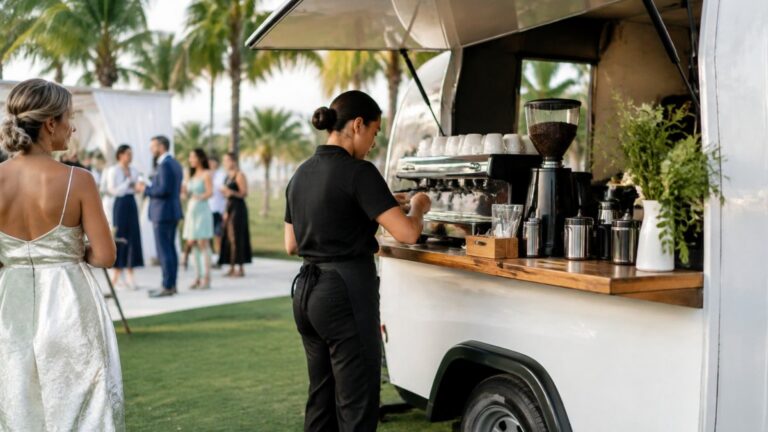
The activations that pay off share one trait: they give guests something worth talking about. A branded mobile coffee cart at a product launch turns a passive attendee into an active participant who waits in line, chats with a barista, and photographs the experience.

That’s the pattern behind most successful activations. A beverage or food element works because it creates a natural pause, a conversation, and a shareable moment. The brand isn’t shouting; it’s hosting.
How Experiential Marketing Compares to Other Channels
Experiential marketing trades reach for depth. A digital ad can reach thousands for a fraction of the cost, but rarely produces the same recall or emotional connection.
| Channel | Relative Cost | Strength | Weakness |
|---|---|---|---|
| Experiential | High per person | Recall, emotional connection | Limited reach |
| Digital ads | Low per person | Scale and targeting | Easy to ignore |
| Low | Direct and measurable | Crowded inboxes | |
| Medium | Tangible | Hard to track |
The right choice depends on your goal. If you need awareness at scale, digital wins. If you need a memorable brand experience that drives loyalty and word of mouth, experiential earns its cost.
When Experiential Marketing Is Not Worth the Cost
Experiential marketing is not worth the cost when you can’t define a measurable goal, when your audience won’t attend in person, or when your margins are too thin to recover the spend. A beautiful activation with no follow-up plan is an expensive photo shoot.
Skip it if:
- You have no way to capture leads or follow up
- Your target audience is dispersed and unlikely to attend
- Your budget leaves no room for contingency
- You’re measuring success by attendance alone
The activation isn’t the investment. The activation plus the follow-up is the investment. Budget for both or don’t start.
The hardest part of experiential marketing isn’t the budget; it’s finding a partner who delivers the same quality on event day that they promised in the pitch. At Colada Kulture Co., we’ve served over 35 weddings, corporate events, and private celebrations with mobile coffee carts and trailers built for tight venues and high guest counts.
Frequently Asked Questions
Is experiential marketing worth the cost for small businesses?
It depends on your goals and budget. Small businesses with a defined target audience and a measurable objective, like lead generation or product sampling, often see strong returns from a single well-executed activation. The key is keeping costs proportional: a branded mobile coffee cart at a local event can generate word of mouth and social sharing for far less than a large-scale pop-up. If you cannot tie the spend to a specific outcome, the investment is harder to justify.
How do you measure the ROI of experiential marketing?
Start by setting a baseline before the event: current conversion rate, average customer value, and cost per lead from other channels. During the activation, track attendance, samples served, email or SMS signups, and social mentions. Afterward, compare new customers or leads attributed to the event against total spend, including production, staffing, and follow-up. A practical formula is (revenue attributed to the activation minus total cost) divided by total cost. Attribution works best when you use unique QR codes, dedicated landing pages, or post-event surveys.
What factors affect the cost of an experiential marketing campaign?
The biggest cost drivers are venue fees, event production (build, signage, power, permits), staffing, product or sample inventory, and follow-up marketing. Location matters too: a high-traffic urban venue costs more than a suburban one. Customization adds expense, whether that is a branded cart, a custom menu, or interactive technology. Contingency budgets for weather, accessibility accommodations, and last-minute logistics typically add 10 to 20 percent. Pricing for any specific vendor depends on quantity, dates, and delivery, so request a quote for exact figures.
How does experiential marketing compare with traditional advertising?
Traditional advertising buys reach; experiential marketing buys interaction. A billboard or digital ad may reach thousands of people, but a live activation puts your product in someone’s hands and creates a memory. Experiential typically has a higher cost per impression but a lower cost per engaged lead because attendees opt in. The trade-off is scale: you cannot put a pop-up store in front of a national audience the way you can with a TV spot. Many brands use both, with experiential driving depth and advertising driving breadth.