
Table of Contents
- Step 1: Set Clear Lead Generation Goals and KPIs Before You Brew
- Step 2: Choose the Right Mobile Coffee Cart for Corporate Events
- Step 3: Apply Experiential Marketing Lead Generation Strategies That Convert
- Step 4: Follow Event Lead Capture Best Practices at Your Coffee Station
- Step 5: Design a Multi-Step Lead Form and Landing Page for Coffee Leads
- Step 6: Connect Event Data to Your CRM and Automate Lead Nurturing
- Step 7: Calculate ROI and Measure Coffee Lead Generation Performance
- Mistakes That Kill Coffee Lead Generation Results
- Frequently Asked Questions
Last Updated: September 24, 2026
Step 1: Set Clear Lead Generation Goals and KPIs Before You Brew
Most teams treat a coffee station as a nice extra, not a sales tool. That’s the first mistake. Learning how to use coffee for lead generation starts with deciding what a lead is actually worth to you before anyone pulls a shot.
Lead generation is the process of attracting and capturing contact information from potential customers so you can follow up and convert them into buyers. A coffee activation gives you a physical reason for people to stop, talk, and hand over their details.
Pick your numbers first:
- Lead volume: How many contacts do you need per event?
- Lead quality: What job title or company size counts as qualified?
- Cost per lead: Total activation spend divided by leads captured
- Dwell time: How long guests stay at your station
- Conversion rate: What share of leads become customers?
A common mistake is chasing raw lead count. Fifty unqualified names are worth less than ten decision-makers who actually want your product. Set the bar before you brew, not after.
Write your follow-up message before the event, not after. If you can’t describe what you’ll send a lead within 24 hours, your capture form is collecting data you’ll never use.
Step 2: Choose the Right Mobile Coffee Cart for Corporate Events
The right mobile coffee cart for corporate events fits three things: your venue, your guest count, and your brand. Get one of those wrong and the activation stalls before the first latte.
Venue logistics kill more activations than bad coffee. Downtown high-rises often have strict power rules and tight loading dock windows. An outdoor product launch needs a cart that handles weather and foot traffic. Before you compare menus, confirm four things with the venue: available amperage at the outlet you’ll use, the loading dock window and freight elevator reservation, whether open flame or propane is permitted, and whether the venue requires a certificate of insurance from your vendor.
Match the cart to the room:
- Indoor office events: compact cart, standard 15-amp circuit, quiet operation
- Outdoor activations: trailer setup with its own power and water
- Large conferences: high-volume cart with two baristas to cut the line
- Weddings and galas: aesthetic cart that photographs well for social sharing
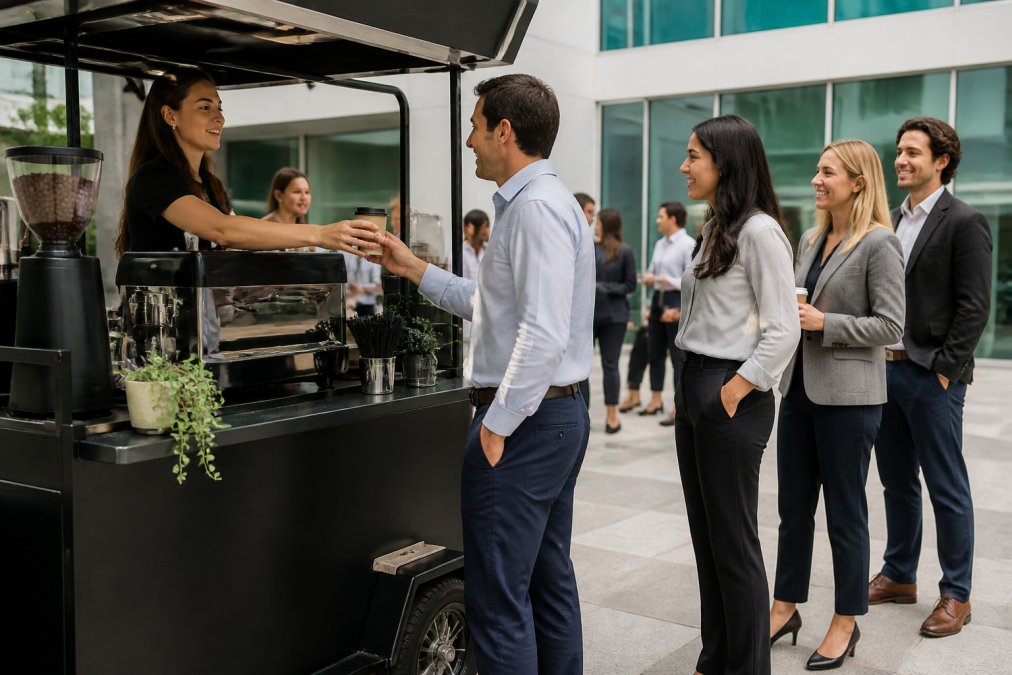
Guest count drives everything else. A single-barista cart serving espresso drinks typically moves roughly 40 to 60 drinks per hour once you account for milk steaming and payment or sign-in time; drip and batch-brew setups run faster because there’s no per-drink milk work. A cart that serves 75 people smoothly will buckle under 200 guests without a second station. Ask your vendor about throughput per hour, not just menu options, and ask what happens when the line hits 30 people deep.
Power and water are the quiet deal-breakers. A commercial espresso machine plus a grinder can pull more amperage than a standard office circuit provides, so a cart that needs a 20-amp dedicated line may not work in a shared breakroom. Trailer setups solve this with onboard generators and fresh-water tanks, but they need a level pad and a hose connection or a refill plan. Confirm which category your venue allows before you sign a contract.
This is where a specialist beats a general caterer. Colada Kulture Co. provides mobile coffee cart and trailer catering services for weddings, corporate gatherings, and brand activations, with menus that flex to oat milk, almond milk, matcha, and seasonal drinks. That flexibility matters when your brand activation needs a signature drink, not a generic drip pot. Ask any vendor for a sample run sheet: arrival time, setup time, service window, and breakdown. A vendor who can’t produce one is guessing at your event.
Step 3: Apply Experiential Marketing Lead Generation Strategies That Convert
Experiential marketing lead generation strategies work because they trade something people want, a free, well-made drink, for something you want, their contact details and attention.
The drink is the hook. The conversation is the conversion.
Here’s what separates activations that fill a pipeline from ones that just hand out coffee:
- Brand the cup, not just the cart. A custom sleeve or stamp keeps your name in the guest’s hand.
- Create a signature drink. A named menu item gives people a reason to talk about you.
- Train staff to start conversations. A barista who asks “What brings you here today?” opens the door.
- Add a small interactive moment. A topping bar or a “pick your roast” choice boosts dwell time.
A common mistake is treating the barista as a coffee machine operator. The best activations use friendly, trained staff who can read a room and start a natural chat. That human moment is what turns a free drink into a qualified lead.
If your team hands out coffee without ever asking for a name or email, you’ve paid for brand awareness, not lead generation. Those are different goals with different budgets.
Step 4: Follow Event Lead Capture Best Practices at Your Coffee Station
Good event lead capture best practices remove friction. Every extra field on a form is a reason for a guest to walk away with their coffee and nothing else.
The best capture tools at a coffee station are fast and invisible:
- Tablet or QR-code forms at the pickup point
- A short, multi-step form instead of one long page
- A clear incentive such as a raffle entry or a free upgrade
- Staff prompts that make the ask feel natural, not pushy
Placement matters.
Step 5: Design a Multi-Step Lead Form and Landing Page for Coffee Leads
A multi-step form and landing page turn a one-time event contact into a lead you can actually nurture. The form captures the data. The landing page gives people somewhere to go after the event.
Build the form in two or three short steps:
- Step one: email address only
- Step two: name and company
- Step three: one qualifying question, such as “What are you shopping for?”
The event is the start of the relationship, not the end. A landing page that gives guests a next step keeps the conversation going after the coffee is gone.
Step 6: Connect Event Data to Your CRM and Automate Lead Nurturing
Event data is worthless if it sits in a spreadsheet. Connecting your capture forms to a CRM turns a pile of emails into a working sales funnel.
Then set up marketing automation to follow up fast:
- A thank-you email within 24 hours
- A second message with your offer three days later
- A check-in after two weeks for anyone who hasn’t responded
Step 7: Calculate ROI and Measure Coffee Lead Generation Performance
- Cart rental or vendor fee
- Barista labor and travel
- Ingredients and cups
- Branded sleeves, signage, and printed collateral
- Staff time spent working the station
- Any raffle prize or incentive you gave away
Then layer in revenue:
ROI = (Revenue from coffee leads − Activation cost) ÷ Activation cost
Track these KPIs at every event:
| Metric | What It Tells You | How to Improve It |
|---|---|---|
| Leads captured | Raw reach of the activation | Add a stronger incentive |
| Qualified leads | Fit with your ideal customer | Add a qualifying question |
| Cost per lead | Efficiency of your spend | Raise capture rate, not budget |
| Qualified CPL | Efficiency against your real target | Tighten the qualifying question |
| Dwell time | Engagement at the station | Add interactive menu choices |
| Lead-to-customer rate | True value of the channel | Improve follow-up speed |
Mistakes That Kill Coffee Lead Generation Results
Three mistakes sink most coffee activations. Fix them and your results change fast.
Frequently Asked Questions
How does a mobile coffee cart improve lead capture at events?
A mobile coffee cart gives attendees a reason to stop and stay. While baristas prepare drinks, guests fill out a short multi-step form on a tablet or scan a QR code. This creates a natural pause for data capture without feeling pushy. Many event marketers see higher dwell time and more completed forms because the coffee provides a built-in conversation starter and a tangible reward for sharing contact information.
What are the best ways to collect contact information at a coffee station?
Use a multi-step form with three to four fields: name, email, company, and one qualifying question about their interest. Offer a small incentive like a free pastry or a branded reusable cup for completing the form. Place a QR code on the cup sleeve that links to a landing page with a lead magnet, such as a specialty coffee guide or a discount code. This approach captures qualified leads while keeping the line moving.
How do you measure ROI from a mobile coffee catering activation?
Track total event cost, including cart rental, staffing, and supplies, then divide by the number of qualified leads captured. Compare that cost-per-lead to your average customer acquisition cost from other channels. Also measure downstream conversion rate: how many captured leads booked a meeting or made a purchase within 30 days. If the cost per qualified lead is lower than your other channels and the conversion rate is comparable, the activation is paying off.
What makes a coffee-based lead magnet successful?
A successful coffee lead magnet is immediately useful and tied to the coffee experience. Examples include a digital guide to brewing specialty coffee at home, a voucher for a free drink at a local partner cafe, or a branded travel mug with a QR code for exclusive content. The key is relevance: the magnet should feel like a natural extension of the coffee activation, not a generic ebook. Sustainable options like reusable cups or compostable coffee bags also perform well with eco-conscious audiences.
Building a coffee activation that generates real leads takes planning, the right cart, and a follow-up system that runs after the event ends. Colada Kulture Co. handles the hard part with premium mobile coffee carts, customizable packages, and a drink menu that spans espresso, matcha, cold brew, and seasonal flavors, all served by professional baristas. Request a quote and turn your next event into a pipeline, not just a nice memory.

