
Table of Contents
- Understanding Coffee Catering Costs for 100 Guests
- Coffee Catering Price Per Guest: Breaking Down the Numbers
- Event Coffee Consumption Estimates: How Much to Plan For
- Mobile Coffee Cart Rental Cost and Service Options
- Barista service pricing typically breaks down as:
- Drop-off pricing typically includes:
- Factors Influencing Your Total Catering Budget
- Hidden Operational Costs and Sustainability Considerations
- Creating Your Coffee Catering Quote and Cost Comparison
- Conclusion
- Frequently Asked Questions
Last Updated: September 25, 2026
Understanding Coffee Catering Costs for 100 Guests
Planning a 100-guest event requires careful budgeting. Coffee catering costs depend on several variables that go beyond just the price per cup. We help corporate planners and couples understand what actually drives expenses so they can make smarter decisions.
The total cost for coffee catering at a 100-person event typically spans a range determined by service type, drink selection, duration, and logistics. Rather than a fixed number, think of cost as a formula with multiple moving parts. Understanding each component helps you build an accurate quote.
Here’s what shapes your final bill:
- Service model (mobile cart vs. drop-off)
- Drink complexity and customization
- Event duration and service hours
- Guest consumption patterns
- Equipment and supply needs
- Travel distance and venue logistics
Coffee Catering Price Per Guest: Breaking Down the Numbers
The cost per head for coffee catering varies widely based on service level. A basic drop-off service costs less than full-service mobile espresso bar attendance with professional barista staff.
For a 100-guest event, you’re calculating how many drinks guests will consume and what type of service delivery fits your venue. The per-guest model helps you estimate total spend, but it’s not the whole story.
Consider these factors when evaluating price per guest:
- All-inclusive packages bundle drinks, supplies, and setup
- Tiered pricing often discounts larger orders
- Premium service (barista on-site) costs more than self-serve
- Specialty drinks (matcha lattes, oat milk options) add to per-cup costs
- Equipment rental fees may apply separately
A professional barista delivering quality service during your event costs differently than pre-made coffee delivered in thermal dispensers. The experience guests receive, and the operational complexity behind it, justifies pricing differences.
Event Coffee Consumption Estimates: How Much to Plan For
Most guests at corporate events or celebrations consume one to two coffee beverages during a 2-3 hour window. This isn’t universal. Consumption depends on event type, time of day, and guest demographics.
A morning corporate meeting sees higher coffee consumption than an afternoon wedding reception. Breakfast events drive stronger demand than lunch or dinner galas.
Plan your quantities using these consumption guidelines:
- Morning events (7-11 AM): 1.5 drinks per guest average
- Midday events (11 AM-2 PM): 0.8 drinks per guest average
- Afternoon events (2-5 PM): 1.2 drinks per guest average
- Evening events (5+ PM): 0.5 drinks per guest average
For 100 guests at a morning corporate event, expect roughly 150 coffee drinks. At an afternoon reception, plan for 80-100 drinks. These estimates guide your supply quantities and staffing needs.
Milk alternatives matter here. Many guests request oat milk, almond milk, or half and half. Budget for variety in your supply calculations, not just whole milk.
Mobile Coffee Cart Rental Cost and Service Options
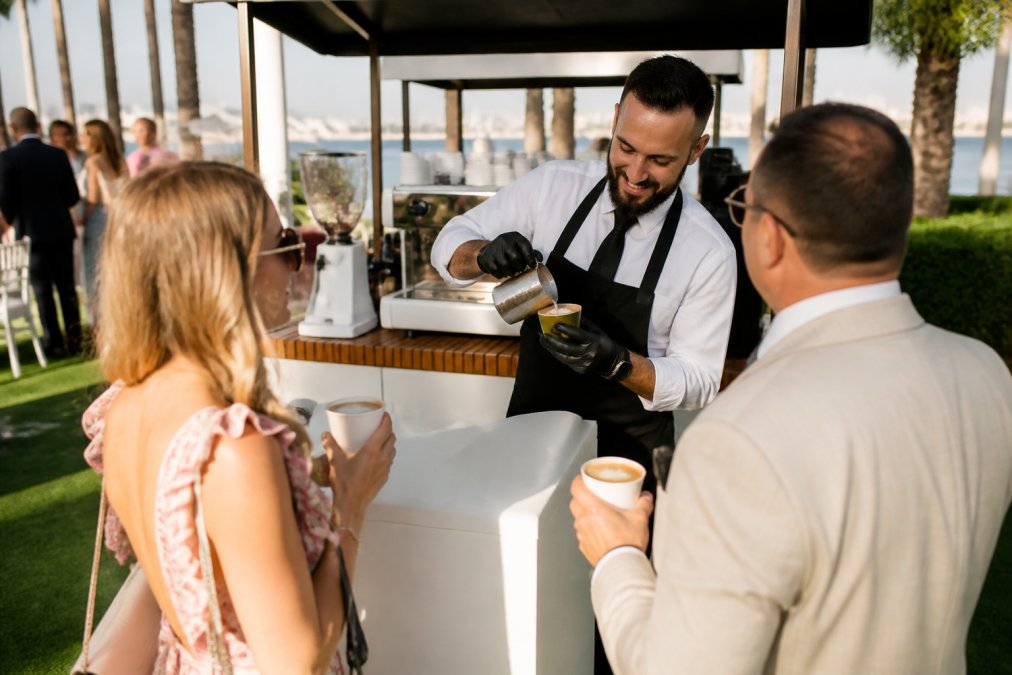
A mobile espresso bar brings professional coffee service directly to your event. This isn’t a simple drop-off; it’s a staffed experience with a trained barista managing the operation. Understanding the cost structure and service model options helps you choose the right fit for your budget and event goals.
Service Model Comparison: Barista vs. Drop-Off
Two primary models dominate the market, each with distinct cost and operational profiles:
Mobile espresso bar with barista service: A professional arrives with a fully equipped cart (espresso machine, grinder, milk steamer, point-of-sale system), sets up at your venue, and serves custom drinks throughout your event. Guests experience direct interaction with the barista, who crafts each drink to order. Setup time runs 30-45 minutes; breakdown takes 20-30 minutes. Service quality remains consistent even during peak demand.
For a 100-guest event with 1-1.5 drinks per person (100-150 total drinks), one barista can typically handle service within a 2-3 hour window, assuming moderate complexity (espresso, cappuccino, lattes, Americanos). Specialty-heavy menus (matcha lattes, pour-overs, cold brew cocktails) or events longer than 3 hours require a second barista.
Barista service pricing typically breaks down as:
Drop-off service: Pre-made coffee arrives in thermal dispensers (airpots) with cups, lids, sweeteners, and milk options. No barista remains on-site. Guests serve themselves. This model costs significantly less but sacrifices the interactive experience and live quality control.
Drop-off pricing typically includes:
Staffing Math for Your 100-Guest Event
Calculate barista needs using this framework:
- 1 barista handles: Up to 120 drinks in 2-3 hours (standard menu)
- 2 baristas handle: 120-200 drinks in 2-3 hours, or 60-120 drinks with complex customization
- Add 30 minutes per barista: For setup and breakdown labor
For your 100-guest event, estimate 100-150 total drinks (1-1.5 per person). A single barista suffices for standard menus (espresso, cappuccino, latte, Americano). If your menu includes matcha, specialty syrups, oat milk, or other customizations, add a second barista or extend the service window to 3-4 hours.
Hybrid Option: Barista + Self-Serve Buffer
Some vendors offer a middle ground: a barista crafts specialty drinks while a self-serve station with thermal dispensers provides quick coffee for guests who don’t want to wait. This model can reduce bottlenecks during peak demand and appeals to guests with varying preferences.
Equipment and Supply Breakdown
Barista service requires:
- Espresso machine (2-3 group heads for 100 guests): included in cart rental
- Grinder: included
- Milk steamer: included
- POS system or manual ordering: included
- Backup supplies (extra milk, beans, cups): typically 15-20% overage built into supply cost
Drop-off service requires:
- Thermal dispensers (airpots): 2-3 units, 40-60 cup capacity each
- Cups and lids: 120-150 units
- Napkins, stirrers, sweeteners: bulk quantities
Choosing Your Model
Select barista service if:
- Your event emphasizes experience and guest engagement (corporate receptions, upscale weddings)
- You want customization and specialty drinks
- Your venue has adequate space and power for equipment
- Your budget allows for a premium service
Select drop-off service if:
- Your event prioritizes convenience and cost efficiency (office meetings, casual gatherings)
- Guests prefer self-service
- Your venue has limited space or power
- Your budget is focused on cost-efficiency
Request itemized quotes from vendors specifying barista hours, equipment included, supply quantities, and travel fees so you can compare apples-to-apples and understand exactly where your money goes.
Factors Influencing Your Total Catering Budget
Your final cost reflects operational realities, not just beverage prices. Several variables push costs up or down depending on your specific situation.
Event duration directly impacts labor costs. A 2-hour service window costs less than 4 hours. Longer events require more supplies, more barista time, and potentially additional staffing.
Guest count scales your expenses in multiple ways:
- More guests = more coffee drinks = higher supply costs
- Larger events may qualify for bulk pricing discounts
- Setup complexity increases with crowd size
- Travel distance from the vendor’s location adds surcharges
Customization affects pricing. A standard menu (espresso, cappuccino, lattes with whole milk) costs less than offering five specialty drinks, matcha lattes, and three milk alternatives.
Hidden Operational Costs and Sustainability Considerations
Beyond the base service fee, several expenses catch planners off guard. Anticipating them prevents budget surprises and ensures compliance with venue and local requirements.
Regulatory and Insurance Costs
Waste Disposal and Sustainability Surcharges
Travel, Parking, and Access Fees
Contingency and Peak-Demand Buffers
Creating a Full-Cost Estimate
When requesting quotes, ask vendors to itemize:
- Barista labor and equipment rental
- Supplies (cups, lids, napkins, syrups, milk)
- Travel and setup fees
- Permits or insurance pass-through costs
- Sustainability surcharges (if applicable)
- Contingency buffer percentage
- Breakdown and cleanup labor
Creating Your Coffee Catering Quote and Cost Comparison
Building an accurate quote requires gathering specific information about your event. Vendors need details to provide realistic pricing.
Document these essentials before requesting quotes:
- Event date and time (morning, afternoon, or evening)
- Expected guest count (100 in your case)
- Venue location and address
- Service duration (how many hours)
- Desired drink menu (standard or specialty options)
- Milk alternative requirements (oat, almond, half and half)
- Setup constraints (loading access, power availability)
- Special requests (branded cups, pastry pairings, matcha service)
| Cost Component | What It Covers | Typical Variables |
|---|---|---|
| Base service fee | Barista labor, cart rental, equipment | Duration, guest count, complexity |
| Supplies | Cups, lids, napkins, syrups, milk | Drink quantity, customization level |
| Travel surcharge | Distance from vendor location | Venue address, fuel, setup time |
| Specialty items | Matcha, oat milk, branded cups | Menu selections, sustainability options |
| Setup/breakdown | Arrival, positioning, cleanup | Venue constraints, complexity |
Conclusion
Calculating coffee catering costs for 100 guests means understanding the variables that shape your final bill. Guest consumption rates, service model, event duration, and venue logistics all influence what you’ll spend. Rather than seeking a single “average cost,” build a detailed quote that reflects your specific event.
Frequently Asked Questions
How much coffee do you need for 100 guests?
Most events see 60-80% of guests consume coffee, meaning 60-80 cups for 100 people. Plan for 0.75-1 pound of coffee beans or 10-15 gallons of brewed coffee, depending on service duration. For a 2-hour event, assume one serving per guest; for 4+ hours, plan for 1.5 servings. Account for milk alternatives like oat milk and almond milk, roughly 30-40% of guests request non-dairy options.
What factors influence coffee catering pricing?
Guest count, service duration, drink complexity, and milk alternatives all affect cost. Setup fees cover equipment delivery and barista labor. Travel surcharges apply if your venue requires distance travel. All-inclusive packages typically include espresso, drip coffee, and basic milk options. Customizable packages with specialty drinks (matcha, seasonal flavors) cost more. Staffing ratios, equipment rental, and disposable supplies (cups, napkins, stirrers) also impact the final quote.
Is a mobile coffee cart rental worth the cost for a small corporate event?
Yes, even for 75-person office events. A mobile espresso bar creates engagement and memorable experiences that standard drop-off service cannot match. Professional baristas deliver consistent quality and speed, handling high-volume service efficiently. The per-cup cost becomes reasonable when spread across your guest count, and the social-media-friendly presentation adds value for brand activations and employee appreciation events.
How do you calculate the cost per person for mobile coffee service?
Divide your total catering quote by your guest count. For 100 guests, if your all-inclusive package is $800, that’s $8 per head. This typically includes setup fees, barista labor, equipment, and supplies. Specialty drink upgrades or sustainability surcharges increase the per-head cost. Request a detailed catering quote that breaks down labor, equipment rental, and supply costs separately so you understand where your budget goes.

