Table of Contents
- Step 1: How to Promote a Trade Show Booth Before the Event
- Step 2: Trade Show Booth Ideas to Attract Visitors
- Step 3: Trade Show Booth Engagement Ideas That Pull People In
- Step 4: Staffing and Conversation Tactics That Boost Booth Traffic
- Step 5: Trade Show Lead Capture Strategies That Work
- Step 6: Measuring Booth Traffic and Tracking ROI
- Step 7: Budgeting, Accessibility, and Your Execution Checklist
- Conclusion: Turning Booth Traffic Into Real Results
- Frequently Asked Questions
Last Updated: October 14, 2026
Step 1: How to Promote a Trade Show Booth Before the Event
Most exhibitors lose the trade show booth traffic battle weeks before the doors open. Booths promoted before the event get visited during it.
So how do you improve trade show booth traffic before you ever set foot on the show floor? You build an appointment list, not a hope list.
Email Invitations and Personalized Outreach
Send personal invitations to top prospects at least three weeks out. A generic “stop by booth 412” blast gets ignored; a message naming a specific time slot and reason to visit gets replies.
Try this template:
Subject: 15 minutes at [Event Name]?
Hi [First Name], I saw you’re attending [Event Name] next month. We’ll be at booth [#], and I’d like to set aside 15 minutes to show you [specific thing relevant to them]. Does [day] at [time] work, or would [alternate time] be better?
Waiting until the week of the show is a common mistake, calendars are full and inboxes buried. Book early, then remind two days before.
Social Media Teasers and Geofencing Tactics
Post countdowns, booth mockups, and behind-the-scenes prep using the event hashtag. Geofencing is the underused tactic: target ads to people within a radius of the venue during setup and show days.
According to EventMB’s trade show marketing research, exhibitors who promote before the show consistently report stronger booth visits than those who rely on walk-by traffic alone.
Ask your confirmed appointments to bring a colleague. One booked meeting often turns into two or three conversations at the booth, and it costs you nothing extra.
Step 2: Trade Show Booth Ideas to Attract Visitors
Your booth has about three seconds to earn a second glance. The fix is not a bigger budget but a clearer visual story and a smarter spot on the floor.
Signage, Graphics, and Visual Appeal
Lead with one message, not five. A single bold headline beats a wall of bullet points, so keep text high and large enough to read from the aisle.
- Use one dominant color that contrasts with the venue’s carpet and walls
- Put your main benefit at eye level, roughly 1.5 to 1.8 meters off the ground
- Add motion: a screen, a spinning sign, or a live demo pulls the eye
Booth Location and Navigating Less Prominent Spots
Corner and island spots get the most foot traffic, but if you are stuck in a back row, you have options.
- Angle your signage toward the main aisle, not straight ahead
- Put a staffer in the aisle with a tray of samples to pull people in
- Ask neighboring booths to cross-promote; a shared draw helps both of you
Step 3: Trade Show Booth Engagement Ideas That Pull People In
A booth people walk past is a booth people forget. The best engagement ideas give attendees something to do, taste, or try, turning passive foot traffic into conversations.
Interactive Demonstrations and Product Experiences
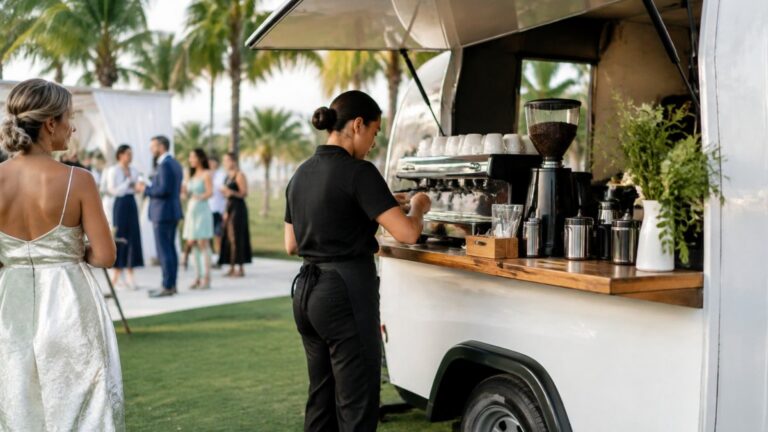
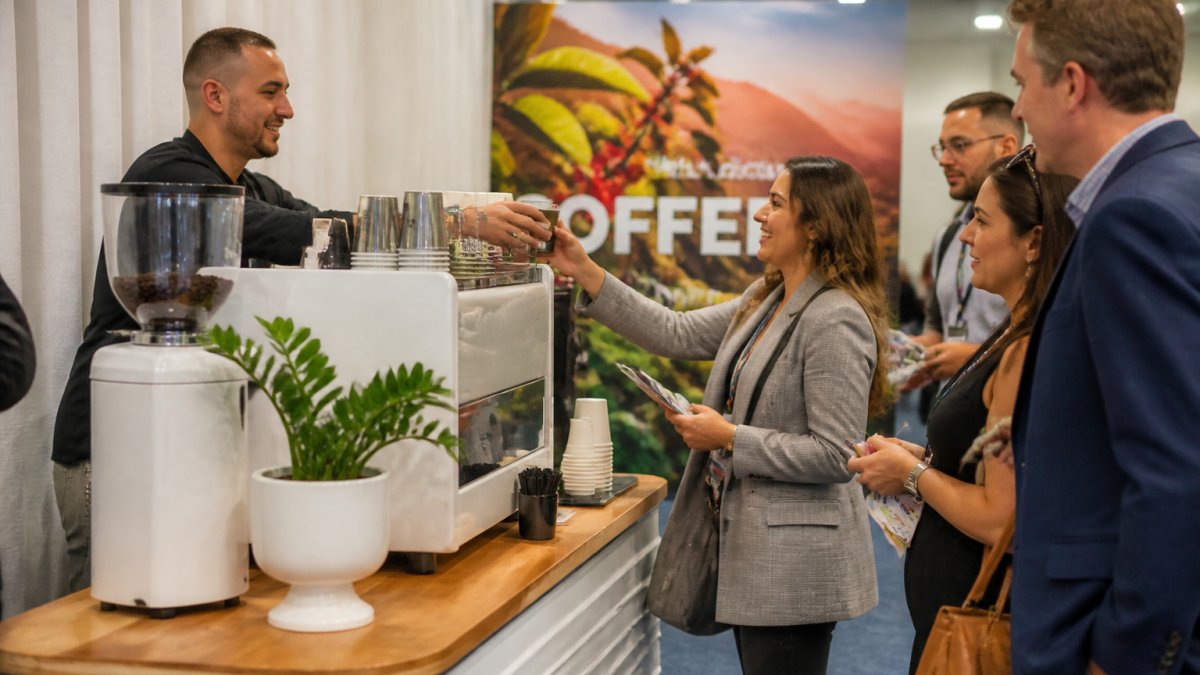
Let people touch the product. Live demos and hands-on trials hold attention far longer than a pitch. A coffee cart is a good example: the smell of fresh espresso and the sight of a barista at work pulls a crowd without a word.
Giveaways, Incentives, and Useful Takeaways
Skip the cheap keychain. Useful takeaways get kept, keeping your brand in front of the attendee long after the show, quality tote bags, branded drinkware, or a free drink. Contests work too, but need a real prize and a clear entry step.
The best booth engagement gives attendees a reason to stay for two minutes. Two minutes is enough time to start a real conversation and capture a lead.
Step 4: Staffing and Conversation Tactics That Boost Booth Traffic
Your booth staff decide whether traffic converts. Train them on one opening line and one goal: start a conversation, not deliver a pitch.
- Stand at the edge of the booth, never behind a table
- Open with a question, not “Can I help you?”
- Keep energy high; tired staff repel traffic
A common mistake is staffing with people who do not know the product. Attendees ask hard questions, and a vague answer kills the conversation.
Step 5: Trade Show Lead Capture Strategies That Work
Lead capture is where most booths leak value. Collect contact info so each lead ties to a real conversation, not just a badge scan.
- Use a quick qualifier question before scanning a badge
- Note what each lead cared about while it is fresh
- Offer something worth the email, like a demo or a sample
The goal is qualified leads, not a big pile of names. A short list of real prospects beats a long list of strangers.
Step 6: Measuring Booth Traffic and Tracking ROI
Raw footfall is the most misleading number at any show. A booth can log 900 badge scans and still produce zero pipeline if those scans were giveaway-chasers. Exhibitors who improve year over year track a funnel, not a headcount, five stages, each with a target set before the doors open.
The Booth-Traffic Funnel
| Stage | What It Measures | How to Track It | Example Target |
|---|---|---|---|
| Qualified visits | Attendees who match your ICP and stop | Greeter tally or clicker counter, filtered by a one-question qualifier | 150 per show |
| Dwell time | Seconds spent in the booth | Stopwatch sample on 20 visitors, or a tablet timer at the demo station | 90+ seconds |
| Conversations | Real back-and-forth, not a badge scan | Staff tally sheet, one mark per conversation | 60 per show |
| Qualified leads | Contacts with a stated need, budget signal, or timeline | CRM tag applied same day | 25 per show |
| Closed deals | Revenue attributed to the event | CRM report at 90 and 180 days | 3-5 per show |
The ratios matter more than raw counts. A common pattern is roughly 4 qualified visits per conversation and 2-3 conversations per qualified lead. A worse conversation-to-lead ratio usually means a qualification problem; a worse visit-to-conversation ratio means staffing or the opening line.
Distinguishing Useful Traffic From Noise
Not every person who walks in is a prospect. Train your greeter to ask one qualifying question before any badge scan, “Are you evaluating [category] this year, or just browsing?”, and log the answer. Each day, split scans into three buckets:
- A, Fit and interested: right company size, right role, stated need. Route to sales within 24 hours.
- B, Fit, not ready: right profile, no current need. Add to nurture sequence.
- C, Not a fit: students, competitors, swag hunters. Do not count these in your traffic numbers.
This sorting step separates exhibitors who can prove ROI from those who report “we got a lot of traffic.”
Dwell Time and Scan-to-Conversation Rate
Dwell time is the best early signal your booth design is working. Have one staffer time 20 visitors across a two-hour window and average the results.
Scan-to-conversation rate is the second diagnostic: conversations divided by total badge scans. Below 30% means staff scan without engaging; above 60% means your greeter qualifies before the scan, exactly what you want.
Cost Per Qualified Lead
Total event spend divided by qualified leads is the number finance will ask for. Include booth space, travel, shipping, staff time, giveaways, and paid promotion. If cost per qualified lead is higher than other channels, either the audience is wrong or the booth execution is weak, the funnel above tells you which.
Track the funnel, not the footfall. Five stages, five targets, set before the show. Review the ratios within 48 hours while the context is fresh, then compare across events to find what actually moves qualified leads.
Step 7: Budgeting, Accessibility, and Your Execution Checklist
Most booth advice ignores the two constraints that actually decide what you can do: money and time. This section handles both, plus the accessibility details that keep every attendee welcome.
Budgeting: Where the Money Actually Moves Traffic
You do not need a six-figure booth to pull a crowd, spend on what attendees notice and cut the rest. A practical split for a mid-size show:
- Booth space and basic build (roughly 40-50% of budget): non-negotiable, but you can save by choosing a less prominent location and compensating with aisle-facing signage.
- Signage and lighting (10-15%): the highest-return line item. One clear headline and good lighting outperform a bigger, busier booth.
- Samples, demos, and giveaways (15-20%): useful items get kept; cheap items get tossed. A single high-quality takeaway beats five forgettable ones.
Low-cost tactics that outperform their price: pre-booked appointments, a staffer in the aisle with samples, cross-promotion with a neighboring booth, and one strong demo. Higher-investment tactics worth it only for large audiences: custom builds, video walls, and paid geofenced ads. If expected qualified visits are under 100, skip the expensive build and fund staff and samples instead.
Accessibility: Design the Booth So Everyone Can Enter
An accessible booth is not a compliance chore, it is a traffic tactic. Attendees with mobility, vision, or hearing needs skip booths that look hard to enter and remember the ones that welcomed them.
- Keep at least 36 inches of clear pathway through and around the booth, with no cables or boxes in the walking lane.
- Make all primary text readable from the aisle: high contrast, large type, and no text below roughly 3 feet off the ground.
- Provide seating at the demo station so attendees who cannot stand for long can still participate.
U.S. Access Board guidelines on accessible design is a useful reference for dimensions and contrast ratios if you want to go deeper.
Execution Checklist With Owners and Timing
Assign a name to every line. Unowned tasks slip.
Three weeks before
- Build the appointment list and send personal invitations, Owner: sales lead
- Confirm booth location and order signage, Owner: marketing
- Book travel, shipping, and booth staff, Owner: operations
One week before
- Send reminder emails to booked appointments, Owner: sales lead
- Launch social teasers and geofenced ads, Owner: marketing
- Run a staff training session on the opening line and qualifier question, Owner: sales lead
During the event
- Greeter tallies qualified visits and dwell-time samples, Owner: greeter
- Demo lead logs conversations, Owner: demo lead
- Closer tags leads A/B/C in the CRM same day, Owner: closer
Within 48 hours after
- Route A leads to sales, Owner: sales lead
- Send follow-up emails to B leads, Owner: marketing
- Review funnel ratios and log lessons learned, Owner: marketing
Run a 15-minute debrief the morning after the show closes, while everyone still remembers which tactics pulled people in. Write down one thing to repeat and one thing to cut.
Conclusion: Turning Booth Traffic Into Real Results
Pulling booth traffic takes planning, not luck. Promote early, design for the three-second glance, staff for conversation, and measure what matters. If you want a proven crowd-puller at your next event, Colada Kulture Co. brings a mobile coffee cart and trailer, customizable catering packages, and a drink menu with espresso, matcha, and seasonal flavors, plus whole, oat, and almond milk options.
Frequently Asked Questions
How do you attract more people to a trade show booth?
Start with pre-event outreach: send personalized email invitations, post teasers on social media, and use geofencing to reach attendees near the venue. On the show floor, combine strong signage, an interactive demo or free sample, and staff who step forward to start conversations. Offering something useful like a specialty drink or a quick product trial gives people a reason to stop instead of walking past.
What should you offer at a trade show booth to attract visitors?
Offer something attendees can use immediately, such as a freshly made espresso drink, a live product demonstration, or a short interactive experience. Useful takeaways like branded cold brew cans or a mini sample outperform generic swag because people keep and share them. Pair the giveaway with a quick qualifying question so you capture contact details while the interaction is still fresh.
How can you measure trade show booth traffic and prove ROI?
Track booth visits with a simple counter or badge scanner, log dwell time for each interaction, and record how many conversations turn into qualified leads. Compare total leads against your event costs, including booth space, travel, and staffing, to calculate cost per lead. Set specific event goals before the show so you can measure performance against a target instead of guessing afterward.
How do you turn trade show booth visitors into leads?
Capture contact information during the conversation using a tablet, badge scanner, or QR code, then note one detail about what the person cared about. Send a personalized follow-up email within 24 to 48 hours while the interaction is still memorable. Segment leads by interest level so your sales team prioritizes the people who asked specific questions or requested a demo.