Table of Contents
- Coffee Cart Catering vs Traditional Catering: The Quick Comparison
- Coffee Catering Cost Breakdown: What Drives the Price Gap
- Mobile Coffee Cart Power Requirements Guide for Event Venues
- Space, Footprint, and Setup Logistics Compared
- Guest Experience and Engagement: Barista-Led vs Buffet-Style
- Mobile Barista Hire for Corporate Events: Throughput and Staffing
- Permitting, Health Department Rules, and Waste Management
- Which Option Fits Your Event? A Decision Framework
- Frequently Asked Questions
Last Updated: September 15, 2026
Coffee Cart Catering vs Traditional Catering: The Quick Comparison
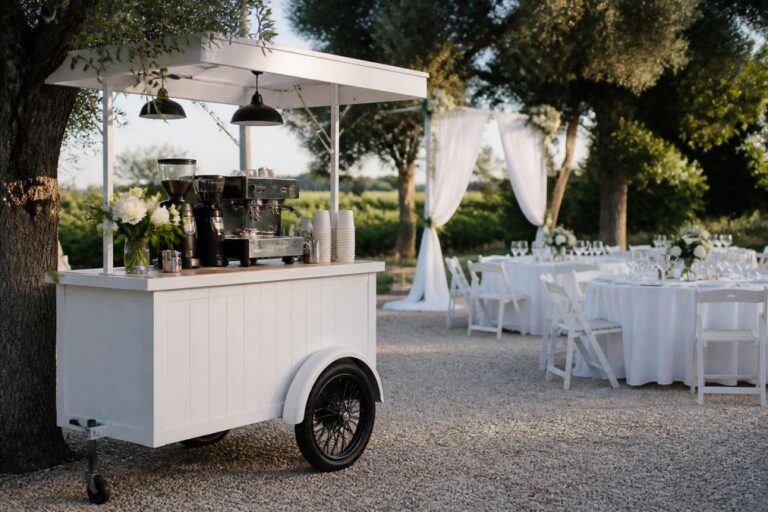
Coffee cart vs traditional catering comes down to one question: do you want a beverage station guests pass through, or an experience they linger at? A mobile espresso cart is a self-contained, barista-led unit that sets up inside or outside a venue and prepares drinks to order. Traditional catering delivers pre-made food and drink from a fixed kitchen line.
This guide from Colada Kulture Co. breaks down cost, power, footprint, and staffing before you sign a contract.
Winner: mobile coffee cart for guest engagement, branding, and setup flexibility. Choose traditional catering when you need full meal service at the lowest cost-per-head. For beverage-only events, the cart wins on almost every metric.
Coffee Catering Cost Breakdown: What Drives the Price Gap
Mobile coffee catering pricing is quoted per guest or as a flat event package. Drop-off service sits at the low end; full-service espresso bars with live baristas sit at the top, because labor, equipment, and drink volume scale together.
According to FlashQuotes coffee catering pricing data, a standard two-hour coffee cart service window typically falls between $765 and $1,700 depending on guest count and service level. Full-service espresso bars with unlimited drinks run higher, with some vendors quoting $1,050 to $2,500 per event.
Per-Guest Pricing Models Compared
| Service Model | Typical Range | What’s Included | Best For |
|---|---|---|---|
| Drop-off coffee | $3-$6 per guest | Boxed coffee, no staff | Tight budgets, short meetings |
| Full-service cart | $10-$18 per guest | Barista, espresso, custom menu | Weddings, corporate events |
| Package pricing | Flat event fee | Unlimited drinks, set hours | Large events, predictable budgets |
Hidden Costs in Traditional Catering
Traditional catering quotes rarely include everything. Watch for staff gratuity, delivery and setup fees, equipment rental, and per-person minimums that apply even when guests don’t show.
Traditional catering contracts often bury a 15-20% service charge and a separate gratuity line. Ask for the total event cost, not the per-head rate, before comparing vendors.
Mobile Coffee Cart Power Requirements Guide for Event Venues
A mobile coffee cart power requirements guide starts with one number: amperage. But the failure mode isn’t usually “not enough power”, it’s a breaker tripping mid-service because the cart’s startup draw spiked past what a shared circuit could handle.
Why Espresso Machines Trip Breakers
A commercial espresso machine’s heating element is the load that matters. A single-group machine rated at 15 amps at 120 volts pulls that amperage almost continuously while recovering temperature between shots. Add a burr grinder, milk refrigerator, LED lighting, and a point-of-sale tablet, and the combined continuous draw can sit at 18 to 22 amps.
That’s why a standard 15-amp household circuit is a non-starter for full-service espresso. Electricians derate to 80 percent for continuous loads, putting a 15-amp circuit’s real ceiling at 12 amps and a 20-amp circuit’s at 16 amps, neither leaves headroom for an espresso machine plus support equipment (nfpa.org).
The practical answer is a dedicated 20-amp circuit at the service point, nothing else on that breaker. A shared circuit that also feeds a chafing dish, a DJ rig, or hallway lighting is the most common cause of mid-event shutdowns.
What to Ask the Venue Before You Book
Don’t ask “is there power?” Ask these four questions instead:
- What amperage is available at the exact service location? A 20-amp outlet in the kitchen is useless if the cart is set up in the courtyard.
- Is that circuit dedicated, or shared with other loads? Shared circuits are the number-one cause of tripped breakers at events.
- What is the panel capacity, and how much is already committed? A venue running a full catering kitchen, AV, and lighting may have no spare capacity even if an outlet exists.
- Is a 240-volt or 30-amp connection available as a backup? High-volume carts with dual boilers or a commercial batch brewer may need it.
When You Need a Generator Instead
If the venue can’t guarantee a dedicated 20-amp circuit at the service point, a self-contained trailer cart running on its own generator sidesteps the problem. Match the generator’s continuous running wattage to the cart’s total load, then add a buffer for startup surge. A cart drawing 20 amps at 120 volts pulls roughly 2,400 watts continuous; a generator rated for 3,500 to 4,000 running watts absorbs the heating-element surge.
Two trade-offs come with generators. Inverter generators run quieter, which matters for ceremonies and indoor-adjacent setups. And a generator can’t run indoors, it needs positioning where exhaust won’t drift into the guest area, and venues with strict noise or emissions rules may prohibit them.
Venue Infrastructure and Loading Dock Access
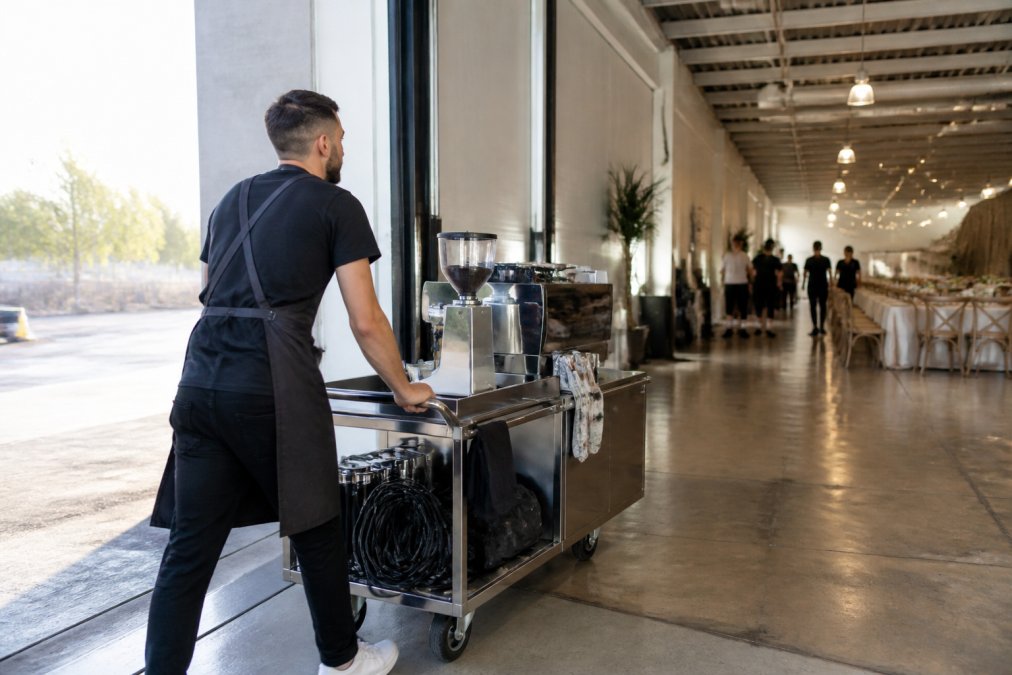
Loading dock access decides whether setup runs smoothly or turns into a 45-minute problem. Carts need a path wide enough to roll equipment in, ideally a freight elevator for upper-floor venues, and a staging area near the service point.
At high-rise venues, the loading dock window is often booked in 30-minute slots shared across all vendors. Confirm the dock schedule in writing and build a 15-minute buffer on either side, vendors who run long eat into the next vendor’s window, and that’s how a coffee cart ends up setting up during the cocktail hour.
Ask your venue for the exact amperage available at your service location, not just “power is available.” A 15-amp outlet two rooms away is not the same as a dedicated 20-amp circuit at the cart. If the venue can’t confirm a dedicated circuit in writing, plan for a generator or choose a cart that runs on a lower-draw setup.
Space, Footprint, and Setup Logistics Compared
A mobile coffee cart needs roughly 8 to 10 feet of linear space and 30 minutes to an hour for setup, while a traditional catering line needs a full service area and often two to three hours of advance staging. That footprint difference changes how you lay out the room.
Carts work in tight spaces a buffet line can’t touch: a lobby corner, a patio edge, a branded activation nook. Traditional catering needs a dedicated zone with room for chafing dishes, serving staff, and a guest queue that doesn’t block traffic.
Setup efficiency favors the cart: a self-contained unit arrives ready to serve with minimal venue prep, while traditional catering requires tables, linens, sterno fuel, and coordinated kitchen timing.
Guest Experience and Engagement: Barista-Led vs Buffet-Style
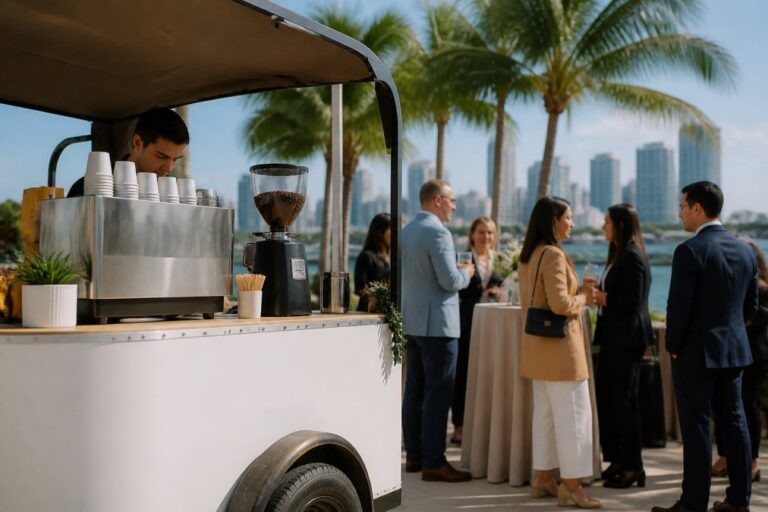
Barista-led service turns a beverage into an interaction, the biggest differentiator between a coffee cart and a buffet line. Guests order by name, watch their drink get made, and often linger to chat. Buffet-style service moves people through fast but leaves no memory behind.
A branded cart also becomes a photo backdrop, which is why marketing teams book them for product launches and brand activations.
The cart’s real product isn’t coffee. It’s the 90 seconds a guest spends at the counter, which is why beverage stations outperform buffet lines on engagement at the same event.
Mobile Barista Hire for Corporate Events: Throughput and Staffing
Staffing decisions to make upfront:
Permitting, Health Department Rules, and Waste Management
A Permitting Checklist for Mobile Coffee Carts
Timeline: When to Start the Paperwork
Permitting is not a week-of task. A realistic timeline:
Waste Management and the Disposable Cup Problem
“Compostable” on a cup only means it will break down in a commercial composting facility, not in a landfill and not in a home compost bin. If the venue doesn’t have a commercial composting stream, compostable cups behave like conventional cups in the waste stream. Confirm the venue’s waste hauler accepts compostable serviceware before you market the event as zero-waste.
Integration with Other Catering Services
Which Option Fits Your Event? A Decision Framework
Use this framework to decide in under five minutes:
Frequently Asked Questions
Is a mobile coffee cart cheaper than traditional catering?
It depends on your menu and guest count. For beverage-only service, a coffee cart is usually the more affordable option, especially for events under 200 guests where you don’t need a full meal spread.
What are the power requirements for a mobile coffee cart?
Most mobile espresso carts need a dedicated 20-amp, 110-volt circuit to run an espresso machine and grinder simultaneously. Some larger trailer setups require a 30-amp or 50-amp connection. If your venue has limited outlets or strict power rules, ask your vendor whether they offer a self-contained unit with a generator or battery bank. Always confirm amperage with the venue before booking, especially in high-rise offices with shared electrical panels.
Does a coffee cart provide better guest engagement than traditional catering?
Barista-led coffee cart catering creates a natural gathering point where guests interact with the barista and each other. Unlike a buffet line where people serve themselves and move on, a coffee cart invites conversation and customization. For corporate events and weddings, this interactive element often produces more social media content and longer guest dwell time. Traditional catering focuses on efficiency and volume; a coffee cart focuses on experience and personalization.
Can a coffee cart handle high-volume events like traditional catering?
A well-staffed mobile barista team can serve 100-150 drinks per hour with two baristas, which covers most events up to 300 guests within a two-hour service window. Traditional catering scales more easily for 500+ guests because it uses bulk preparation. If you expect a large crowd, ask your coffee cart vendor about adding a second barista or a pre-batch option for drip coffee to keep lines moving.
How much space do I need for a mobile coffee cart at my venue?
A standard coffee cart footprint is roughly 6 to 10 feet wide and needs about 3 feet of clearance behind the barista station. Trailer setups require additional space for towing access and level ground. Indoor venues with elevators or narrow hallways may limit trailer access, so a cart configuration is often better. Confirm your venue’s loading dock dimensions and floor plan before finalizing your coffee cart catering setup.