Table of Contents
- Types of Mobile Coffee Trailers for Events
- 1. Aero Build Mobile Coffee Shop Trailers
- 2. Hudson Trailer Company: Health-Code Focused Design
- 3. Karpatia Custom Coffee Trucks & Trailers
- 4. Golden State Trailers: USA-Built Custom Options
- 5. Summit Cargo Trailers: Structured Starter Packages
- 6. Prima Coffee Equipment Kickstart Mobile Cart
- 7. Used Trailers & Turnkey Solutions
Mobile Coffee Trailer for Events: 7 Options & Setup Guide
Last Updated: July 23, 2026
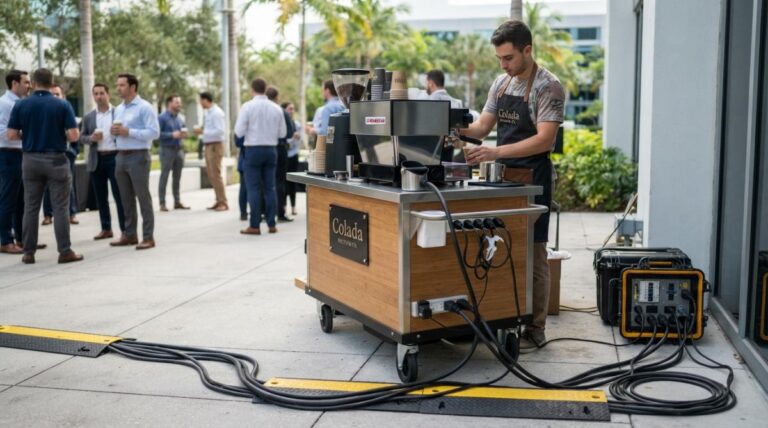
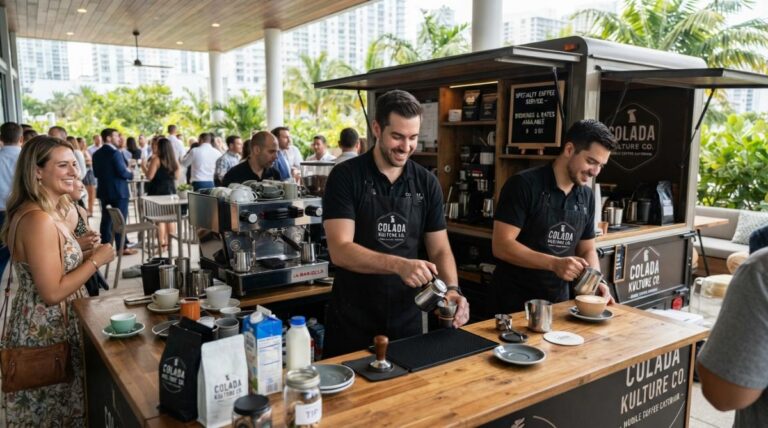
A mobile coffee trailer for events transforms any venue into a specialty coffee destination. Whether you’re planning a wedding, corporate gathering, or brand activation, the right setup delivers premium drinks while creating an unforgettable experience. At Colada Kulture Co., we know what separates a forgettable caffeine station from a memorable experience guests actually talk about afterward.
The challenge isn’t finding a mobile coffee trailer, it’s finding the right one that matches your event’s scale, venue constraints, and brand vision. The best setups combine professional-grade espresso machines, efficient workflow design, and baristas trained to deliver quality under pressure.
Below, we’ll walk you through seven proven options, from turnkey trailers to custom builds, plus setup essentials, permitting realities, and what separates premium service from the rest.
Types of Mobile Coffee Trailers for Events
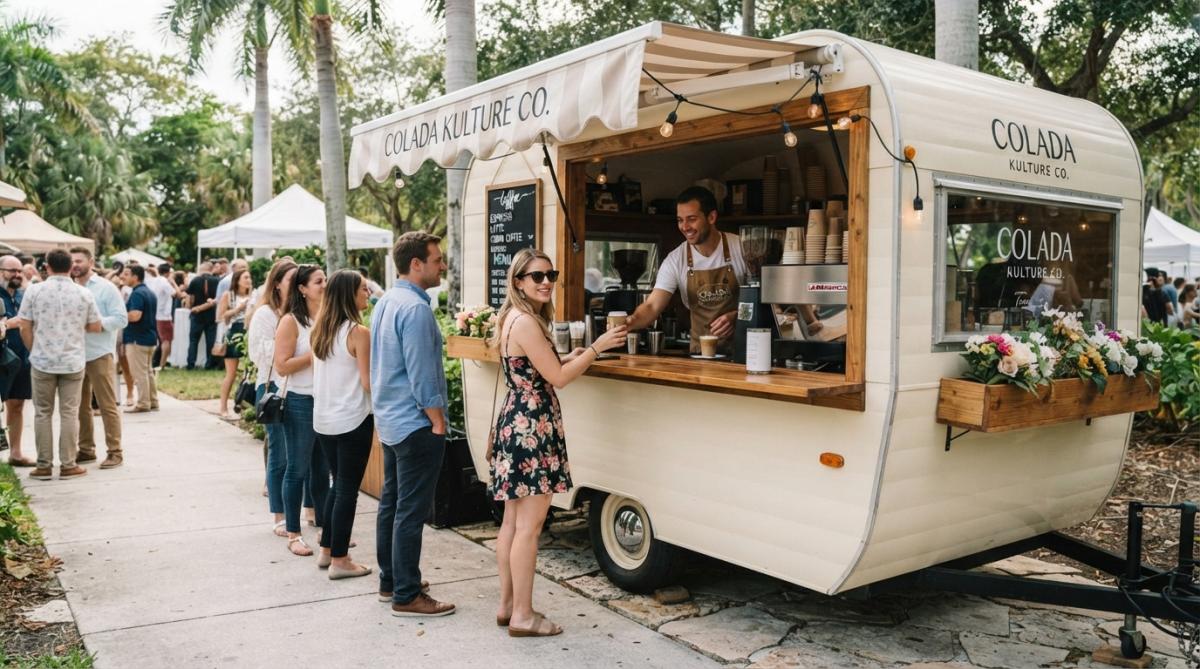
The mobile coffee landscape includes three distinct equipment categories, each suited to different event sizes and operational needs.
Coffee Carts vs. Trailers vs. Trucks
Coffee carts are compact, portable units that fit in a standard vehicle and work best for smaller events (under 100 guests) but offer limited refrigeration and slower service when lines form.
Trailers are the middle ground. A 13-16 foot enclosed trailer gives you room for multiple espresso machines, full sink setup, refrigeration, and proper electrical infrastructure. This handles 200-400 guests comfortably and is where most professional event operators operate. You need a truck to tow it, and venue access can be tricky at high-rises.
Trucks (step vans) offer the most space and mobility for high-volume events (400+ guests) and operate independently without towing. The premium is higher initial cost and fuel consumption.
Most event planners choose trailers because they deliver professional capacity without the operational complexity of trucks or the limitations of carts.
1. Aero Build Mobile Coffee Shop Trailers, Best Overall Build Quality
Aero Build manufactures premium trailers engineered specifically for coffee workflows. Their Nashville-based team designs each trailer around espresso bar efficiency, water systems, and electrical infrastructure.
The Business Series 13-foot trailer starts at $52,745 and includes full plumbing (hot water heater, pump, fresh and grey water tanks), 5 electrical outlets plus one 220V high-capacity connection, and customizable interior layout. Add espresso equipment ($8,000-$19,000) and you have a complete operation ready for events.
What sets Aero Build apart: they guide you through equipment selection, launch logistics, and position you to run a profitable operation. The realistic timeline is 90-120 days for a new build.
Aero Build’s trailers are designed to meet health department codes from the start, saving thousands in retrofitting later. Check your local health department requirements before ordering.
2. Hudson Trailer Company: Health-Code Focused Design
Hudson Trailer Company offers pre-designed layouts optimized for speed of service and regulatory compliance. Available in 14 and 17-foot models, their trailers come with efficient floor plans that baristas can work without thinking.
Entry-level basic trailers start around $44,000. Fully equipped, turnkey options run $60,000-$80,000. Hudson offers commercial espresso machine options from Rocket, Estella Caffe, La Marzocco, and Simonelli.
Hudson’s strength: they design for health department regulations, not around them. The 8-12 week lead time is longer than some competitors, but the finished product arrives inspection-ready.
3. Karpatia Custom Coffee Trucks & Trailers, Best for Unique Branding
Karpatia builds custom coffee solutions from 7 feet up to 50 feet. Their process starts with discovery: understanding your coffee philosophy, workflow preferences, and brand identity.
This is the choice for baristas and coffee entrepreneurs who want their mobile setup to reflect their craft. Karpatia handles creative wraps, custom decor, and interior layouts that match how you actually work. They offer a two-year warranty on builds.
Pricing requires a custom quote, but the investment reflects personalization. For event catering, Karpatia’s strength is building a rig that becomes part of your brand story.
Custom builds have longer lead times than standard models. If your event is within 4-6 months, Karpatia might not be the fit. Plan ahead or choose a pre-designed option.
4. Golden State Trailers: USA-Built Custom Options
Golden State Trailers builds customizable coffee food trailers from 16-30 feet in California, with a focus on durability and compliance. You define the layout, equipment, wrap design, and features.
Some builds complete in as little as 4 weeks, though custom projects take longer. Golden State offers financing and nationwide delivery, removing the logistics burden of towing a trailer yourself.
For event operators in the Western US, Golden State’s proximity and quick turnaround make them practical. For East Coast or Midwest operators, shipping costs might favor a closer builder.
5. Summit Cargo Trailers: Structured Starter Packages
Summit Cargo Trailers offers pre-designed packages with clear upgrade paths. Their three tiers, Brew Starter, Barista Pro, and Espresso Elite, let you pick a foundation and customize from there.
All packages include polycore exterior, concession window, triple sink package, and 50-amp electrical. Optional add-ons cover wood siding, additional concession windows, and generator platforms.
This structured approach reduces decision fatigue. You’re choosing from proven configurations rather than building from scratch.
Summit’s package approach works best if you’re starting small and scaling up. If you need a full-featured setup immediately, the base packages might feel limited.
6. Prima Coffee Equipment Kickstart Mobile Coffee Cart, Best for Portability
Prima Coffee’s Kickstart Mobile Coffee Cart is a collapsible system designed for operators who need to transport their entire setup in a truck, van, or SUV. No trailer. No towing. Everything assembles on-site in under an hour.
The system includes knock box, pitcher rinser, hot/cold sink kit, and pre-cut openings for espresso machine and grinder installation. You’ll need to source your own espresso machine and grinder, and some jurisdictions require a 3-compartment sink kit for health code compliance.
For events where venue access is tight, rooftop receptions, indoor corporate events, pop-up activations, the Kickstart removes the trailer constraint.
7. Used Trailers & Turnkey Solutions
UsedVending offers new and used coffee trailers across the country, often with equipment already installed. Prices range from $20,000 for a basic 5×8 cart to $38,500+ for a fully equipped 6×12 espresso trailer.
The advantage: immediate availability. Many listings are ready to operate or need minimal setup. If your event is in the next 60 days, used trailers can work.
The risk: condition varies. A $25,000 used trailer might need $5,000 in equipment repairs within the first month. Used trailers make sense if you’re testing the market before committing to a $60,000+ new build.
Equipment & Espresso Station Requirements
A professional mobile coffee trailer requires specific infrastructure that casual operators often overlook.
Espresso Machines for High-Volume Service
Single-group espresso machines work for small events (under 100 guests) but create lines when demand spikes. Most professional event setups use 2-group machines, which let you pull two shots simultaneously and double throughput.
La Marzocco, Rocket, and Simonelli dominate the mobile coffee space because they’re built for durability and reliability under continuous use.
Water & Plumbing
The trailer needs fresh water (typically 30-40 gallon tank), a water pump, hot water heater, and grey water tank. A self-contained system means you control quality and don’t depend on unreliable venue hookups. Most professional trailers include a 3-compartment sink (wash, rinse, sanitize) required by health departments.
Electrical & Power
Standard 110V outlets power grinders, espresso machines, and refrigeration. Most trailers include 30-50 amp service. If your venue has limited power, you’ll need a generator (2,000-5,000 watts).
Refrigeration
If you’re serving cold brew, iced drinks, or milk that needs temperature control, refrigeration is essential. Without it, you’re limited to hot drinks or pre-chilled beverages.
| Equipment Component | Purpose | Why It Matters for Events |
|---|---|---|
| 2-group espresso machine | Pull two shots simultaneously | Prevents service bottlenecks with 200+ guests |
| 30-40 gallon fresh water tank | Self-contained water supply | Doesn’t depend on unreliable venue hookups |
| Hot water heater | Maintains water temperature for espresso | Ensures consistent drink quality throughout service |
| 3-compartment sink | Health code compliance | Required by local health departments for legal operation |
| 30-50 amp electrical | Powers machine, grinder, refrigeration | Prevents equipment shutdowns mid-event |
| Refrigeration unit | Keeps milk, cold brew, ingredients cool | Enables full menu flexibility and food safety |
Customization & Branding Options
The best mobile coffee trailers become part of your event’s visual identity.
Exterior Wraps & Paint
Custom wraps covering the entire trailer cost $2,000-$5,000 but transform visual impact. Your logo, brand colors, and messaging become impossible to miss.
Interior Branding
Branded cups, napkins, signage, menu boards, lighting, and barista uniforms contribute to the overall experience. Guests photograph drinks and share them, make sure your branding is visible.
Custom Layouts
Some trailers offer configurable interior layouts. If you’re primarily serving espresso-based drinks, optimize for that workflow. Custom builders like Karpatia design layouts around your specific menu and operational preferences.
Health Department Regulations & Permitting
This is where many operators get stuck.
Local Health Department Requirements
Every jurisdiction has different rules for mobile food service. Some require a separate commissary (commercial kitchen) where you prep and store ingredients. Others allow self-contained trailers with built-in sinks and refrigeration.
Before buying a trailer, contact your local health department and ask about handwashing sink requirements, refrigeration standards, water system specifications, waste disposal requirements, and permits required for mobile food service. Many trailers are built to meet California or Florida health codes but don’t comply with stricter jurisdictions, creating expensive retrofitting.
Permitting for Events
Beyond the trailer itself, you need permits to operate at specific venues. Event permits typically require certificate of insurance, food handler certification for staff, mobile food service license, proof of commissary (if required), and venue approval.
Permitting delays are the #1 reason mobile coffee services miss events or operate illegally. Start the process 8-10 weeks before your event, not 2 weeks before.
Service Speed & Workflow Efficiency
A mobile coffee trailer for events lives or dies on throughput.
Designing for High-Volume Service
A single barista can pull approximately 40-60 drinks per hour. With two baristas and a 2-group machine, you’re looking at 80-120 drinks per hour. For events with 300 guests over 2 hours, you need at least two baristas working simultaneously.
The trailer layout matters. Efficient setups have everything within arm’s reach: espresso machine, grinder, milk steamer, cups, and the window all in a compact zone.
Menu Simplification for Events
A full coffee menu sounds good but creates bottlenecks. For events, we recommend offering 4-6 signature drinks: espresso-based options (cappuccino, latte), cold brew or iced coffee, and 1-2 specialty options (matcha latte, seasonal drink). This keeps the line moving while still feeling premium.
Pre-Batching & Prep
Cold brew, syrups, and milk can be prepared before the event. Hot drinks are made to order, but everything else should be ready. This reduces on-site work and keeps the line moving.
ROI & Business Planning for Operators
If you’re buying a mobile coffee trailer for events as a business, the numbers matter.
Initial Investment
A turnkey trailer (equipment included) runs $50,000-$80,000. Add insurance ($1,500-$3,000 annually), permits ($500-$2,000), and initial inventory ($2,000-$5,000). You’re looking at $55,000-$90,000 to start.
Event Revenue
Corporate events typically pay $800-$2,000 for 2-3 hour service. Weddings range from $1,200-$3,500. A realistic scenario: 8-10 events per month at an average of $1,500 per event = $12,000-$15,000 monthly revenue. Net income of $3,000-$6,000 per month is achievable for a solo operator running 10-12 events monthly.
Break-Even Timeline
With $70,000 invested and $5,000 monthly net profit, you break even in 14 months. In reality, the first 6 months are slower (building reputation), so break-even often takes 18-24 months.
Sustainability & Waste Management
Modern events expect sustainable practices.
Compostable Cups & Packaging
Compostable cups cost 2-3 cents more per unit but signal environmental responsibility. For 300 guests, that’s $6-$9 additional cost, negligible against event pricing.
Milk & Ingredient Sourcing
Offering oat, almond, and whole milk options reduces waste and meets dietary preferences. Source from suppliers with minimal packaging when possible.
Waste Segregation
Separate compostable cups, plastic lids, and cardboard for proper disposal. Many venues now require this.
Workflow & Setup Timeline
A professional mobile coffee trailer requires planning beyond just showing up.
Pre-Event Setup (2-3 hours before guests arrive)
- Position the trailer and level it (15 minutes)
- Connect water, power, and waste systems (30 minutes)
- Turn on water heater and espresso machine to stabilize temperature (45 minutes)
- Stock cups, napkins, syrups, and ingredients (30 minutes)
- Test espresso pull and milk steaming (15 minutes)
- Final walkthrough and guest briefing (15 minutes)
Total: 2.5-3 hours. Event planners book setup time before guests arrive, not during the event.
During Service
Two baristas can handle 200-300 guests comfortably over 2-3 hours. Beyond that, you need a third person managing the line or prepping ingredients.
Post-Event Breakdown (1-1.5 hours)
- Drain water tanks and disconnect systems (30 minutes)
- Clean espresso machine and grinder (30 minutes)
- Wash dishes and sanitize (30 minutes)
- Pack inventory and secure for transport (15 minutes)
Benefits of Mobile Coffee for Events
A mobile coffee trailer for events delivers value beyond just serving drinks.
Creates Memorable Experiences
Guests remember a beautifully designed coffee bar staffed by skilled baristas more than a standard catering table. It becomes a focal point and conversation starter.
Flexible Venue Solutions
Not every venue has a full kitchen or coffee service. A mobile setup works anywhere: outdoor gardens, rooftops, warehouses, private estates. This flexibility opens event options that would otherwise require expensive venue upgrades.
Custom-branded trailers turn your event into a branded experience. Guests photograph the setup and share it, providing free marketing tied to your brand.
Tailored Menu
A specialty coffee service can match your event’s tone. A corporate event gets professional espresso drinks. A casual celebration gets fun seasonal flavors.
Professional Staff
Trained baristas elevate the experience and handle the technical side, freeing your event team to focus on guests.
Quick Comparison: Mobile Coffee Trailer Options
| Option | Best For | Setup Time | Price Range | Key Strength |
|---|---|---|---|---|
| Aero Build | Serious operators building a business | 90-120 days | $52K-$72K | Build quality and design efficiency |
| Hudson Trailer | Compliance-focused operators | 8-12 weeks | $44K-$80K | Health code alignment from the start |
| Karpatia | Unique branding and custom vision | Custom timeline | Quote-based | Personalization and creative design |
| Golden State | USA-built, fast turnaround needs | 4-8 weeks | Quote-based | Speed and domestic manufacturing |
| Summit Cargo | Budget-conscious starters | Varies | Quote-based | Structured packages and upgrade paths |
| Prima Kickstart | Portability and venue flexibility | 1 hour on-site | Quote-based | Compact, transportable, no towing |
| Used Trailers | Quick entry or testing market | Immediate | $20K-$40K | Low cost and immediate availability |
Final Takeaway
Choosing a mobile coffee trailer for events requires balancing budget, timeline, and operational needs. If you’re running a business, invest in quality equipment and design, you’ll earn it back. If you’re hiring for a single event, work with an experienced operator who handles the logistics and delivers consistency.
The best setup is one you actually use and that reflects your event’s values. Whether that’s a custom-built trailer with your brand wrapped across the side or a portable cart system that gives you flexibility, the goal is the same: create an experience guests remember.
Event planning involves dozens of details competing for your attention. The coffee service shouldn’t be one of them, it should be seamless, professional, and genuinely memorable. Colada Kulture Co. specializes in premium mobile coffee cart and trailer catering designed to elevate weddings, corporate events, and brand activations across Miami and South Florida. With customizable menus ranging from espresso to matcha, professional baristas trained for high-volume service, and flexible options including whole, oat, and almond milk, we handle the logistics so you focus on your guests. Request a quote and see how a thoughtfully designed coffee experience transforms your event.
Frequently Asked Questions
What types of events are best suited for a mobile coffee trailer?
Mobile coffee trailers work exceptionally well for weddings, corporate appreciation events, product launches, outdoor festivals, and private celebrations. They're ideal for venues without built-in coffee service and create a memorable focal point for guests. Event coffee services can handle anywhere from intimate 50-person office gatherings to large 300+ guest weddings, adapting workflow and menu to match your event size and theme.
How much does it cost to hire a mobile coffee trailer for an event?
Coffee catering prices vary significantly based on guest count, event duration, location, and menu complexity. Pricing depends on whether you're purchasing a trailer outright or hiring a catering service. For hiring services, costs typically scale with guest count and distance traveled. For purchasing a custom coffee trailer, investment ranges from entry-level setups to fully equipped turnkey solutions. Contact Colada Kulture Co. or local providers for current quotes tailored to your specific event needs.
What equipment and setup do I need for a custom coffee trailer?
A custom coffee trailer typically includes commercial espresso machines, grinders, refrigeration units, water tanks (fresh and grey), hot water heaters, electrical service (30-50 amp), and plumbing for sinks. Key considerations include trailer dimensions, power requirements (220V connections recommended), water hookups, and compliance with local health department codes. Workflow efficiency depends on layout design, so pre-designed layouts from manufacturers like Hudson or Aero Build optimize barista movement and service speed.
Do I need permits and health department approval to operate a mobile coffee trailer?
Yes. Mobile coffee trailers must comply with local health department regulations and require proper permits for operation. Requirements vary by location but typically include food service permits, business licenses, and inspections of plumbing, electrical, and food safety systems. Many trailer manufacturers (Hudson, Golden State, American Food Trucks Factory) design units specifically to meet health codes. Contact your local health department early to understand specific requirements before purchasing or booking a service.
How far in advance should I book a mobile coffee trailer for my event?
For catering services like Colada Kulture Co., booking 2-4 weeks in advance is recommended to secure your preferred date and customize your menu. For purchasing a custom coffee trailer, lead times typically range from 4-12 weeks depending on the manufacturer and customization level. If you're renting a used trailer, availability may be tighter during peak wedding and event season (spring-fall), so earlier booking ensures better options.
This article was written using GrandRanker