Table of Contents
- 1. The Espresso Bar That Doubles as a Networking Hub
- 2. Interactive Conference Ideas: Coffee Tastings and Latte Art
- 3. Conference Networking Activities: Table Topics and Conversation Cards
- 4. Themed Break Spaces: From Picnic Nooks to Focus Booths
- 5. The Conference Break Schedule: Timing, Flow, and Energy Management
- 6. Coffee Catering for Corporate Events: Setup, Staffing, and Dietary Needs
- 7. Budget Tiers and How to Measure Whether Your Conference Coffee Breaks Worked
- Frequently Asked Questions
Last Updated: October 6, 2026
1. The Espresso Bar That Doubles as a Networking Hub
A well-run espresso bar is the most effective networking tool at any professional conference. It gives attendees a reason to stand still, a warm cup to hold, and a natural opening line that doesn’t feel forced. This guide from Colada Kulture Co. covers 7 coffee break ideas for professional conferences, from quick setup wins to full themed experiences.
Here’s the core insight most planners miss: the coffee isn’t the point. The break is. Refreshments simply give people a reason to linger, and lingering is where connection happens. Below, we’ll show you exactly how to turn a standard refreshment pause into the highest-value thirty minutes on your agenda.
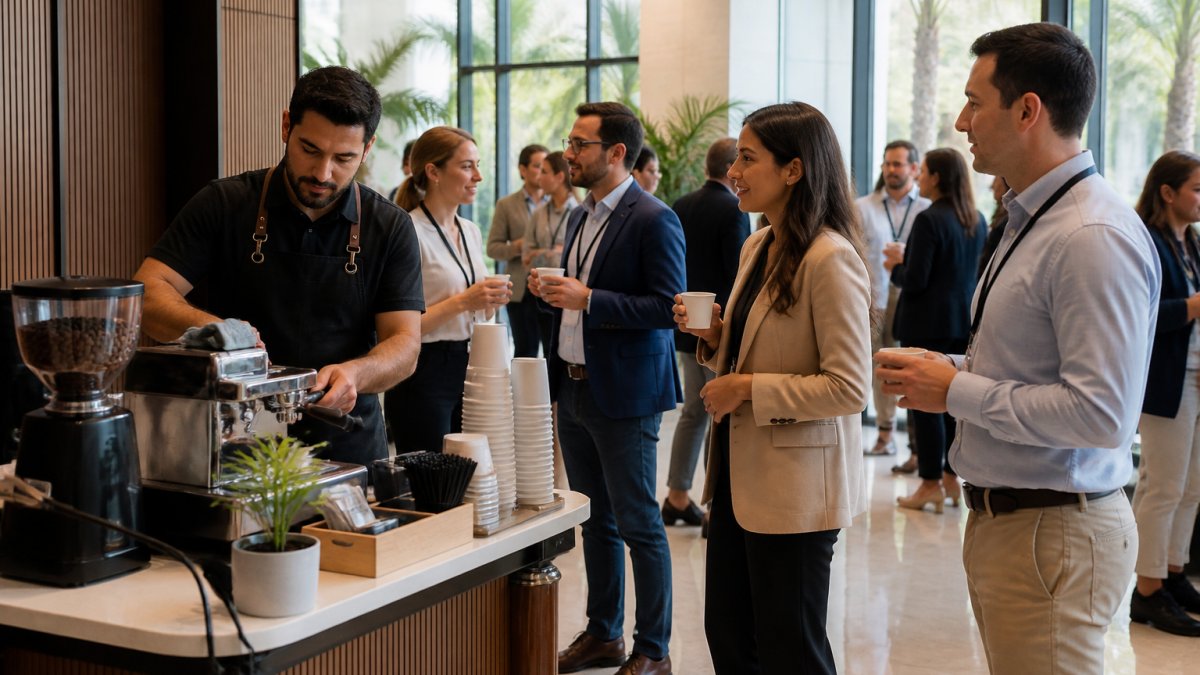
The setup matters more than the menu. Position the cart so the line curves through open space rather than into a wall. A curved queue forces eye contact and side conversations. Straight lines into corridors kill them.
Put the cart at least ten feet from the session room doors. Attendees who grab a cup right at the threshold drift straight back inside. Distance creates dwell time.
2. Interactive Conference Ideas: Coffee Tastings and Latte Art
Interactive conference ideas work best when the activity happens in the attendee’s own hands. A guided tasting flight or a latte art station turns a passive queue into a five-minute experience people actually talk about.
Set up three small tasting cups per person: a single-origin pour-over, a standard espresso, and a seasonal flavored drink. Ask attendees to rank them on a simple card. That card becomes a conversation starter at the next table.
Latte art stations need one barista per twenty guests during peak flow. Let attendees attempt a basic heart pour under guidance. Most will fail. That’s fine, because the laughter is the engagement.
Event planning guidance from the American Society of Association Executives
3. Conference Networking Activities: Table Topics and Conversation Cards
Conference networking activities succeed when they remove the awkwardness of cold introductions. A simple printed card on each break table does more for interaction than any icebreaker script.
Print cards with prompts like “What’s the most useful thing you’ve heard today?” or “What problem are you actually trying to solve this quarter?” Place one at every seat. Attendees pick them up, read them, and start talking without a facilitator.
Keep the prompts specific to your industry. Generic questions produce generic answers and the table goes quiet in ninety seconds.
- Numbered seating cards that pair strangers deliberately
- A “find someone who” bingo sheet with work-related squares
- Sticky-note idea boards where attendees post one takeaway each
The best conversation card asks a question the attendee can answer in one sentence but can’t stop explaining in three. Aim for that middle ground.
4. Themed Break Spaces: From Picnic Nooks to Focus Booths
Break spaces shape behavior. A themed space signals what kind of interaction belongs there, and attendees self-sort accordingly.
Start with a simple zoning rule: one square foot of break space per attendee, split roughly 60/30/10 across active, quiet, and focus zones.
The active zone. High-top tables with a 42-inch top height and 30-inch stools seat four comfortably and keep people standing, which shortens conversations and increases the number of people each attendee meets.
The quiet zone. Soft seating in clusters of two to four, not long sofas. A long sofa seats six but only lets two people talk.
The focus nook. A screened or semi-enclosed space for two people. A 6-by-6 footprint with a small table, two chairs, and a sound-absorbing panel on one side is enough.
Flow and congestion. The single biggest cause of a dead break is a bottleneck at the service point.
Outdoor and natural light. Natural light and alfresco seating lift energy noticeably during afternoon slumps. If your venue has a patio or courtyard, use it.
Walk the break space at the same time of day as the actual break. A room that feels open at 9:00 a.m. can be a glare-filled oven at 2:45 p.m. when the sun hits the west windows.
Materials checklist for a 200-person break:
- 10 high-top tables (30-inch round or 24-by-42 rectangular)
- 40 backless stools or a mix of stools and standing rails
- 8 armchairs in four facing pairs
- 2 small side tables for the quiet zone
- 1 focus nook with a 6-by-6 screen or panel
- 2 service stations with 6-foot tables and linens
- Signage at each zone entrance stating the intended use
Label the zones. A small sign reading “Quiet conversations” or “Meet someone new” does more to route traffic than any staff member directing people by hand.
5. The Conference Break Schedule: Timing, Flow, and Energy Management
A conference break schedule built around 7 coffee break ideas for professional conferences should follow the body clock, not the agenda grid. Most attendees hit an energy low between 2:00 and 3:30 p.m., so that’s where your strongest coffee service belongs.
Build in a fifteen-minute break every ninety minutes of programming. Longer breaks of twenty-five to thirty minutes work better mid-morning and mid-afternoon, when people need real recovery time.
| Time Slot | Break Length | Best Format | Primary Goal |
|---|---|---|---|
| 10:15 a.m. | 20 minutes | Espresso bar, standing tables | Networking |
| 12:30 p.m. | 45 minutes | Networking lunch with coffee service | Connection |
| 2:45 p.m. | 25 minutes | Themed space with cold brew and tea | Re-energizing |
| 4:30 p.m. | 15 minutes | Grab-and-go cart near exits | Transition |
Stagger the flow. If two hundred people all hit the same cart at once, the line becomes the event. Split service across two stations on opposite sides of the room.
6. Coffee Catering for Corporate Events: Setup, Staffing, and Dietary Needs
Coffee catering for corporate events comes down to three variables: power, staffing, and menu breadth. Get those wrong and even excellent coffee becomes a bottleneck.
Confirm power access before you book anything. Many venues require a dedicated circuit for espresso machines, and some charge for it. Ask about loading dock access and setup windows in writing.
Staffing follows a simple ratio. One barista per seventy-five to one hundred guests handles a standard break comfortably. Add a second for latte art stations or tasting flights.
Dietary accessibility is not optional. Offer whole, oat, and almond milk as standard, plus at least one caffeine-free option. Label everything clearly, including syrups and seasonal flavors.
- Whole, oat, and almond milk at every station
- Decaf espresso and a selection of teas
- Herbal tea and mineral water for non-coffee drinkers
- Clearly labeled seasonal syrups and flavor options
Skipping a non-dairy milk option shuts out a meaningful share of your attendees and generates complaints that outlast the event. Confirm milk alternatives before you sign the catering contract, not on the morning of.
7. Budget Tiers and How to Measure Whether Your Conference Coffee Breaks Worked
Budget planning is simpler when you break it into the four variables that actually drive cost: guest count, drink selection, service duration, and travel. Pricing depends on all four, so request a quote rather than guessing at a per-person figure, but you can still build a realistic range before you call anyone.
What drives the number. A self-serve drip and tea station costs the least per head because it needs no barista. A staffed espresso cart costs more because you’re paying for labor, equipment, and the time the barista spends per drink.
Three budget tiers to plan against:
- Entry tier, self-serve station. Drip coffee, hot water, a selection of teas, and a cold water dispenser. Minimal or no staffing. Best for short 15-minute transitions and large rooms where speed matters more than craft. Lowest cost per attendee.
- Mid tier, staffed cart with espresso. One or two baristas, espresso and drip, whole and non-dairy milks, pastries, and a cold brew option. Best for 20- to 30-minute breaks where you want people to linger. Mid-range cost per attendee.
- Premium tier, full mobile espresso bar. Dedicated baristas, custom menu, branded cups and signage, latte art or a tasting flight, and a second station for overflow. Best for flagship breaks, sponsor activations, and events where the coffee is part of the experience. Highest cost per attendee.
A simple way to estimate. Ask each vendor for a per-person rate at your guest count for a 30-minute service window, then add travel and any venue fees. Compare vendors on the same guest count and duration, a quote for 100 guests is not comparable to one for 250.
How to measure whether it worked. Measure coffee breaks the same way you measure sessions: with data. Three numbers tell you most of the story.
- Participation rate. Count cups served against total attendees. A healthy break draws most of the room. If fewer than half show up, your timing or location is wrong, not your menu.
- Dwell time. Have a staff member spot-count how many people are still in the break area at the 5-minute and 10-minute marks. If the room empties in the first five minutes, the break is too short or the space isn’t comfortable enough to hold people.
- Connection quality. Ask two questions on the post-event survey: “Did you have a useful conversation during a break?” and “Was the refreshment service easy to access?” Those two answers predict overall event satisfaction better than almost anything else.
A quick benchmark to aim for. A common pattern is that participation tracks with break length up to about 20 minutes, then flattens, people who wanted coffee have it, and the rest are checking email.
Track one number per break: cups served divided by attendees. If it’s above 0.7, your break is working. If it’s below 0.5, fix the location before you fix the menu.
Meeting and event industry research from the Events Industry Council
Frequently Asked Questions
How long should a coffee break be at a professional conference?
Most conference break schedules work best with 20 to 30 minutes for a standard coffee break. If you are adding a structured networking activity or a tasting station, allow 30 to 45 minutes so attendees do not feel rushed. A good rule is to give 15 minutes for the actual coffee service and another 10 to 15 minutes for conversation. Watch the first break closely; if lines run long, add a second service point or extend the next break by five minutes.
What should you serve at a conference coffee break?
Offer a mix of hot and iced espresso drinks, drip coffee, tea, and still water. Include whole, oat, and almond milk so attendees with dietary preferences are covered. A small pastry or fruit option rounds out the food and beverage experience without slowing service. If your budget allows, a signature drink tied to the event theme gives people something to talk about. Cold brew and matcha are popular choices for afternoon breaks when attendees want something lighter than a hot latte.
How do you encourage networking during a conference coffee break?
Use simple conference networking activities that lower the barrier to conversation. Place conversation cards or table topic prompts on high-top tables, or set up a dedicated networking corner with seating arranged in small clusters rather than rows. A barista calling out drink names can also spark small talk. One proven approach is a coffee tasting station where attendees compare two roasts and vote, which gives strangers an instant shared activity and a natural reason to talk.
How do you make a conference coffee break more engaging?
Add one interactive element to each break rather than trying to do everything at once. Interactive conference ideas that work well include a latte art demo, a blind coffee tasting, a trivia card at each seat, or a build-your-own cold brew station. Keep the activity optional so attendees who just want caffeine and quiet can still get it. Rotating the activity type across morning and afternoon breaks keeps energy up and prevents the break from feeling like the same routine repeated.
What dietary options should coffee catering for corporate events include?
Standard coffee catering for corporate events should include oat, almond, and whole milk, plus a non-dairy creamer and a sugar alternative. Label everything clearly so attendees with allergies or dietary restrictions can serve themselves without asking. If you are serving pastries, include at least one gluten-free and one vegan option. For larger conferences, a dedicated allergen-friendly table with separate tongs and labels prevents cross-contact and signals that you planned for everyone.