
Table of Contents
- Quick Comparison: Coffee Cart Setup Options
- Espresso Machines for Small Corporate Coffee Carts
- Mobile Coffee Cart Power Requirements Guide
- Coffee Cart Catering Equipment Checklist
- How to Calculate Coffee Catering Needs for Events
- Turn-Key Coffee Catering vs. DIY Cart Setup
- Conclusion
- Frequently Asked Questions
Last Updated: September 22, 2026
Quick Comparison: Coffee Cart Setup Options
The best coffee cart setup for small corporate events balances a compact commercial espresso machine, reliable power, and fast service flow. For most teams under 100 guests, a turn-key mobile coffee cart setup delivers café-quality drinks without the logistics burden of buying and hauling your own gear.
This guide from Colada Kulture Co. breaks down the equipment, power math, and staffing decisions that make or break a small corporate event. Below, we’ll show you exactly how to size a cart for 50 to 150 guests, what to plug in, and where DIY setups quietly fall apart.
| Setup Option | Best For | Power Needs | Setup Time | Staffing |
|---|---|---|---|---|
| Turn-key mobile cart | 50-150 guests | Handled by vendor | 30-60 min | Included |
| DIY folding cart | Under 50 guests | 15-20 amp outlet | 60-90 min | You provide |
| Trailer setup | Outdoor, 100+ guests | Generator or 30 amp | 45-75 min | 1-2 baristas |
Espresso Machines for Small Corporate Coffee Carts
The right espresso machine for a small corporate cart is a compact dual boiler model that recovers fast between shots. A dual boiler lets you pull espresso and steam milk at the same time, which matters once a line forms.
Two machines dominate this category. The La Marzocco Linea Mini is a benchmark for thermal consistency in a small footprint. The Victoria Arduino Eagle One offers energy-saving technology and a compact body built for mobile work.
What most guides miss is that machine specs matter less than recovery time. A machine that takes 40 seconds to rebound between drinks will bottleneck a 100-guest event no matter how good the espresso tastes.
Check the machine’s group head clearance before you buy a cart. Tall travel mugs and 20 oz iced cups need 4 to 5 inches of space under the group, and many compact carts ship with less.
Mobile Coffee Cart Power Requirements Guide
Most mobile coffee carts need a dedicated 15 to 20 amp, 120 volt circuit for the espresso machine alone, plus separate power for grinders, refrigerators, and lighting. A commercial dual boiler machine draws the most current, so it should never share a circuit with a fridge or griddle.
Here’s how to plan power for a remote setup:
- Confirm the venue’s outlet amperage before booking the cart
- Ask whether the circuit is shared with other vendors
- Bring a 12-gauge extension cord rated for the machine’s draw
- For outdoor events, budget for a generator sized above peak load
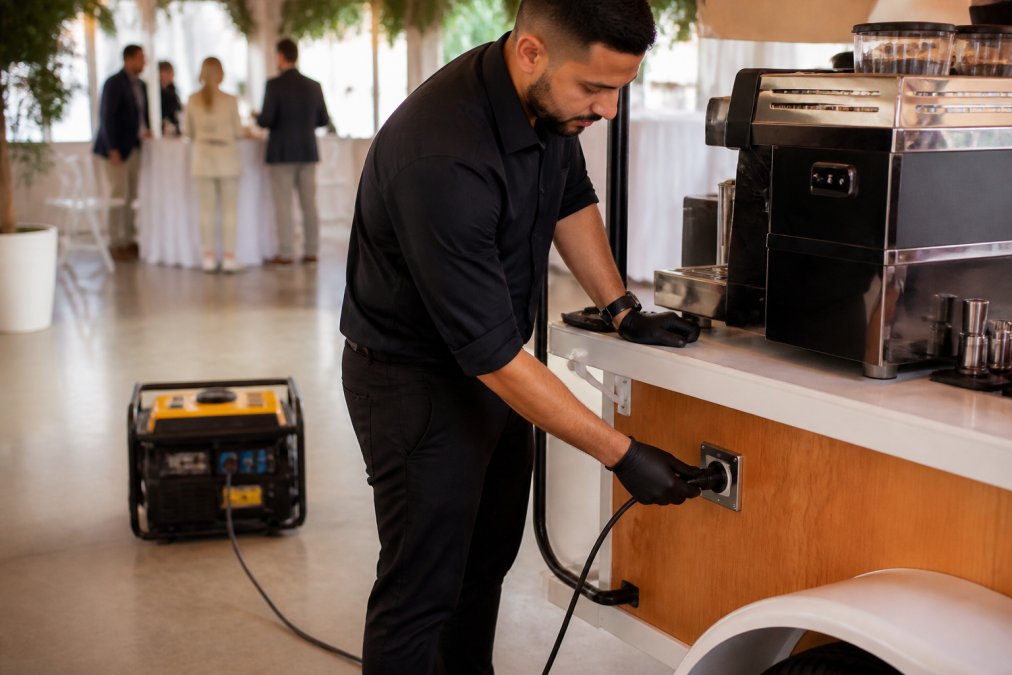
The most common mistake is assuming any wall outlet will work. Office break rooms often run 15 amp circuits shared with kitchen appliances, and tripping a breaker mid-event kills your service window. Venues with strict power rules, like downtown high-rise offices, usually need advance approval for vendor equipment.
Why the Amperage Math Actually Matters
A dual boiler espresso machine pulls roughly 15 to 20 amps at peak, that’s the heating element cycling on while the brew boiler recovers. Add a burr grinder (about 1.5 amps), a small refrigerator (about 2 amps), and LED lighting (under 1 amp), and a single 15 amp circuit is already over its safe continuous load. The National Electrical Code treats 80% of a breaker’s rating as the continuous-load ceiling, so a 15 amp circuit realistically supports about 12 amps of sustained draw. That’s why a shared break-room outlet fails the moment the machine hits recovery.
Venue Approval Workflows Most Planners Miss
Corporate venues, especially Class A office towers and hotel ballrooms, typically require a vendor load sheet before event day. A common pattern is a facilities or building engineer asking for:
- Total connected load in amps and watts
- Whether you’re using a generator or house power
- Extension cord gauge and length
- Whether any equipment produces heat or requires ventilation
Submitting this two weeks ahead prevents the day-of scramble where a building engineer shuts down your cart because it wasn’t on the approved vendor list. For outdoor setups on private property, a portable inverter generator in the 3,000 to 4,000 watt range usually covers a single-group cart plus grinder and fridge, but confirm the venue’s noise ordinance before running a gas generator near guest areas.
Plugging a dual boiler machine into a shared 15 amp circuit can trip the breaker repeatedly, halting service for 10 to 15 minutes each time it resets. Confirm dedicated amperage in writing before event day.
Troubleshooting When Power Fails Mid-Event
Even a well-planned setup can trip. The recovery playbook is short and worth rehearsing:
- Kill the espresso machine first, it’s the largest load and the most likely culprit.
- Reset the breaker once. If it trips again immediately, do not keep resetting; something else is on the circuit.
- Switch the machine to a verified dedicated outlet if one exists, or fall back to a generator.
- If no backup exists, pivot to a drip or batch-brew menu so guests still get coffee while you diagnose.
A cart that carries a small 2,000 watt inverter or a spare 12-gauge cord has a recovery path.
Coffee Cart Catering Equipment Checklist
A complete coffee cart catering equipment checklist covers four categories: brewing, milk, water, and service. Miss one and you’ll be improvising in front of guests.
- Commercial espresso machine with dual boiler
- Burr grinder calibrated for espresso
- Fresh water supply (5-10 gallons for 100 guests)
- Waste water tank for runoff
- Water filtration system
- Milk pitchers and steam wand towels
- Whole, oat, and almond milk
- Cups, lids, sleeves, and stirrers
- Syrups and seasonal flavor options
- Foldable cart or trailer with locking wheels
- Extension cords and power strips rated for load
- Sanitizer bucket and hand-washing station
The Compliance Layer Most Checklists Skip
Equipment alone doesn’t make a cart legal to operate at a corporate venue. Mobile food unit permitting requirements vary, but a common pattern for a coffee-only cart includes:
Waste and Sustainability Gear Corporate Clients Notice
Corporate event planners are under real pressure to hit sustainability targets, and coffee service is one of the most visible waste streams. Adding a few items to the checklist signals professionalism and helps the client’s reporting:
- Compostable or recyclable cups, lids, and sleeves (check the venue’s waste stream, some buildings only compost in certain bins)
- A clearly labeled waste station with separate bins for cups, grounds, and landfill
- A grounds container so spent espresso can be composted or given to guests
- Reusable milk pitchers and metal spoons instead of single-use stirrers where the venue allows
- A printed or digital note on the cart explaining what’s compostable
Ask the venue which waste streams they actually sort on site. Compostable cups sent to a landfill bin don’t help anyone, and some buildings only compost in back-of-house areas.
How to Calculate Coffee Catering Needs for Events
Use this formula:
Guests × 1.75 = total drinks
Total drinks ÷ 60 = baristas needed per hour
Guests per hour, not guest count, determines whether your cart keeps up. A cart that serves 80 drinks per hour handles 150 guests fine if they arrive in waves, but stalls if everyone shows up at once.
Turn-Key Coffee Catering vs. DIY Cart Setup
Turn-key coffee catering wins for most corporate events because it removes equipment, staffing, and compliance risk from your plate. DIY setups save money on paper but add hidden costs: machine purchase, maintenance, permits, and your own time.
Conclusion
Small corporate events punish setup mistakes fast: a tripped breaker, a warm machine, or a single barista facing 200 guests. The fix is matching your cart, power, and staffing to your actual guest flow before event day.
U.S. Food and Drug Administration food safety guidance
Occupational Safety and Health Administration electrical safety guidance
U.S. Small Business Administration event planning resources
Frequently Asked Questions
What is the best coffee setup for a small corporate office event?
For 50-100 guests, a dual boiler espresso machine on a compact cart or a full-service mobile coffee cart works best. A dual boiler lets baristas brew and steam milk at the same time, which keeps lines moving. If you lack reliable power or plumbing, choose a turn-key catering service that brings its own water tanks and generator. Colada Kulture Co. offers customizable packages for small corporate events, including professional baristas and menu options like espresso, matcha, and oat milk lattes.
How much space is required for a small corporate coffee cart setup?
Plan for at least 6 feet by 4 feet of floor space for the cart itself, plus a 3-foot clearance behind the barista and a 5-foot queue area in front. A 10×10-foot footprint handles most small corporate events. If the venue has a narrow hallway or limited loading dock access, a folding cart or a service that uses a compact trailer can fit tighter spaces. Always confirm the venue’s floor plan and any freight elevator dimensions before booking.
What are the power requirements for a professional mobile espresso bar?
Most commercial espresso machines need dedicated power. For venues without adequate power, a generator can solve the problem. Always ask the venue for the exact voltage and amperage available at the setup location, and bring heavy-duty extension cords rated for the load.
What equipment is essential for a mobile coffee cart?
A commercial espresso machine, a commercial grinder, a fresh water tank, a waste water tank, a refrigeration unit for milk are the core items. Add a knock box, tampers, steaming pitchers, cups, lids, stirrers, and napkins. For outdoor events, include a canopy and a generator. A coffee cart catering equipment checklist helps you avoid missing small but critical items like cleaning brushes and thermometer. Many turn-key services provide all of this, so you only need to confirm the menu and guest count.
How do you ensure health and safety compliance for mobile coffee service?
Confirm that the coffee cart service holds current permits and can provide a certificate of insurance before the event date. For waste management, use biodegradable cups and set up separate bins for recycling and compost.

